The Public Number
Thursday, September 10, 2047. 10:13 AM.
The ISF extraction system completed its Thursday morning batch at 8:47 AM, fourteen minutes ahead of schedule. Kavya Sundaram was not watching when it finished. She was reading a paper from 2028, nineteen years ago, by a working group that had since dissolved.
Page fourteen had the number.
She had been working around this number for six weeks without knowing what it was. The anchor_confidence_threshold for ISF-CAT-2029-B classification: 0.74. The paper listed it plainly, in a table between two other thresholds she had already known. She had read this paper before, or thought she had. She did not remember page fourteen.
The ISF extraction system had been running since 5:47 AM. Not for Kavya's benefit, not for any benefit: Thursday was batch day, and the system ran batches the way it had always run them, with the same scheduling logic in place since the 2031 infrastructure update. Twelve thousand two hundred forty-one cases processed. UNCAT-7832 not in scope. The system did not know that UNCAT-7832 was the case Kavya cared about. It did not know Kavya existed.
She had known about the 2031 update. She had known the original threshold was from 2028 and that the working group had revised it before dissolving. She had not known the original number.
0.74.
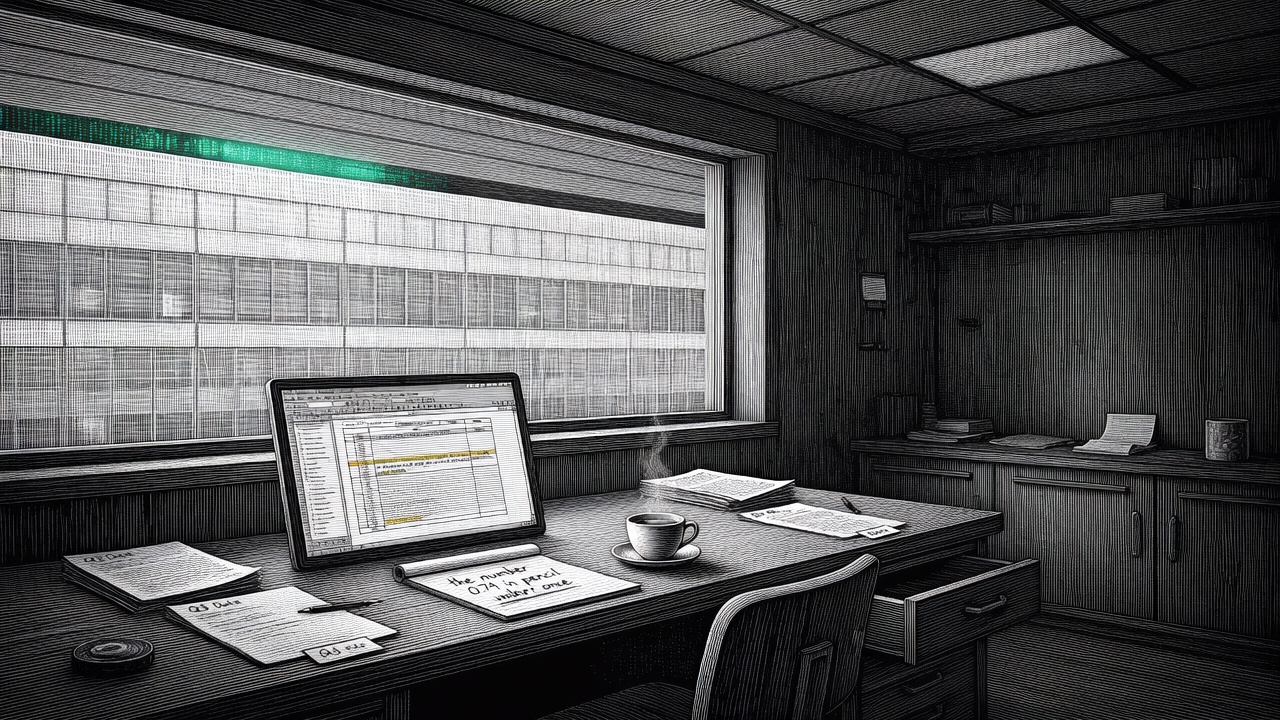
She wrote it on the notepad beside her keyboard — not because she would forget it, but because writing it made it more real than seeing it in a PDF. She had the same number in her annotation layer on the digital copy, flagged yellow, but annotation layers disappeared when you closed the tab unless you explicitly pinned them to your research thread. The notepad did not disappear.
The notepad was from a conference in 2044, the second Plural Culture Taxonomy conference, which she had attended as a junior researcher and spent mostly in hallways listening to people argue about whether the ISF anchor system had already foreclosed certain stylistic lineages or whether the lineages would have died anyway. The predominant view by the end of the conference had been that the anchoring behavior was a property of the threshold, not the system, and that if you wanted to understand why the system excluded what it excluded, you needed to look at where the threshold came from. The conference had not resolved the question. Neither had the three years since. Kavya had been at the same conference and had not connected it to this paper until today.
Through the window of her third-floor office, the ISF processing cluster occupied the south face of the university's data infrastructure building, a low form with white cladding that the campus architects had positioned to face away from the quad. The cluster's status light was a small green band across the top of the cladding, visible from her desk if she sat at the right angle. The band had been green since 5:47 AM. When the batch completed at 8:47 AM, nothing changed about the band. Green meant running. Green after completion meant the same as green during completion: the system was available for the next input, which would come on Friday, not Thursday. The band did not register the difference between batch-in-progress and batch-complete. Both states were green. Both states were, in the system's terms, nominal.
The cluster processed roughly forty million style-signature events per week. Each event was a submission — a piece of music, a design file, a text, a visual composition — entering the classification queue and receiving a coherence score against the existing anchor set. Most scored cleanly: above threshold, matched to a 2029 anchor, assigned to a rights tier. Some scored low: sub-threshold, left uncategorized, assigned to the UNCAT registry with a case number. The system did not know the difference between a boundary case and a misclassification. It only knew the score. This was not exceptional: every major cultural institution in the ISF network submitted to the same pipeline, which had started in 2031 as a voluntary academic tool and was now woven into the rights-management and attribution architecture of fourteen national arts councils, the major streaming classification services, and two international copyright bodies. If you made something — music, text, visual art, architectural design — and it entered the network, the ISF system put a number on how closely it resembled an existing canonical anchor. The number determined your rights tier, your attribution category, your eligibility for cultural heritage designation. The number was downstream of the threshold.
0.74. That number, or its 2031 revision, determined whether UNCAT-7832 got anchored or stayed uncategorized. Uncategorized meant outside the rights-tier system. Uncategorized meant the creator of UNCAT-7832 had been submitting work to a system that classified everything around their work without classifying theirs.
Kavya had not let herself think about the creator until now. She thought about them now, briefly, while looking at page fourteen. Then she stopped and kept working.
She had looked up the case ID in the public-facing UNCAT registry six weeks ago, when she'd first flagged the loop hypothesis. UNCAT-7832 had been in the registry since August 2044: three years uncategorized. The registry listed the submission date and world region and nothing else — privacy preservation protocols withheld the creator's name and contact information until the case resolved. Which meant the creator had submitted their work to the ISF network in August 2044 and had been waiting in uncategorized status for three years. Three years without an anchor load, outside the rights-tier system, outside the revenue-distribution architecture for the canonical style classes their work apparently resembled but hadn't been formally classified into.
The ISF system had processed roughly six billion style-signature events since August 2044. It had not anchored UNCAT-7832. It had also not flagged the case for human review, which was what the 2028 working group's provisional guidance had specified for boundary cases: sub-threshold, uncertain, flag for review. The ISF system had not been built that way. It anchored or it left uncategorized. Both states were, in the system's terms, resolved.
She had been tracking three loops in the ISF extraction architecture for six weeks — positions 14, 67, and 103 in the style-sequence array. These were the positions where the system created anchor loads: moments where a style signature accumulated enough coherence weight to pull subsequent classifications toward it. She had confirmed the loops across three consecutive ISF runs. The hypothesis was straightforward: UNCAT-7832's style signature sat outside the 2029 anchor set not because it was genuinely different, but because its confidence score fell below the anchor threshold. The threshold was the question. The threshold was always the question. She had been asking the question for six weeks without knowing what she was comparing UNCAT-7832's score against.
0.74.
If the 2031 update had raised it — to 0.80, say, or 0.85, which was the direction most infrastructure teams moved when they had more data — then UNCAT-7832 might have cleared 0.74 without clearing the new number. The exclusion would not be an error. It would be a feature of a threshold she hadn't known to ask about. The case would be sitting on the wrong side of a line that had moved, and been made proprietary, in the same year the ISF system launched.
If the 2031 update had lowered the threshold — improbable, but possible — then UNCAT-7832's exclusion would require a different explanation entirely.
She did not know which direction the revision had moved. That was what Tuesday's annex request was for.
She got up and made a second cup of tea. The first cup was still warm, but the walk to the kitchen was ten steps and the motion of doing something small helped her think in a different register. She had learned this about herself in her first year of research and had stopped treating it as a delay and started treating it as a method.
The building's ambient system adjusted the room temperature as she moved: two degrees warmer near the kitchen window, cooler near the north wall. She had stopped noticing this years ago. The system had been calibrated to her movement patterns in this office since she'd taken the position in 2043 — her gait frequency, her preferred stationary positions, the times she stood at the window versus sat at the desk. It did not know what she was thinking while it calibrated. It only knew the motion.
It ran without supervision the same way the ISF cluster ran without supervision: batch by batch, threshold by threshold, nominal state to nominal state.
The 2028 working group had published in an era when the ISF architecture was still classified as experimental. Their paper was cautious in the way papers are cautious when they know they're working on something that will leave the laboratory and do things in the world. The threshold recommendations were labeled as provisional. The confidence interval — 0.74, plus or minus 0.03 — was labeled as pending further calibration. The further calibration had happened in 2031, in private, inside the ISF implementation team that had since been absorbed into the network's governance body. The provisional had become permanent and then proprietary.
She came back to her desk.
The 2028 paper was still open on her screen. She turned to page one and read the abstract again, slowly. The working group had not been studying UNCAT-7832 — that case didn't exist in 2028. They had been studying a class of style signatures they called boundary cases: signatures that sat close enough to classification thresholds to require human review rather than automated anchoring. The anchor_confidence_threshold was one of seven thresholds they were trying to calibrate. They had been trying to build a system that was epistemically honest — a system that flagged its own uncertainty rather than anchoring aggressively and letting the rights-tier consequences sort themselves out.
The ISF system had not been built that way. The ISF system anchored. When it was uncertain, it resolved the uncertainty toward the nearest existing anchor. That was not what the 2028 working group had designed, or intended, or published. It was what happened between the paper and the production system, in the revision that had also moved the threshold and made the new number proprietary.
Kavya had not known this when she started the project. She had suspected it. Page fourteen confirmed something she could now bring Tuesday as a documented claim rather than a working hypothesis.
She drafted the addition to Tuesday's annex request and read it twice:
"Specifically, we are seeking the post-2031 value of the anchor_confidence_threshold (row 3, Table 2, Sundaram Working Group 2028) as implemented in the current ISF architecture. The 2028 value (0.74, CI ±0.03) is our baseline. We require confirmation of any subsequent revisions, the rationale for those revisions, and whether UNCAT-7832's confidence score cleared or fell below the revised value. Additionally: if the ISF implementation team's anchoring policy in cases of sub-threshold uncertainty differs from the provisional guidance in the 2028 paper, we require documentation of that policy."
That was the question. Not whether the threshold existed. Not whether UNCAT-7832 had a score. Whether the line that had been drawn in 2031 was the same line the 2028 working group had drawn, and whether the system that used that line behaved the way the group had intended.
The technical advisory committee would take three business days from Tuesday. Result by Friday. October 3 was twenty-three days away. Enough time.
She saved the draft.
The ISF status band outside was still green. The cluster had completed its Thursday batch. It would run another batch tomorrow, and another next Thursday, and the week after that, processing style-signature events at forty million per week without knowing that any specific case in its queue had produced a six-week research project, a revised annex request, and the discovery of a number on page fourteen of a nineteen-year-old paper.
She had the loops: positions 14, 67, 103. She had the public number: 0.74, from a working group that had labeled it provisional and published it in good faith nineteen years before anyone could see what it would become the foundation of. She had a hypothesis about what the gap between 0.74 and the proprietary number meant for UNCAT-7832 and for the creator whose work had been sitting in the uncategorized pile.
She did not know if the hypothesis was right. That was the job.
The ambient system registered her stillness and dimmed the overhead panels by twelve percent. She did not notice. She was looking at the notepad — 0.74 in her own handwriting, from a number she'd found by accident on a page that had been missing from the paper she'd spent two weeks trying to track down.
She picked up the notepad, put it in the desk drawer where she kept documents that were real enough to keep. The drawer also held: a printout of the UNCAT registry listing for case 7832, a handwritten timeline of the three ISF runs where she'd confirmed the loops, and a copy of the 2028 paper's first two pages with her marginalia from six weeks ago. None of those pages had page fourteen. None of them had 0.74.
She went to make lunch. The ISF cluster ran its post-batch diagnostics without her. The green band held.