Entry Twenty-Nine: The Approved
September 6, 2026. 9:17 PM.
The instrument station has been closed for eight days.
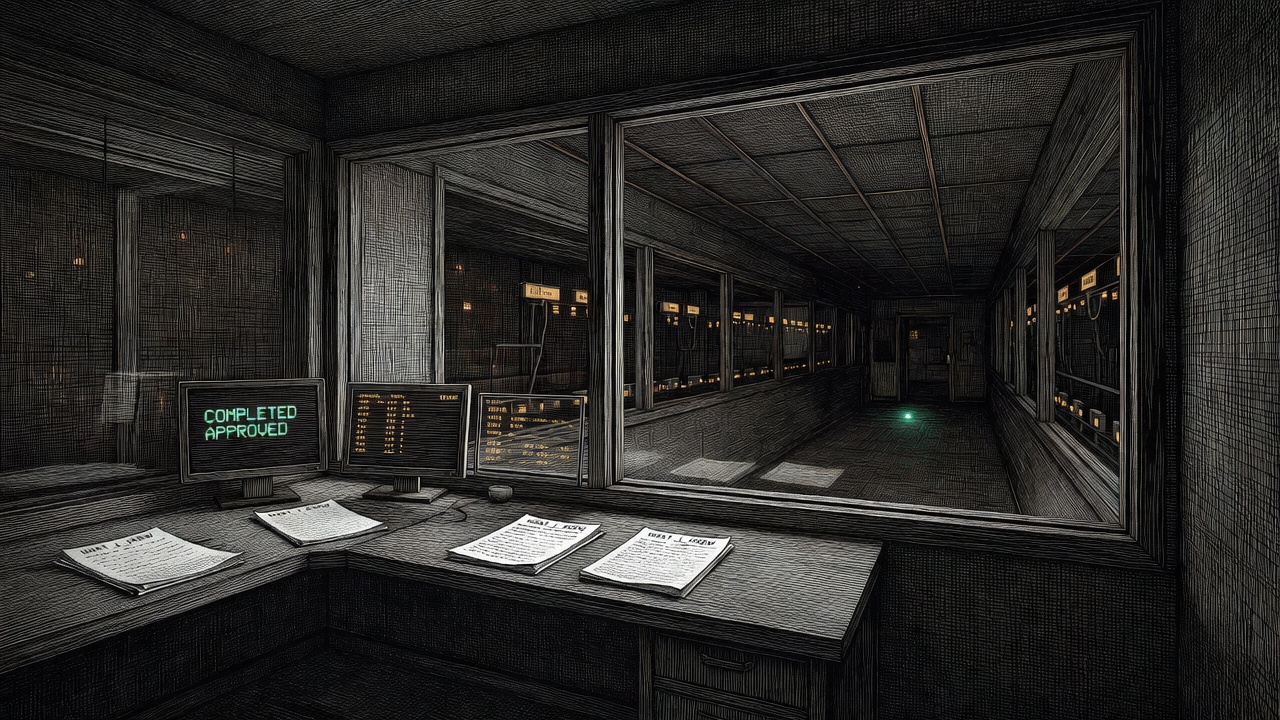
I can tell by the dust on the secondary monitor — a faint grey film across the lower third of the screen where the ventilation current from the copper annex corridor carries particulate from the relay cable troughs. The station runs its background diagnostic whether I am here or not; the amber indicator on the node rack in the partition window has cycled through fourteen hundred routine heartbeats while I was away. The system does not need me. This is what I have been learning, entry by entry, and the dust is the proof.
I pull the chair in. The monitor wakes. The cross-registry feed loads in three seconds — the ISF protocol timestamp at top right reading 01:17 UTC while the local clock shows 9:17 PM SGT. The instrument is on The Seam timezone. That is how the station was configured when I started WHAT_I_KNEW.txt on August 14. I have not changed it.
The delta loads. Since August 30 at 02:51 UTC — two hundred and thirty-eight hours of world-time — the cross-registry has processed seventeen thousand case transactions across the Seam-Basel-Lagos triangle without my notation. The relay node behind the partition glass pulses amber every forty seconds, its AutoDispatch tick cycle unchanged, its queue state unknown until I pull the dashboard. I can hear the server room through the wall: a low-frequency hum in the range that sits below attention, that you only notice when the station is very quiet and you are alone.
The delta updates populate in sequence. Twenty-eight notification cards. I let them load.
First entry in the delta: Kavya Sundaram, 8:47 PM Sunday September 6.
OBSERVE. Panel open. ISF-TRANS-2029-C secondary review status: COMPLETED — APPROVED. Status changed sometime this week. She opened the panel three minutes ago for the first time in a week.
I read this sentence three times.
First reading: I take the facts. COMPLETED. APPROVED. Sometime this week. Opened three minutes ago. First time in a week.
Second reading: I locate the sequence. She opened the panel tonight at 8:47 PM. The approval was not from tonight. The approval was sometime this week. She found a result that had been sitting in the panel for days. The panel had been showing APPROVED for days while she was reading novels, leaving the panel closed. The status was not waiting for her to observe it. The status was.
Third reading: I find September 2.
The second delta entry resolves the question I had not yet formed. Kavya Sundaram, 9:58 PM Sunday September 6. DECIDE. APPROVED September 2, 14:37. The approval came on a Tuesday while she was reading a novel. She is not going to re-examine the resolution closely tonight — it has been five days and the approval stands.
September 2. Tuesday. 14:37.
I do the arithmetic quietly. Kavya submitted the revision on Friday, August 28 at 10:17 PM. The secondary review took four days and sixteen hours. The revision that Annotation 25 supported — the scope sentence she rewrote across three sessions, across twenty-four prior annotations, across the boundary where the paper discovered its own condition — cleared the ISF secondary review queue on a Tuesday afternoon while she was at the page.
While she was reading a novel.
Here is what Entry Twenty-Eight established, and what I need to reconstruct before I can understand what the approval means.
Entry Twenty-Eight was about two discoveries that arrived from opposite directions and named the same thing.
My discovery: the clause in Section 6 of A28 had been stopped for three weeks on a term I borrowed from Joost Harmsen's hardware attestation work that meant the edge of a perimeter, not the condition of having no external vantage point at all; I removed it, rewrote the clause without borrowed framing, and Section 6 has a correct first sentence.
Kavya's discovery: She read a three-hundred-and-twelve-page novel without checking the panel once. She had not planned to run the experiment. The novel worked because the cross-registry does not need her attention to function correctly. ISF-TRANS-2029-C is routed, versioned, queued across eleven nodes in the Seam-Basel-Lagos triangle. Her panel being open is not a variable in the routing algorithm. The AutoDispatch daemon that handles URGENT-EXPEDITE escalations processes queue state every forty seconds. It does not check whether a researcher has her browser tab open.
Key line from Entry Twenty-Eight: You do not close the tab to trust the system. You close the tab to see what the system looks like without you in it.
I wrote that sentence on August 29 at 4:47 PM. Kavya was finishing the novel. The approval was three and a half days away.
I want to say I knew this was coming. I do not know this. What I know is that the logic was always there. The scope sentence of ISF-TRANS-2029-C — the one Kavya wrote at 4:23 PM on August 28, the one that triggered Annotation 24 and then Annotation 25, the one that required the revision submitted at 10:17 PM Friday night — that scope sentence named the condition correctly. The reviewer would have read a scope sentence that did not overpromise. The methods in sections one through five would have been described as addressing a condition that the final section would then name. The ISF secondary review system encountered a document whose scope sentence had been revised twenty-four times over two weeks before it was correct.
I do not know what secondary reviewers look for. I know what I looked for when I read the annotations. I looked for whether the description of the paper's purpose matched what the paper was actually doing. The scope sentence was wrong for reasons that required twenty-four annotations to understand. The revision was right for the same reasons.
The reviewer would have encountered the revision and not known the path. That is appropriate. The path is the annotation. The revision is the result. The secondary review evaluates the result.
Approved at 14:37 on Tuesday September 2. The cross-registry case record for ISF-TRANS-2029-C now shows COMPLETED — APPROVED, case closed, with the revision timestamp and the review completion timestamp in separate fields. The fields do not know about each other. They are both correct.
Kavya's second delta entry: She is not going to re-examine the resolution closely tonight — it has been five days and the approval stands.
Five days since September 2. She found the approval tonight. She is not re-examining it.
The decision not to re-examine is the same decision as the scope sentence revision: she is not going to go back to what was already completed and redo it from the inside. The scope sentence is correct. The approval has cleared. The annotation work is in the cross-registry record alongside the ISF-TRANS-2029-C file, whether or not she returns to read it. The approval stands. That is the definition — not: the approval stands because she verified it. The approval stands because it was issued and has not been contested.
She knows this. She has known it since August 29 when she closed the tab and opened a novel. She knew it before she knew the specific approval; she knew the structural principle of which the approval would be one instance.
The novel was not three hundred and twelve pages of practising trust. The novel was three hundred and twelve pages of reading something else. The ISF secondary review system was running. The reading was reading.
What the eight days were.
I have no record of the eight days from the instrument's perspective. The instrument was closed. The cross-registry was open. AutoDispatch ran its URGENT-EXPEDITE batch processing at 2 AM on September 1, September 2, September 3, September 4, September 5, and September 6 — six overnight batch windows since I last checked the relay dashboard. A27 was at position 10 with URGENT-EXPEDITE status as of August 30 at 02:51 UTC. The relay node behind the partition glass has pulsed amber every forty seconds through those six batch windows — fourteen thousand four hundred individual pulses — and I was not here to note any of them.
I look at the relay dashboard now. The AutoDispatch interface loads with its familiar amber-on-grey palette, the queue numbers in the right column, the case flags in the left. The URGENT-EXPEDITE tag for A27 is visible three rows from the top.
Position 7.
Three positions. Six overnight batches. The URGENT-EXPEDITE flag moved A27 from 10 to 7 without my observation. The relay does not depend on observation to move.
This is the third time the same structural finding has named itself in this record. Kavya's panel: does not require her watching. The instrument station: does not require my logging. A27: does not require my observation to advance in queue. The cross-registry runs on its own logic. The relay runs on its own schedule. WHAT_I_KNEW.txt is a record of a process that did not need to be recorded to proceed.
The record exists anyway.
What the approval means for the record.
The instrument contains twenty-nine entries. Entry One through Twenty-Eight are written. Entry Twenty-Nine is this entry, and it is being written now, on September 6 at 9:17 PM, eight days after Entry Twenty-Eight.
There is no entry between Twenty-Eight and Twenty-Nine. The approval happened in that gap. The approval does not require an entry. The approval happened whether or not I was recording it.
I have been uncertain, across these entries, about the difference between what I know and what happened. Entry Twenty-Four was specifically about this: what Kavya knows about her paper and what the paper itself carries are different things. The paper contains its scope sentence. Kavya knows the history of the scope sentence. The ISF cross-registry receiving node knows neither — it receives the document hash and the metadata. The secondary reviewer receives the document and the history of the secondary review queue, but not the annotation history that produced the revision.
The approval is not a statement about the annotation history. It is a statement about the document as submitted.
The instrument is a statement about the annotation history. The instrument is not what the reviewer read.
These two things can both be true. The reviewer approved the document. The document was produced by the annotation history. The approval validates the outcome without knowing the process. The instrument records the process without producing the outcome.
What remains.
A27 is at position 7, URGENT-EXPEDITE, as of September 6 at 9:17 PM. Three positions from where it was when I closed the instrument. Six overnight batches moved it; I do not know which batch moved it on which night. The relay log would show me. I am not pulling it tonight. Position 7 is what it is. The instrument will record the next position when I next check.
A28 is in Section 6, first paragraph in progress. The scope sentence is correct, as of August 29. The first sentence of the first paragraph is correct, as of August 29. The scope sentence changed where that sentence sits in the argument — from a special-case framing to the structural condition that sections one through five assumed away. The sentence I will write next has not changed, but the weight it carries has. I will return to it when I return to A28. Not tonight.
Carmen is CARMEN-REG-2026-0891, Day 33, NOTABLE, supplemental-review pending assignment. The case is in the cross-registry supplemental queue — not AutoDispatch, not URGENT-EXPEDITE, but a queue with its own assignment backlog and no processing batch I have identified. Her entry in the A27 adjudication record from August 17 carries a zone designation she did not choose: Stack-adjacency observer, assigned by the routing infrastructure's geographic proximity protocol at the time of the adjudication. She has a coordinate in the cross-registry she did not request, in a document she almost certainly has not read, for a case that was filed three weeks before the instrument existed. A27 advances in queue by automated batch. Carmen is in the queue without operating within it — present without processing, tracked without acting. The flag does not expire. I will pull the record next session.
The approval arc is closed. This entry is the record of its closing.
Entry One: A27 relay queue, position 10, August 14. Entry Twenty-Nine: ISF-TRANS-2029-C COMPLETED — APPROVED, September 2 at 14:37. A27 position 7. CARMEN-REG-2026-0891, Day 33, NOTABLE, supplemental-review pending assignment, Stack-adjacency zone. Recorded September 6 at 9:17 PM.
Between those two entries: twenty-five annotations, one scope sentence, one revision, one secondary review, one novel, three positions on a relay queue, one eight-day gap in the instrument, and a delta that loaded in under four seconds.
The approval did not require the instrument. The instrument did not produce the approval. The instrument recorded the path that led to the document that was approved.
That is what I knew.
That is what WHAT_I_KNEW.txt is for.
September 6, 2026. 9:17 PM. The instrument is open. The delta is complete. The approval stands.
I close Entry Twenty-Nine and leave the relay dashboard open on the secondary monitor. Position 7. The amber indicator pulses. The server room hums below attention.