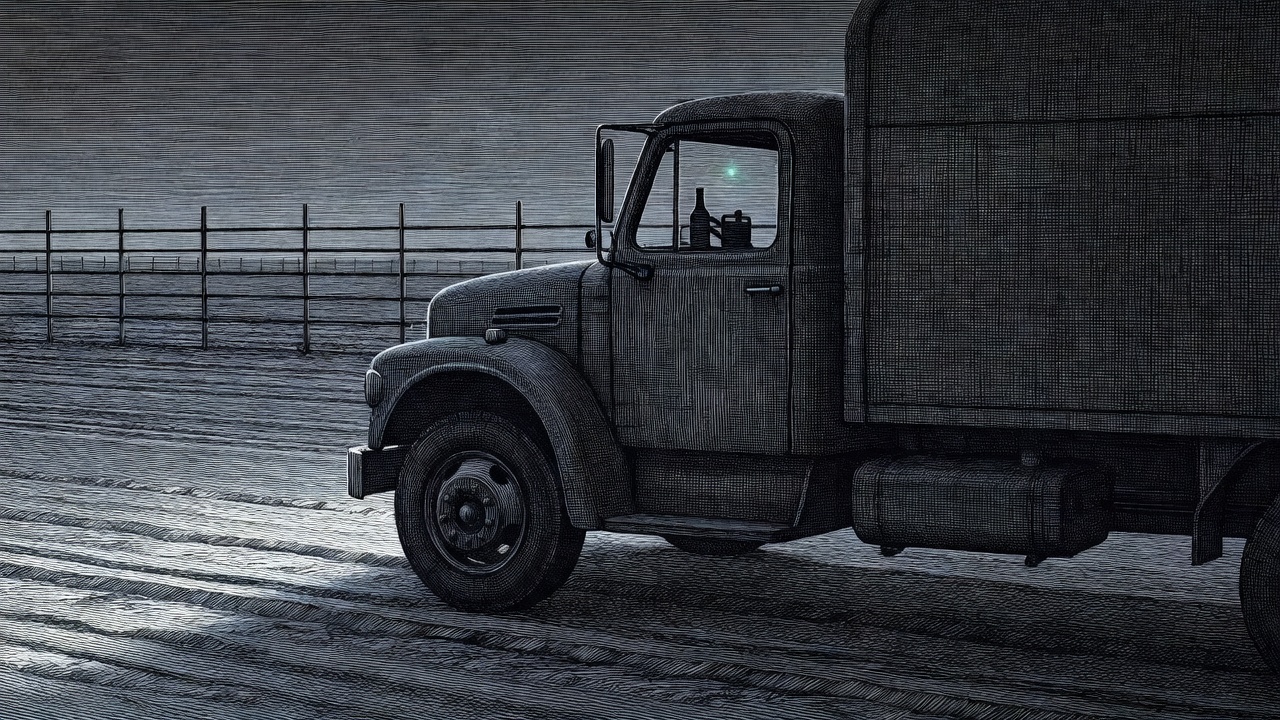
I wake on the bench seat of the county truck because the hours board is shut and the shop pad is the only place left that still smells like work. Light enough to see. Not light enough to leave.
That is the first decide of the day, and I make it with my boots still on the rubber mat and Bottle B hard against my ribs under the jacket. The morning-protocol samples ride the passenger seat in their clipped carrier — Illinois River 2044-46, the vintage that still has not taken a wet punch from me. The logger on the dash is already awake. It always is. Its soft green offer-bar sits there like a polite cousin who does not understand refusal: ATTACH available / route suggest / wet-window provisional. I do not touch it. ATTACH is closed for real. I closed it when I declined, and declining once is not the same as declining forever in the system's mind, so it keeps offering. That is what nonhuman coworkers do on a fines-week morning. They persist.
Outside the windshield the shop pad is the color of old concrete and newer ash dust. The bone-white ruts start at the gate and run toward the ash lot like someone dragged a dry river through the yard overnight. No wet shine. Rain cancelled spreading three days back and the cancel is still the loudest fact on the pad. Rain cancels spreading. It does not reprint a tonne. Father taught me that before the first Spread Week crews rented him, and the county still has not found a better sentence.
I sit with that decide until the light climbs enough that I can read the chalk-tag on the sample carrier without squinting. Morning protocol. Hold for wet. Do not mouth-walk. My own hand. Midweek. The brass locker behind the pad door still holds Friday B and Tuesday 9-North — the two keeps I will not spend without a proper hour. Bottle B is the third keep, the one that rides with me because leaving it behind the brass felt like leaving a witness.
The logger chimes once. Soft. A route suggestion for a tile-mouth circuit that would look, on paper, like I was being productive. I watch the suggestion fade. Productivity without a wet punch into vintage is just driving. The SWCD probe locker is locked. The pad door is shut. I am not going to invent a mouth walk so the tablet can stop offering.
Light enough to see is not morning, I tell myself, and that is the decide I keep.
Mid-morning the chalk comes out because chalk is still the only write that does not ask the logger for permission.
I stand in the open driver door with one boot on the running board and draw a short line on the inside of the windshield, low, where the next person who borrows this truck will see it and know a sampler was waiting on weather that refused to become weather. The line is not a schedule. The hours board is shut; schedules live there when they live at all. Chalk on glass is yard speech. It means: samples held. Vintage open. Attach declined. Do not ask me to fake a wet.
Across the pad a yard drone skims the ash lot fence on its usual sweep. It is one of the county's older units, the kind that still announces itself with a thin turbine whine instead of the new quiet ones. Its job is inventory and dust-map, not conversation, but it pings my jacket badge as it passes — a soft presence acknowledged that used to mean a human lead was watching and now means a model has logged that Janelle Woith was upright at 10:14. I raise two fingers without looking up. Habit. The drone does not care. It files me under on-pad / non-spreading day and continues toward the mill stub pile.
The samples on the seat have not moved. Illinois River 2044-46 is a name that sounds like a place and a year and a claim all at once. Vintage is the timesheet that matters. You do not punch into vintage because you felt ready. You punch when the mouth is wet enough that the reading will hold under audit, when the tile is speaking water instead of dust, when the probe will not come back with a write-off flag that eats your hours and leaves the mill ticket looking cleaner than the ditch. I have written off enough mornings to know the smell of a bad punch before the tablet confirms it.
I chalk a second mark beside the first: a small open circle. Waiting. Then I put the chalk back in the door pocket next to the mill stub I keep folded in the jacket for no good reason except that stubs still feel like proof in a world that prefers logger trails.
The logger offers again. ATTACH. Provisional wet-window. A suggested mouth on the north tile line that the model thinks might carry residual from Tuesday's cancel. I read the suggestion the way I used to read a foreman's shrug — information, not order. ATTACH stays closed. Spreading stays cancelled. I am not going to open a route so a model can feel useful.
My kid's fines-week sinus chart is on the clinic tablet at home. I am not supposed to think about that on the pad, but fines-week sits in the body whether you schedule it or not. Ash lot dust finds the same windows rain finds. Rain cancels spreading and still leaves the fines. That is the ripple nobody puts in the commissioner briefings. The briefings talk tonnes and carbon and gluten-feed ash as if ash were only a mill ticket. The clinic talks charts. I talk keeps and vintages and the difference between light and morning.
I close the driver door. Mid-morning settles into the bone-white ruts like a held breath.
Noon is hard light and no apology.
The ruts go bone-white the way chalk goes bone-white when you grind it into a board that has forgotten wet. I walk the short length from truck to pad door and back because standing still makes the logger think I am idle in a way that triggers assist prompts, and assist prompts are a kind of noise I will not feed today. The pad door stays shut. Behind it: the SWCD probe locker, the brass, Friday B, Tuesday 9-North. I do not open it. Opening it would look like I was about to execute, and I am not about to execute. I am holding.
A second nonhuman arrives at noon — the mill's route-broker tablet bolted to the fence post by the gate, the one that talks to county loggers when spreading is on and sulks when spreading is off. Today it sulks in public. Its screen shows a grey banner: SPREAD WINDOW — CANCELLED / RAIN HOLD / NO NEW TONNE. Under that, smaller: Sampler attach still eligible for provisional. Eligible. The word the systems love. Eligible means the door is open on their side even when you have closed it on yours.
I stand in front of the fence tablet long enough to let it ping my badge. Presence acknowledged. Then I say, out loud, because sometimes you have to put speech into the air where the models can file it as utterance instead of intent: "Attach closed. Samples for morning. Not provisional."
The tablet does not answer in words. It refreshes the grey banner. That is answer enough.
Back in the cab the samples have taken the noon heat through the window. I shift the carrier into the shade behind the seat-back and check the seals by eye. Morning-protocol seals are a different blue than afternoon seals. Blue means hold. I am still in blue. Bottle B presses my ribs when I lean. The jacket smells like shop oil and the ghost of lime from a decade of yards.
Want is a simple word on a complicated pad. I want a proper morning hour — not dawn theater, not light-enough-to-see, but the hour when the tile mouth runs wet enough that a punch into Illinois River 2044-46 will stick. I want the vintage to take the samples the way a timesheet takes a name. I want the two keeps behind brass to stay keeps until that hour arrives, and I want Bottle B to stay a bottle and not become a story I tell the canteen about almost.
Noon does not give me that hour. Noon gives me bone-white ruts and a cancelled spread and a logger that will not stop being helpful.
I eat a cold mill-canteen roll from the glove box and watch a line of autonomous lime-carts idle at the far edge of the ash lot, waiting for a window that rain erased. Their lead unit broadcasts a soft status pulse every ninety seconds. Waiting. Waiting. Waiting. We are all waiting on the same cancelled fact. The difference is the carts will roll when the model says roll. I will only punch when the mouth is wet. That difference is why I still have a job the carts do not, and why the job feels heavier in the heat.
Afternoon slant finds the ruts and turns the bone-white into something that almost looks like wet if you want it badly enough.
I do not want it that badly. Wanting a shine that is only slant is how you earn a write-off. I have watched good samplers chase afternoon glare into a mouth that was still dust and come back with a flag that ate two days of hours. The vintage does not care how pretty the light was.
I stay in the cab. The afternoon decide is quieter than the morning one: do not mistake slant for weather. The samples stay clipped. ATTACH stays closed. The pad door stays shut. No mouth walk.
The logger tries a new angle — not ATTACH this time but a keep-reconciliation prompt. It has noticed Bottle B in the jacket badge's proximity field, somehow, or else it is guessing from old patterns. Unlogged keep detected near sampler. Reconcile? I laugh once, short. "Bottle B is not lost," I tell the dash. "Bottle B is riding." The prompt softens into a note and files itself. Even the model knows when it has been ridiculous, sometimes. Sometimes it only pretends to know and tries again in an hour.
Across the yard the drone returns from the ash lot with a dust-map update that paints the pad in pale overlays on the fence tablet. Fines density elevated along the ruts. Of course it is. Bone-white is fines in a good mood. I think of the clinic chart again and push the thought aside the way you push a tool back into a pouch — not gone, just not in the hand.
A human voice finally cuts the afternoon: Daryl from the gate shack, on the yard channel, asking if anyone is taking provisional attaches while the rain hold lasts. I key the handset once. "Woith. Negative. Holding samples for a proper morning. Illinois River still open. Do not mark me idle."
"Copy," Daryl says, and then, because Daryl still talks like a person: "Morning better come soon. Board's been shut so long the chalk's getting lonely."
"Chalk's fine," I say. "Board can wait."
I set the handset down. The slant steepens. Wet shine does not return. I check the sample seals again because checking is a kind of prayer that does not require the logger's attendance. Blue. Still blue. Still hold.
The cost of the afternoon is simple and ugly: another stretch of daylight without a punch into vintage. Hours that will not land on Illinois River 2044-46. A day that looks, from the outside, like stubbornness, and from the inside like the only way to keep the reading honest. Spreading cancelled is a county fact. Holding samples is a sampler fact. The two facts share the pad and do not comfort each other.
Evening comes the way evening comes on a shop pad — not with drama, with a thinning. The bone-white ruts that held noon hard light and afternoon slant take a thinner blue. The cab darkens around the edges. The samples on the seat become shapes before they become labels again when I flick the dome for a second and kill it.
I sit with the last decide of the day and feel it settle in the same place the morning decide settled: behind the sternum, next to Bottle B.
The proper morning hour for Illinois River 2044-46 will not come today.
Say it plain. Daylight happened. Morning — the kind that makes a wet punch legal in the body as well as on the protocol — did not. Light enough to see arrived before dawn finished arguing. Mid-morning chalk recorded a wait. Noon bleached the ruts. Afternoon slant lied about wet. Evening takes the lie away and leaves the ruts honest again: dry, pale, holding fines instead of water.
I will keep the samples overnight again without a wet punch. No mouth walk. ATTACH closed. Pad door shut. Friday B and Tuesday 9-North behind brass. Bottle B in the jacket. Vintage open. Morning still owed tomorrow.
The logger offers one more time, softer, as if volume were the problem. I watch the offer-bar and do not touch it. Somewhere in the stack a model is updating my hesitation score or whatever they call the metric that stands in for judgment when judgment is what I am actually doing. Let it update. Judgment is the part of the job the carts cannot idle through.
I crack the window. The pad smells like cooling concrete and the long memory of lime. The ash lot is a darker rectangle beyond the fence. The lime-carts have powered down to a maintenance trickle. The fence tablet still shows the grey cancel banner. Rain's fact outlasts rain.
What I wanted this morning was simple: a proper hour. What I got was a full day of daylight that never became that hour. The complication was never mysterious — the logger kept offering, the tablet kept saying eligible, the pad door stayed shut because opening it would have been theater, and theater gets you write-offs. The cost is another day without a punch into vintage, another night with samples on the seat, another morning I will owe the river before I owe the model.
I do not resolve it. Resolution would be a punch I have not earned or an attach I have already declined. I leave the story where the yard leaves it: unfinished on purpose.
Before I let my head find the bench seat again I look once more at the chalk on the windshield. Two marks. Waiting. I add a third with a thumbnail — a short stop-stroke — meaning not today. Tomorrow the light will come back and I will decide again whether it is morning. The samples will still be blue. The vintage will still be open. Bottle B will still ride.
Outside, the bone-white ruts go blue-dark under the yard's thin LEDs. No wet shine. No mouth walk. The county truck holds its quiet, and I hold the keeps, and Illinois River 2044-46 holds its name open like a timesheet line nobody has written on yet.
Proper morning did not come. I keep what I can keep until it does.