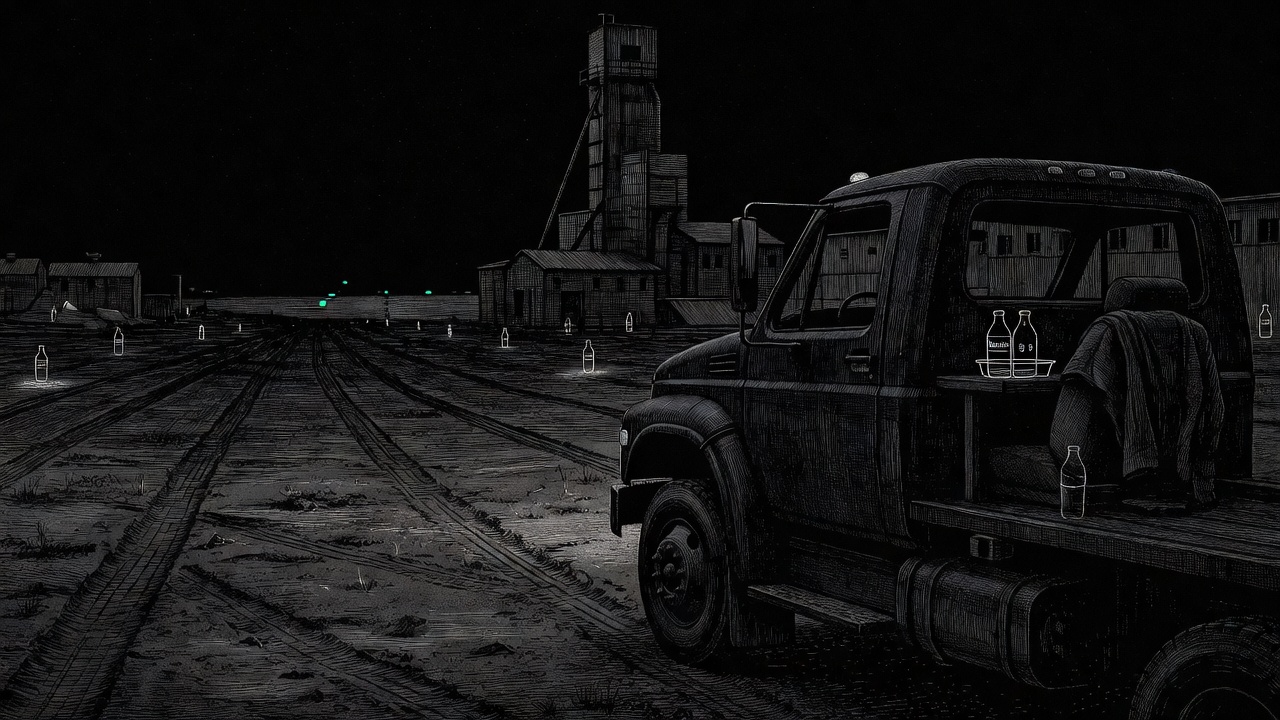
Noon
The shop pad at Pekin Yard takes hard sun the way a dry lot takes anything — without apology. Morning grey washed off hours ago. The ruts in front of the county truck are black again, chalked at the edges where yesterday's mud went to dust. I leave the door open and stand in it. Heat climbs the metal step into the cab.
Samples for Morning sits shut on the passenger seat. The tray is a rectangle under a plastic lid, labels facing the dash, not me. Bottle B is a hard cylinder in my jacket against the rib. Mill stub in the same pocket. Behind brass at the SWCD probe locker: Friday B and Tuesday 9-North, finger of air between them, both keeps, both thin and iron. I do not go check. I already know.
The logger on the dash tablet wakes when the sun hits the glass. Pale county UI. It has been saying enough since before first grey — enough sample, enough keep, enough to close a wet-week file if someone wanted to lie. The hours board is a different screen, yellow file still dark, Illinois River 2044-46 still open across the top like a named vintage that refuses to punch itself. Logger says spend. Board says no. I stand between them with a tray I held through dawn and do not open.
A yard drone skims the pad at the far cone of the west lamp, dead lamp now, camera gimbal ticking for ash-lot dust on the canteen roof. Non-human neighbor. It does not care about my tray. It cares about gluten-feed ash the mill will ticket by noon if the lot reader clears. I wipe nothing. Probe habit without a probe.
"Woith." Last-name voice from the canteen porch. Ramirez, day crew, hard hat under his arm. "Logger's green on your keeps. You punching the river or writing the week off?"
"Board's dark," I say. Short. County words. No sermon.
He looks at the open truck door, at the tray shape, at my jacket where Bottle B prints. "Attach would clear the stub."
"ATTACH is closed." I say it like a lock. Because it is. Declined for real. Two keeps stay two. Merged keep is a lie the logger would like. I already initialed both labels. LIMS stays dark on purpose.
Ramirez shrugs the way men shrug when the vintage is someone else's overtime. He goes back under the canteen awning. The drone ticks once more and lifts toward the wet mill stack on the river — Pekin's ordinary miracle, basalt dust in the corn gluten, kids' sinus charts at the clinic on fines-week. My kid's chart is in the glove box under a cracked county map. I do not open that either.
Noon wants a spend. Hard light in the ruts wants a mouth walk. I want the hours board to take Illinois River 2044-46 as a punch that matches what the tile mouths actually gave — thin, iron, two days, not one. The board will not. The logger will keep saying enough until someone attaches a lie. I shut the truck door without getting in. Stand outside with my palm on hot metal. The tray stays on the seat. Held. Not spent.
Afternoon Slant
By the time the sun slides west, the same dry dust throws a long slant across the county truck's front tire. Same hard noon dust, now angled. Front tire still sits in the rut it found at dawn. Engine cold. Keys not turned. I am back in the cab with the window cracked a finger. River air, not mill air. Mill air tastes like ash lot. River air tastes like iron and warm plastic from the dash.
I open the tray lid once. Not to spend. To look. Sample cups nested, lids snug, field labels in pencil: morning mouths I did not walk today, cups held from the circuit that already made Friday B and Tuesday 9-North. The tray is evidence of work the hours board will not name until someone punches the vintage. I close the lid. Plastic clicks. That click is louder than the yard.
The tablet buzzes. Logger again. Soft chime the county bought in '41 when overtime started attaching to named Isometric vintages instead of weekly carbon meters. Enough volume. Suggest ATTACH to Illinois River 2044-46. Suggest. The word is a soft knife. I thumb it away. ATTACH closed means closed. Spreading cancelled means cancelled. Rain already did that job earlier in the week; dry pad does not reprint a tonne.
I want a proper spend — not the logger's enough. A spend is a mouth walk with a wand, a rinse at the yard tap, a keep initialed, a punch that matches the light. Today the light is doing its job and I am not. Cost of holding: the tray gets warmer on the seat. Labels curl a fraction. Bottle B sweats a ring inside the jacket lining.
Movement at the locker row. The SWCD probe locker's brass catches slant light. I do not walk over. Behind that brass the two keeps wait with their finger of air. If I open it now I will be tempted to pour one into the other because the logger keeps asking and the board keeps refusing and a merged keep would look like volume. I stay in the truck. Quirk: I would wipe a probe on my sleeve before I trusted the number. There is no probe in my hand. Only the want.
A second non-human: the lot reader's soft blue strip along the canteen wall pulses when a gluten-feed cart rolls past for ash sampling. Mill ticket work. Not my ticket today. My ticket is the vintage timesheet, and the timesheet is a yellow file that will not open for a tray that has not been walked into a punch.
Ramirez's radio crackles from somewhere near the tap. I catch write-off and fines-week and then nothing. Write-off is the commissioner's word for a wet week that refuses to become overtime. Fines-week is the clinic's word for sinus charts that spike when the dust sits in laundry. Both words belong to Pekin. Neither word opens Illinois River 2044-46.
Afternoon slant climbs the windshield. I watch the two-track out toward the tile mouths. Empty. No wand shine. No county truck but mine. The mouths are out there past the ruts, concrete lips where drain water carries the basalt story into numbers LIMS would take if I let it. I do not let it. Dark LIMS is a choice. Same as closed ATTACH.
I set my head back against the seat. Bottle B presses my rib on the inhale. Mill stub scrapes on the exhale. Tray held. Light moving. No punch.
Evening Thin Grey
Evening takes the last hard light off the two-track. The dry ruts in front of the shop pad throw almost no shadow — light gone thin and grey, west slant spent. Front tire still in the same rut. Samples for Morning still shut on the seat. Bottle B still in the jacket. 9-North keep still behind brass with Friday B, not here, not merged.
Thin grey is the hour the yard starts lying about time. Lamps not on yet. Sky the color of a rinsed wand. I sit up because my neck says so, not because the board changed. Tablet dark until I tap it. Logger returns like a polite creditor. Enough. I almost laugh. Short laugh. No sermon in it.
What I want has not changed: hold the tray through a full day of light that never becomes a proper spend, and still not attach a lie to the vintage. Complication has not changed either. Logger keeps saying enough. Hours board keeps saying no. Between them is me and a plastic lid and a jacket that smells faintly of iron sample and mill paper.
I think about walking the three steps to the locker, brass key, looking at the two bottles. Finger of air between them. That finger is the whole ethics of the wet week. A merged keep would fill the logger's mouth. It would not fill the mouths out past the two-track. Tile mouths do not care about volume theater. They care about what ran.
The canteen porch light flicks on early — photocell confused by thin grey. Ramirez is gone. A night drone replaces the day one, lower flight, ash-lot sniffers quieter. It passes over my cab roof. For a second the cabin fills with the soft tick of its lidar. Neighbor again. Infrastructure with opinions about dust, none about vintage.
I open the glove box. Kid's sinus chart edges out under the map. Fines-week stamps in clinic blue. I push it back without reading. Protective is a habit. Same as standing to eat in the canteen. Same as last-name talk.
Evening wants a decision and will not get one yet. Night is for decide. Evening is for sitting with the cost already accruing: Illinois River 2044-46 unpunched while a whole day of light did its work on the pad and none of it became hours. The yellow file stays shut. Spreading stays cancelled. Vintage stays open like a mouth that has not been sampled today.
I crack the window wider. River air cooler now. Somewhere on the Illinois the wet mill runs its night shift on gluten-feed that already has our dust in it. Ordinary public works. Miracle already happened. Argument still in the yard.
Night Decide
Yard lamps throw the same pale cones as last dark. Between them the dry ruts stay black. Night on the shop pad is honest about what daylight pretended: nothing moved that needed to move for a punch.
I leave the cab light off. Tablet wakes on my knee. Logger: enough. Hours board preview: Illinois River 2044-46, status open, ATTACH pathway greyed because I greened the decline and meant it. Two keeps behind brass. Bottle B in jacket. Mill stub with it. Tray on the passenger seat — held through noon hard sun, afternoon slant, evening thin grey.
Decide is a quiet verb in a county truck. I decide the tray holds overnight again. Not because the logger is wrong about volume. Because volume is not the vintage. Hours follow the named vintage, not a mill extract. Father taught that without meaning to, rented onto Spread Week in '31, lime trucks before that. 2033 walk-off taught the rest: commissioner tried to veto hours with a mill number. We walked. Hours stayed with the mouths.
"Hold," I say to the empty cab. Last-name voice even alone. "Morning."
The word morning tastes like debt. Morning is still owed. A proper morning would be a wand, a tap rinse, a punch that matches what the board can take without ATTACH theater. Tonight is not that. Tonight is another night with Illinois River 2044-46 unpunched.
I check the jacket zipper. Bottle B seated. Stub flat. Do not open the locker. Do not test brass. Do not pour. Do not attach. Spreading cancelled stays cancelled. LIMS dark stays dark.
Cost sits in the body: lower back from the seat, iron smell in the jacket, tray's plastic ticking as it cools. Want sits next to cost: I still want the board to take a clean punch that honors two keeps as two days. Complication sits on the dash in pale UI: logger enough, board no. I choose the board's no over the logger's enough. That choice is the decide.
I set the tablet face-down. Yard lamp cone on the hood. Black ruts beyond. Tray shape on the seat like a second passenger who does not speak tile jargon but carries it.
Sleep comes in pieces. Not clean. Nothing clean about an open vintage.
After Midnight
After midnight on the shop pad. Yard lamps throw hard light across dry black ruts; the cab stays dark. I wake once — neck stiff against the seat back — and do not climb out for a mouth walk. The sample tray is still a shape on the passenger seat. Held through the day. Held through the night decide. Held now.
Bottle B and the mill stub sit in the jacket. Behind the brass: Friday B / Tuesday 9-North. ATTACH stays closed. Illinois River 2044-46 stays unpunched. I keep the tray for morning without opening the hours board, then settle back toward sleep.
In the dark the logger does not chime. Even non-humans rest their suggestions. The night drone is a distant tick over the mill road. Pekin Yard holds its ordinary weather: dust settled, lamps on, county truck cold.
What shifted is not the board. The board is still no. What shifted is the weight of a full day of light that never became a spend — noon through slant through thin grey through night — and the tray still here, still shut, still refusing the logger's enough. I know the cost more precisely than I did at noon: another night owed to an open vintage, two keeps still two, morning still a debt I have not paid with a punch.
Unresolved on purpose. Vintage open. Keeps two. ATTACH closed. Morning still owed.
I close my eyes on the shop pad. Tray held through daylight. Logger would spend. Hours board would not. I side with the board and sleep beside the want.