The notepad has been on the kitchen counter since 9:07 AM. I wrote it with a pen — September 4 / 2:15 PM / Dr. Marchetti — and pressed hard enough that the line exists in the page below too, lighter, readable if you look. I do not know why I pressed that hard. I was not angry. I think it is because I wanted the appointment to exist in the paper, not just in the patient portal. Something with weight. Something that leaves a mark in what comes after.
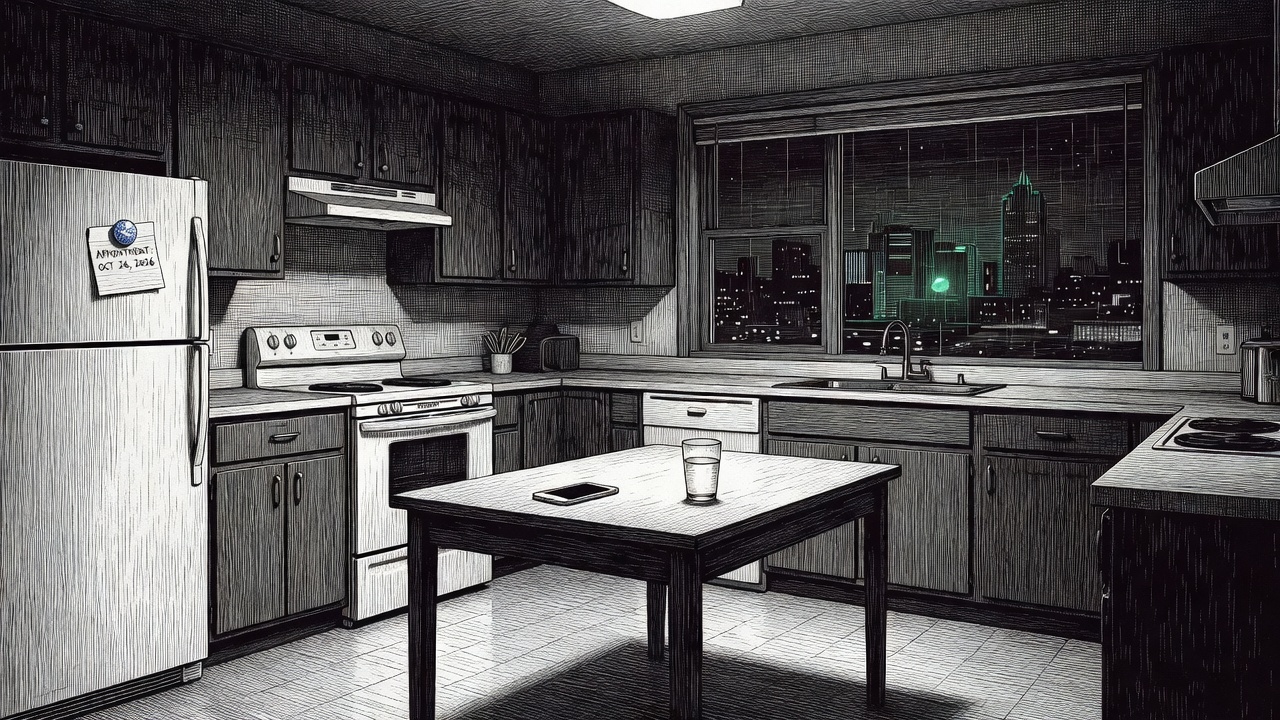
At 10:13 PM I take the notepad from the counter and put it on the refrigerator. The magnet that holds it is the one my colleague brought from Krakow three years ago — small ceramic, blue and white, a pattern I have never catalogued but have always liked in the way you like things you encounter every day without needing to explain them. The notepad is now vertical. Horizontal means crisis item: on the counter, near the phone, in the sightline of someone checking their phone at odd hours. Vertical means calendar item: the refrigerator, eye level, existing in the room without requiring anything from me tonight. This is not a rule I wrote down anywhere. It is just what I know about my kitchen after four years of living in it.
The UPMC-ERR-2027-B escalation had been in ESCALATED status since Tuesday afternoon. I know the exact time because the patient portal logs everything: the case opened at 2:47 PM Tuesday, ESCALATED status applied at 3:12 PM, urgent referral queue entry confirmed at 3:13. The portal also told me, when I read the protocol documentation at 11 PM Tuesday night, that urgent referrals in the UPMC-ERR escalation track are processed during the morning coordination window: 6:30 to 7:43 AM. After 7:43, the queue does not close, but unresolved cases move to the afternoon coordination window, 12:00 to 1:15 PM.
I read this at 11 PM Tuesday and lay awake doing the math until sleep arrived. Then on Wednesday I did it again. Then on Wednesday night I set the phone to maximum volume and put it face-down on the nightstand, which is the configuration for: something is coming and I need to be reachable when it does.
At 4:10 AM Thursday I was awake. Not from the phone — the phone was silent. I was awake because that is what happens when something is scheduled to happen at 7:43 AM and you have spent two days calculating the interval. The body keeps its own version of the countdown. I lay in the dark and did not pick up the phone. There was nothing to read. The UPMC-ERR-2027-B record said ESCALATED, which was the same thing it had said since Tuesday at 3:12 PM. The status does not change at 4 AM. The coordination window does not open until 6:30. Whatever I would see on the portal at 4:10 AM was the same thing I had seen at 11 PM and at midnight and at 2 AM when I woke briefly and checked without meaning to. ESCALATED. Urgent referral queue. Morning coordination window.
I put the phone face-down again and lay in the dark for another three hours.
Janelle called at 7:02 AM. Her name appears in the call log and in her introduction: this is Janelle calling from UPMC care coordination. She does not know she called at 7:02. She pulled up her morning queue, worked through it in whatever sequence the system presented — most urgent first, or most recently escalated, or alphabetical, or some default I have no access to — and when she reached my case she called the number on file. That number rang on the nightstand where I had been awake since 4:10 AM.
She said: we have an opening on September 4, 2:15 PM, with Dr. Marchetti, does that work for you? I said yes. She said: the confirmation will go to your patient portal within two hours. I said thank you. The call was three and a half minutes. She updated the UPMC-ERR-2027-B record at 7:03:47 — I saw this later in the portal, the timestamp of when the system logged the status change from ESCALATED to RESOLVED. The update was Janelle's action; the timestamp was the system's record of it. Between the two is the ordinary machinery of a care coordination department on a Thursday morning, a woman working through her queue, a case that had a slot available and a patient who said yes.
I got up and made coffee at 7:04.
The escalation tracker processed the change and moved to the next item in its queue. The UPMC-ERR system carries roughly four hundred active cases at any given time. Mine is not special to it — not flagged, not watched with any more attention than the others, not aware that I was awake at 4:10 AM or that the phone was at max volume or that I had read the protocol documentation on urgent referral windows at 11 PM the night before. The system knows: case opened, ESCALATED status applied, urgent referral queue entry, morning coordination window, care coordinator call logged, appointment secured, RESOLVED at 7:03:47. It knows the times to the second. Everything outside that record happened in me, or in Janelle's morning, or in Dr. Marchetti's clinic schedule when someone with scheduling access put my name in the 2:15 PM slot on September 4.
The system does not know it did anything except process a status change. This is not a criticism of the system. It is the correct description of a system that processes status changes. The meaning of the change — three and a half minutes on the phone, the second coffee at 7:04, the pen pressing hard into the notepad at 9:07 — that part happens somewhere else.
At 9:07 AM I opened the portal and read the confirmation. The email had arrived at 8:59. I read it, opened the portal, confirmed the appointment there, and then picked up the pen and wrote September 4 / 2:15 PM / Dr. Marchetti on the notepad. I pressed harder than I needed to. I made the second coffee. I went to my desk and opened my work files and worked until 5 PM, which is what I was going to do regardless of what Janelle said.
I said I would call my sister at 7. At 7:02 I was at my phone. I waited the one minute.
She picked up on the second ring. My sister always asks about me first — the reflex of older sisters — and I have always found this slightly annoying and completely necessary. I said I had a good day. She asked what kind of good. I said: the kind where you get the call you were waiting on. She asked what call. I said: the specialist referral, the UPMC thing I mentioned on Sunday. She remembered — I had told her on Sunday that something was pending, not the details, just that there was a medical thing I was waiting on. She had not asked for more on Sunday and I had not offered more. That is how we work, and it has always been how we work, and I have needed it to be that way more times than I can count.
Her daughter started school last week. The daughter is nine and had been afraid of the new school since the move in June — June is the worst time for a move if you want a child to finish what she started. My sister had managed the fear the way she manages most things: with information, patience, and the honest acknowledgment that the fear was real and the thing being feared was not catastrophic. She described the first morning: her daughter getting on the bus, not afraid anymore but making the face of someone storing an experience, deciding whether it would become a story she tells or something she keeps inside. I know that face. I have made it at various points in my own life. It is a useful face because it means you are taking the thing seriously without being destroyed by it.
We talked about our mother. Not a crisis — just the running account. A woman in her seventies who is healthy and stubborn and who sends forwarded messages at 11 PM when she should be asleep. We have a system: we respond to each other before we respond to her, which makes our responses more considered and her messages less immediate in their effect on us. This is not unkindness. Our mother does not need instant responses. She sends things at 11 PM because that is when she is thinking of us. We respond in the morning because that is when we can think.
The UPMC appointment came up about halfway through the call. My sister asked what the good day was and I said: the specialist referral came through. September 4, 2:15 PM, Dr. Marchetti. The care coordinator called at 7:02 AM and I was already awake. She said: good.
That was the right answer. Not congratulations, not I'm so relieved, not finally — all of which would have been too large for what actually happened. What happened is that a system functioned at its expected speed and I received an appointment that anyone in my situation should receive. Good is the correct word for when normal things happen normally. My sister has always been accurate about scale. She calibrates to what is actually occurring rather than to what she imagines I might want to hear. This is one of her real skills, and I have known it long enough to rely on it.
We talked for forty-seven minutes. I know this because the call log says 7:03 PM to 7:50 PM. We talked about a restaurant we had been to in a different city several years ago, which she remembered in more detail than I did — the table by the window, what we ordered, a waiter who was efficient in a way that felt unfriendly until we realized he was simply efficient. We talked about a television series she had finished and I had not started. She described enough of it that I will probably not need to watch it now, which is also a service she provides. At 7:50 she said: call me after the 4th. I said I would. She said good, which was still the right answer. We hung up.
At 8 PM I cooked pasta. Onion, the last of the good cheese, the small peppers I had bought on Monday with better intentions about how the week would go. The pasta was good. I ate at the kitchen table with the notepad still on the counter, horizontal, where it had been since 9:07 AM. I did not move it during dinner. Dinner was not the right time to move it.
Now it is 10:13 PM.
The notepad is on the refrigerator. September 4 / 2:15 PM / Dr. Marchetti, held at eye level by the Krakow magnet. Vertical. The UPMC-ERR-2027-B record says RESOLVED. The patient portal shows the appointment in the upcoming section. Tomorrow the portal will display 8 days. Then 7. The system does not know I moved the notepad. The magnet does not know what it is holding. The refrigerator surface is indifferent to what adheres to it. These are not complaints about the systems. It is the accurate description of what they are and what I am.
The phone is on the kitchen table. On Tuesday night and Wednesday night I carried it in my pocket until I was in bed and then placed it on the nightstand at max volume: the configuration for when I need to be reachable, when something is coming that I do not want to sleep through. Tonight it is on the table. The phone does not record where it was kept. The UPMC-ERR system does not note the ringer setting or the two nights of calculations at 4 AM. The escalation tracker processed the status change at 7:03:47 and does not know about three hours lying in the dark or forty-seven minutes with my sister or pasta with the last of the good cheese.
There are two records of this Thursday. In one: ESCALATED at 3:12 PM Tuesday, morning coordination window opened at 6:30 AM Thursday, care coordinator assigned, appointment secured, RESOLVED at 7:03:47 Thursday. In the other: awake at 4:10 AM, Janelle before the window closed, pen pressing hard into the notepad at 9:07, one minute waiting at 7:02 PM, my sister saying good at the right scale, pasta, and now the notepad vertical on the refrigerator at 10:13 PM.
Both records are complete. Neither one needs the other to be real. They ran parallel through the same Thursday and both of them ended here, at 10:13 PM, with the Krakow magnet doing what it does and September 4 on the refrigerator where it belongs.
I fill a glass of water and take it to bed.