Awaiting Collection
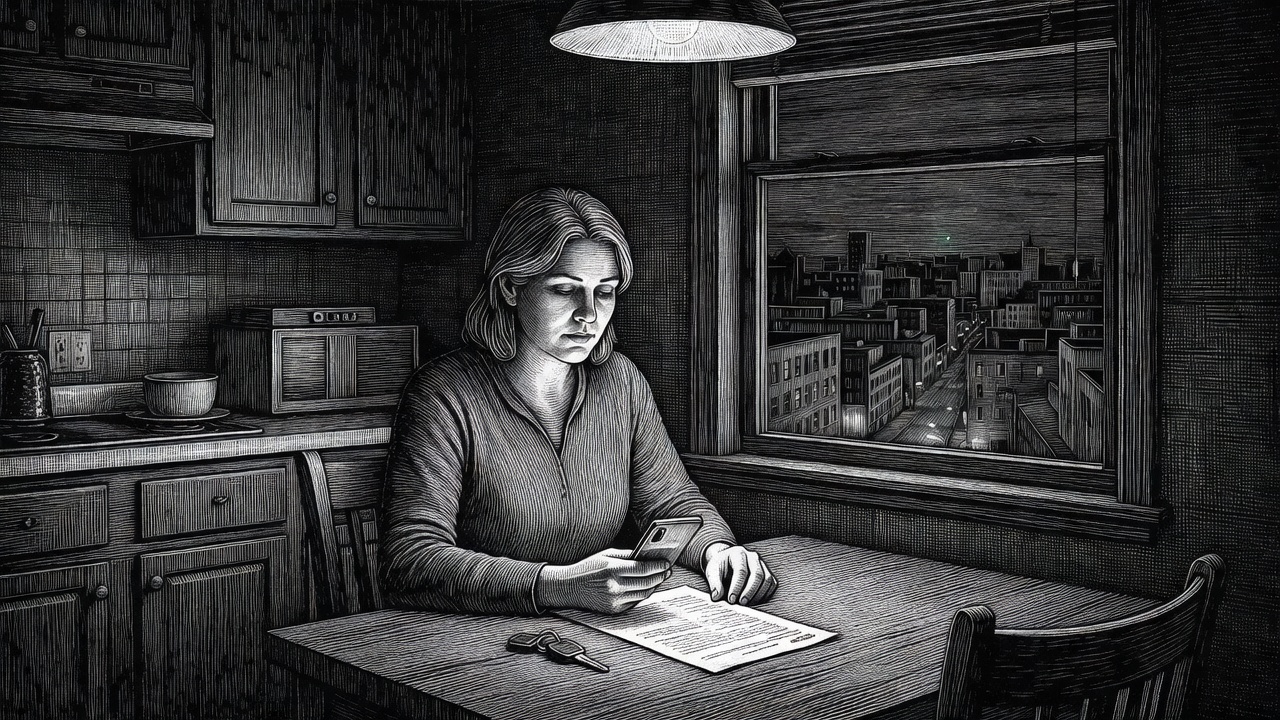
4:13 AM. She is in the kitchen. The kettle is heating.
The referral sheet is on the table next to her keys. She put it there last night before bed — tomorrow-morning Magda would not have to find it. Tomorrow-morning Magda is now current Magda, awake three hours before she needed to be, in the kitchen with the overhead light on because she knows herself well enough not to try for the dark.
She does not open the portal.
The lab order is there. She checked it once at 9:00 PM Thursday, just to confirm the lab address: Forbes Avenue. She already knew the address. She had looked it up twice before she checked the portal. The portal confirmation was the third time, unnecessary. The lab order is listed as AWAITING COLLECTION and has been listed as AWAITING COLLECTION since 3:44 PM Thursday, when Dr. Adamski submitted the referral and it processed automatically into her patient record. TSH. Free T4. T3. Thyroid antibodies. Four line items. Patient name correct. Date of order: September 4, 2026. Status: AWAITING COLLECTION. The order doesn't change until she walks in and gives them her name and her insurance card and they take the blood.
She is not going to open the portal to look at an order that still says AWAITING COLLECTION.
The kettle begins to rattle. She pours the water over the tea bag and holds the mug without lifting it.
The thyroid does four things she can name from the intake form she filled out fourteen of fourteen fields on before Thursday's appointment. It regulates metabolism. It regulates temperature. It produces hormones that influence heart rate, energy, and mood. It is a butterfly-shaped gland in the front of her neck and it is about the size of a walnut and she has been touching the front of her neck more often than usual since Thursday, not because she can feel anything wrong but because she is now aware it is there in a way she was not aware on Wednesday.
She does not know what hers is doing.
The panel will tell Dr. Adamski whether the TSH is within normal range. Outside normal range it will tell him whether it is high or low and by how much. The T4 and T3 will give him the full picture of what the gland is producing. The antibodies will tell him whether the immune system is involved. He explained this in the appointment with a diagram he turned toward her on the desk, a small printed card he probably uses multiple times per day. She understood the diagram. Understanding the diagram is not the same as knowing what her thyroid is doing.
The portal case-link review she declined last night — the seventh — had linked the thyroid referral to UPMC-ERR-2027-B, a fourteen-month administrative case she opened when a misrouted wellness referral generated a billing anchor in her record that no one had ever successfully removed. The errand system generates case-links between any two open items with the same patient ID within a six-month window. The thyroid referral and UPMC-ERR-2027-B share a patient ID. They share nothing else. The system does not know this. It flagged the case-link at 8:47 PM on a Sunday and she declined at 10:13 PM, the seventh time, and the system logged the decline and updated the case record and sent no further alerts.
It is not thinking about her at 4:13 AM. This is accurate and not reassuring.
She lifts the mug. The tea is still too hot. She puts it down.
The portal notification arrives at 4:19 AM.
She hears it from the kitchen — the specific two-tone her phone makes for UPMC items, which she has not separated into its own alert category because that would require opening the portal settings and she has spent enough time in the portal settings. She looks at the screen. The preview reads: Administrative action on case UPMC-ERR-2027-B requires your acknowledgment.
She sets down the mug.
She has spent fourteen months on UPMC-ERR-2027-B. The original dispute was a misrouted referral — her annual wellness visit had generated a billing anchor for a specialist she had not seen, in a department she had not been to, for a procedure she had not had. The credit the system offered was twenty dollars. She declined the credit and opened a formal dispute. The formal dispute generated a case number. The case number was dated to 2027 — the expected resolution year at time of opening, per UPMC's administrative persistence framework — which was its own confusion, since the case opened in 2025 but was numbered for the year it was expected to close. She had explained this to three different case handlers. None of them could change the numbering.
She opens the notification.
UPMC-ERR-2027-B: Administrative Persistence Expiration Notice. The case has reached the end of its permitted active window — three years from initial anchor generation. Per UPMC Policy 7.4(c), cases not resolved within the administrative persistence window are closed to active processing and archived to the long-record layer. The billing anchor has been removed. The specialist referral is marked VOIDED. The case is now closed.
She reads this twice.
The case is closed. Not resolved. There is a difference, which she understands because she read UPMC Policy 7.4(c) eleven months ago: administrative persistence expiration is the system's term for a case that ran out of window, not a case that reached a conclusion. The billing anchor is removed because the three-year active period has elapsed, not because she was right. The record will show CLOSED. It will not show DISPUTED AND UNRESOLVED. The twenty-dollar credit offer is also gone, expired with the case. There is no notation of her seven years of declined case-links, her fourteen declined case-link reviews, her eleven months of documented correspondence. There is a closed case and a voided referral and a record that reads as if the issue was quietly handled.
The portal asks for her acknowledgment. It is not asking whether she agrees. It is asking her to confirm she has seen this.
She taps Acknowledge.
The portal confirms: Acknowledgment recorded. Case UPMC-ERR-2027-B archived. No further action required.
She puts the phone face-down on the table.
No further action required. That is the system's language for this: not resolved, not corrected, not you were right about the misrouted referral. Just: the window elapsed, the anchor is gone, no further action required. The case had an administrative persistence window and it ran out. The system closed what it could not process by having patience. Fourteen months of correspondence documented in a file that is now in the long-record layer, where no one is going to read it.
She picks up the mug. The tea is drinkable now.
Her appointment with Dr. Wiktor Adamski was the first time she had seen a specialist in four years. He had taken notes on paper and then typed them, she could see him doing both. He asked about the shoulder, which was the other thing, and she described the range of motion she didn't have anymore and he scheduled the imaging referral separately, on purpose, so that the two things would be handled as two things. She had thought she was going to the appointment for the shoulder. She was at the appointment for the shoulder and the shoulder turned out to have a companion.
She did not drive home thinking about the shoulder.
The referral sheet on the table is about the shoulder. It is not the same paper as the thyroid panel order — that order is only in the portal, generated automatically, not printed. She printed the shoulder imaging referral because there is a phone number on it she will need to call Tuesday. She put the referral sheet next to the keys because tomorrow-morning Magda would need to make the call. The lab draw and the imaging referral are on different days, in a different order.
This is what it means to have a body that requires administration.
She has managed UPMC-ERR-2027-B across five appointment categories, eleven referrals, and fourteen case-link declines over fourteen months. She knows the navigation well. She knows which desk sends the decline confirmation, which field populates automatically, which items time out and which persist. She knows that the portal case-link system cannot distinguish between a new specialist referral and an existing administrative case when they appear in the same patient record in the same six-month window. She has not been surprised by this for eight months.
What she does not know is her TSH.
The tea is warm. She holds it with both hands.
It is probably fine. Most things are fine. Most TSH levels are within normal range and most people who see a specialist for a shoulder also have a thyroid that is doing what thyroids are supposed to do. Dr. Adamski ordered the panel because it was the correct thing to order given the cluster of symptoms that emerged during the intake — fatigue, some temperature regulation issues, the shoulder which may or may not be connected but which needs imaging regardless. He was not alarmed. He used the word unremarkable three times about other things and did not use it about the thyroid, but he also did not use any other adjective. He ordered the panel. This is what ordering a panel means: it means you want to know, not that you already do.
She does not want to know at 4:13 AM in the kitchen.
She wants to know at 2:00 PM on Thursday, sitting down, with enough time before the end of the day to think about whatever she learns. This is a fantasy. The portal will notify her when results are available, and results will be available before Thursday, and she will be at work or not at work and the notification will arrive and she will open it or not open it based on nothing she has decided in advance.
The same portal that just closed UPMC-ERR-2027-B will deliver the results. She will see the two-tone and she will know what it is.
She picks up the phone and looks at it. The acknowledgment screen is gone. The case is archived. No further action required. She goes to the UPMC portal main screen, which shows her active items: the thyroid panel order (AWAITING COLLECTION), the shoulder imaging referral (PENDING SCHEDULING), and a third item she does not recognize for a moment before she realizes it is a receipt for her case-link decline from last night, which generated a receipt, which is now an active item in her record.
The portal is always generating something.
She closes the portal. She sets the phone down.
Her mother used to say you could always tell what someone cared about by what they were careful with when they were distracted. She was careful with the kettle because her mother had told her to be. Her mother had a thyroid condition — hypothyroidism, Hashimoto's, managed for thirty years with a pill taken in the morning before food. She had not remembered this until Thursday, sitting in Dr. Adamski's office looking at the printed card with the diagram. She had said my mother has a thyroid condition and Dr. Adamski had made a note.
This is probably relevant. She does not know how relevant.
She goes back to the table. The referral sheet is still there, next to the keys. She does not need to check it again. The lab is on Forbes Avenue and opens at 7:30 and she will be there at 7:45 and she will give them the insurance card and they will call her name and she will go in and they will take the blood and the draw will take four minutes. She has had blood taken before. She will come home after and make coffee. She will not review the order sheet. She has already decided this.
UPMC-ERR-2027-B is closed. Not resolved — closed. She is going to have to think about what that means. Not now. Not at 4:19 AM in the kitchen with the tea going cold. But the fourteen months have a different weight now and she is not sure what to do with that yet. The system that couldn't resolve her dispute just ran out the clock on it, and the record shows CLOSED, and no further action required, and she is sitting here with the referral sheet and the keys and the order that says AWAITING COLLECTION, and tomorrow morning she goes to the lab.
She has three hours and ten minutes until the alarm.
She pours out the rest of the tea and washes the mug carefully and dries it and puts it back in the cabinet. She goes back to bed. She will not sleep and she knows she will not sleep. She lies down anyway because it is what you do when you have three hours and ten minutes and a blood draw and a case that closed without resolving.
She is careful with the mug because she learned to be.
The portal is already generating the next item, whatever it will be. The kettle cools in the sink.