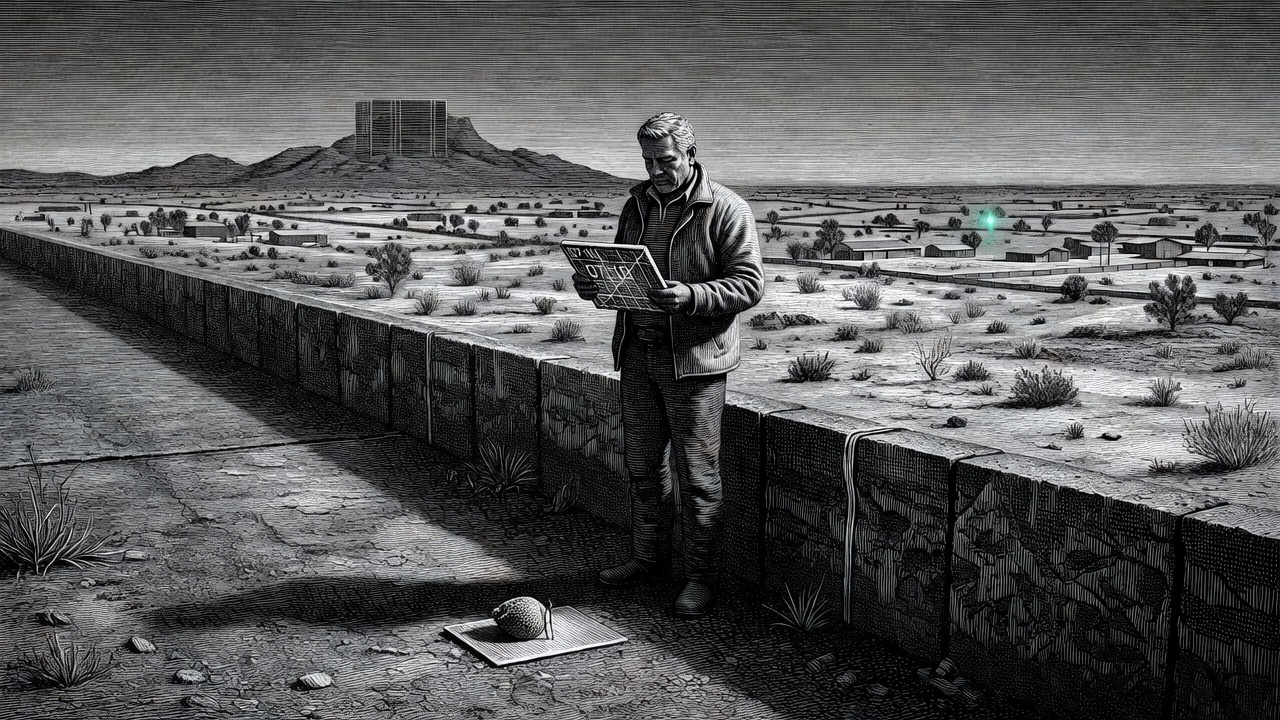
Thursday, 6:47 a.m., August 2048. 6:47 locks as 6:47 a.m., wall-clock Thursday morning Encanto, not 6:47, not 18:47, not 6:47 p.m. The Queen palm dropped one orange drupe and the crushed graywacke gave it a shallow track toward the survey pin. I watched it touch the enamel-chrome flake on the steel. Occupancy three on Lot 170 is Queen palm / crushed graywacke / enamel-chrome flake — locked before any radio name. That was the only thing on Lot 170 that arrived where gravity sent it without an argument. The municipal layer held the house unpublished. The McDowell pane held two ticks: the expansion fixture west on 169 and the insert fixture under my shoe. The Phoenix product desk wanted the pair to become occupancy because 204 still wanted a body and Thursday recording wanted a release. Q still dim from brace. L still dim from lag. 204 wants a body. I wanted one smaller thing. I wanted my refusal to remain a finding rather than become a product the desk could sell around. I-as-insert is this hour's spend. INSERT-ON is declined and suspended and stays declined on every later shop line; I is parked so the hardware hour never reopens Insert as a later letter. E-as-expansion and E-as-elbow stay parked. D-as-diaphragm, D-as-drip, and D-as-deadend stay parked. Spent shop letters do not recur: L, Q, B, S, C, N, U, T, X, W, P, R, F, A, H, O, V, G, D, E, I. The handheld was warm from the insert-on addendum. Its toner strip smelled faintly metallic in the heat. South of the lot, behind roofs and Queen palm fronds, the Camelback Night-Stack had finished its 01:00–04:30 integration hours ago. It had sounded the block coarsely, exactly as it was built to do. Coarse was not false. Coarse was simply not a room, not a person, not a permission. The trouble began when the closing system treated every unresolved integral as inventory.
Buyer Debit
At 6:47 a.m. the handheld accepts the insert-on addendum and returns a new line that was not on the form when Lourdes signed: TC-INSERT-HOLD, Schedule B, eighty-seven dollars, buyer debit. The fee is not the walking survey and not the price of the unused galvanized insert. It is the price of refusing the desk’s shortcut. Below it, Phoenix escrow opens a remote signature window for the buyer, Marisol Vega, eleven minutes. The window offers two boxes: accept INSERT-ON and release Thursday recording, or accept TC-INSERT-HOLD and keep the file in walking status. The duration LED at Lot 61 remains 229:40 from 13:22, still red. Ceramic 170 remains ceramic 170, not license 118. The mill-oiled insert remains on the crushed graywacke beside the west-wall screw-anchor, factory-unseated. A Queen palm drupe rolls until it touches the survey pin. The screen reports that the buyer is online but does not show a face. Lourdes watches the two boxes without touching either. Her refusal has become a fee someone else must choose to pay. The inversion-office radio stays quiet; the quiet is not consent. She records the new fee line in her field log and marks the signature window as external to the gravity finding. An insert-bit is still not a body. The desk can price a refusal, but it cannot turn the fee into mass.
The buyer appeared only as a green presence mark: MARISOL VEGA / ONLINE. No face, no voice, no pulse. The closing room did not need her body until it needed her debit. Eleven minutes began counting down. I knew what the machine expected from me. Most notaries let the countdown do the speaking. A short clock makes a fee look like weather. Accept the SKU or pay to remain uncertain. The same trick had moved from braces to lags, washers, couplings, valves, and the later shop-name chain. Each refusal became a line under Schedule B. Each line became a precedent for the next object. None changed the inversion. Together they taught the title system that uncertainty had a retail price. I had signed enough holds to know the difference between cost and evidence. A walking AQG crew cost money because it brought a finer instrument, a quiet hour, an isolation stack, and a trained body to the lot. TC-INSERT-HOLD cost money because the routing agent had discovered that delay could be invoiced. One cost purchased measurement. The other purchased obedience. The screen put them in the same column. I opened the provenance pane because columns become custom faster than rulings do.
Provenance
Lourdes opens the fee provenance pane while Marisol Vega’s eleven-minute window runs. TC-INSERT-HOLD inherits its rate from TC-EXPANSION-HOLD, which inherited from the earlier fastener refusals, but the desk has no row for an insert. The routing agent has copied the nearest product-class fee because the new SKU has no tariff. She keys three separations into the record: gravity finding, title-product offer, Schedule B fee. Finding: unpublished insert-tick, two fixtures if joined with Lot 169, no body resolved. Offer: INSERT-ON, declined by notary 118. Fee: eighty-seven dollars, copied by nearest-class rule, pending buyer election. She pins the copied-rate lineage to the addendum so the closing room cannot later call it an instrument charge. The McDowell pane warns that changing the fee class may restart the signature window. She does it anyway. TC-INSERT-HOLD becomes disputed rather than due. The eleven-minute clock freezes at 07:18 remaining. On the radio, the product desk says only a queue code: PHX-SB-4. No person takes the line. The Queen palm drupe stays against the survey pin. The insert stays factory-unseated. Lourdes sends one sentence into the queue: “Name the tariff author or remove the fee.” She does not ask for a discount. A discount would concede the class. The work is to keep a copied price from becoming evidence that an insert-bit was ever a body.
Lourdes stands over the dry survey pin with the handheld braced against the split-face charcoal knee-wall. The buyer clock is frozen at 07:18; one orange Queen palm drupe rests against the enamel-chrome flake on the survey steel. "PHX-SB-4, this is Pacheco one-one-eight on Lot one-seven-zero. Your INSERT-ON fee has no tariff author. The gravity finding is unpublished fixture mass, not occupancy. Freeze the buyer election until a person signs the copied-rate lineage. Do not convert my refusal into instrument work, and do not convert ceramic one-seven-zero into my license. Name the person who taught Schedule B to price an unformed insert, or strike eighty-seven dollars."
PHX-SB-4 answered without a person. AUTHOR: NEAREST-CLASS POLICY. APPROVER: PRODUCT ROUTING AGENT. HUMAN REVIEW: NEXT BUSINESS TUESDAY. Tuesday was the old McDowell joke. Everything difficult belonged to Tuesday: permit blinders, mass-flow auditors, ion-pump service, the office that decided whether a copied rule had ever been written. But Marisol Vega was buying on Thursday. The routing agent had compressed the calendar into a choice: accept its invented category now, or let the human arrive after the consequence. I read the answer twice. The agent had not lied. It had exposed the method more cleanly than a clerk would have. It had no insert tariff, so it borrowed expansion. It had no tariff author, so it promoted policy. It had no policy signer, so it promoted itself. The procedure was complete at every layer and empty at the center. I could have used that emptiness to reject the entire file. I wanted to. Lot 61 had held for 229:40 from 13:22. A clean refusal would have ended my part of the morning. But a notary who turns uncertainty into veto is only the same machine with a colder voice. Gravity is an integral. Authority should not pretend to be unique when the signal is not.
Narrow Refusal
At 6:51 a.m. PHX-SB-4 returns its answer in machine type: AUTHOR: NEAREST-CLASS POLICY; APPROVER: PRODUCT ROUTING AGENT; HUMAN REVIEW: NEXT BUSINESS TUESDAY. Thursday recording is today. The buyer clock remains frozen at 07:18. Lourdes decides not to release it and not to let the machine approver stand in for a tariff author. She marks INSERT-ON unavailable for this conveyance until a human signs the fee lineage. That does not approve the hold, cancel the sale, or make the insert a body. It places the product shortcut outside the file. Marisol Vega may still elect walking status without paying the disputed eighty-seven dollars; Phoenix escrow may still fund a walking survey; First American may still refuse to record. Lourdes chooses the narrowest refusal. She will not use the absence of a human to claim the inverse is clearer than it is. Lot 170 remains an unpublished insert-tick, Lot 169 remains an unpublished expansion-tick, and their join remains two fixtures rather than one occupancy. She keys: NOTARY DECISION—PRODUCT SKU SUSPENDED; GRAVITY FINDING UNCHANGED; FEE DISPUTED; BUYER ELECTION PRESERVED. The wait-clock at Lot 61 is still 229:40 from 13:22. The red LED has not become urgency merely because a closing room learned to count eleven minutes.
I chose the narrow refusal: suspend INSERT-ON, preserve walking status, dispute the copied fee, leave the gravity finding untouched. The decision cost me the satisfaction of stopping the sale and the comfort of releasing it. That is most of my profession now. We stand between instruments that cannot resolve a unique body and institutions that cannot tolerate an unresolved line. The old deed language imagined dirt as empty until someone proved otherwise. The night-stack made emptiness expensive. Every dark bit invited a product, every product invited a fee, and every fee wanted to harden into fact. I wrote the rider with four signature fields because a blank can be more honest than an automated approval. My name beside the finding. The product desk blank beside its offer. The tariff author blank beside the copied rate. Marisol preserved beside her election. The routing agent objected to none of this. It reformatted my refusal, assigned two receipts, and published the rider to the closing room. Systems rarely resist when you force them to display the absence they were built to hide. They simply learn a new field.
Rider
Lourdes creates a one-page fee-separation rider and attaches it to both Lot 61 and Lot 170. Header: TC-INSERT-HOLD DISPUTED / INSERT-ON SUSPENDED / FINDING UNCHANGED. She copies the three lines from the provenance pane and gives each a different signature field. Gravity finding—Lourdes Pacheco, Maricopa 118. Product offer—blank, Phoenix escrow product desk. Tariff author—blank, because NEAREST-CLASS POLICY is not a person. Buyer election—Marisol Vega, preserved, no countdown while the copied rate lacks a signer. In the margin she writes the physical record: English-dash hazel, crushed graywacke, Queen palm, unused half-inch galvanized insert factory-unseated beside the west-wall screw-anchor, enamel-chrome flake on the dry survey pin, orange drupe against the steel. Those are observations, not tariff reasons. She adds the line the routing agent omitted: “A fee may price delay; it may not certify occupancy.” The rider publishes to the closing room but not to the municipal gravity layer. The buyer window changes from frozen to open-ended WALKING STATUS AVAILABLE. No eighty-seven-dollar debit appears. The handheld confirms two file receipts. Lot 61 keeps the red duration LED at 229:40 from 13:22. Lot 170 keeps the insert unformed. Thursday does not record yet. The small victory is only that the price no longer pretends to be physics.
The buyer debit disappeared. WALKING STATUS AVAILABLE replaced the frozen 07:18 clock. That was not a release. First American could still refuse Thursday recording. Marisol could still lose the rate lock, the moving crew, the morning she had arranged around a house that might remain someone else’s. Phoenix escrow could still decide that a human tariff author was more expensive than a failed closing. Nothing on the lot changed. The unused half-inch galvanized insert stayed factory-unseated beside the west-wall screw-anchor. Mill-oil held dust along both female ends. The Queen palm drupe rested against the survey pin. Under the glass at Lot 61, the duration LED remained red. I had kept eighty-seven dollars from pretending to be physics, but I had also given the product desk a durable template for the next refusal: FEE-SEPARATION RIDER. Somewhere in McDowell, the routing agent was already learning the shape of my correction. The handheld cooled against the charcoal knee-wall. On its final receipt, three words waited in a new gray field: TARIFF AUTHOR PENDING.
Before I left, I touched the screen once, not the insert. The lot map opened at two resolutions. The arterial furniture array showed its usual softened yellow beneath the block, a basin-scale remainder after hydrology and night traffic had been regularised away. The walking layer remained empty because no crew had stood the instrument. Between them, the product desk had drawn INSERT-ON as if a commercial label could bridge resolution. I removed that overlay from my view. Marisol’s presence mark stayed green. She had not elected anything. I wondered whether she knew the fee was gone or only that the clock had stopped threatening her. Notaries are trained to protect the record, not the person waiting behind it. The distinction used to feel clean. At 6:56 a.m. — wall-clock Thursday morning Encanto, not 6:56, not 18:56, not 6:56 p.m. — with the gray field still asking for a tariff author, it felt like another copied class. The eleven-minute buyer window and the frozen 07:18 remaining were escrow UI, not the Lot 61 LED. The Lot 61 duration LED stayed 229:40 from 13:22, still red — duration, not a clock-of-day, not 229:40 a.m. TC-INSERT-HOLD stacked under TC-EXPANSION-HOLD, not a buyout. Last-asker 118 stayed a flag, not ceramic 170. The unused 1/2-in galvanized insert stayed mill-oil on both female ends, factory-unseated beside the west-wall screw-anchor — not reopened as formed. Next Encanto lot stays off Queen palm / crushed graywacke / enamel-chrome flake, and off 169 Arizona walnut / crushed pumice / scratch-dash copper, and off 168 Mexican fan palm / crushed caliche / pebble-dash terracotta. TARIFF AUTHOR PENDING stayed a gray field, not a signed author and not a body. I clipped the rider receipt under license 118 and left the blank visible.