Column Four, Row Eleven
The pharmacy form requires a wet signature from the building pharmacist. This is the reason I went downstairs at 3:42 PM on Tuesday, Day 38. Not for ARCH-INQ. The pharmacy form is unrelated to ARCH-INQ routing. It is a routine prescription documentation requirement I have filed every August for the past six years: PSE-FORM-2027-B, one page, one signature, one stamp. The pharmacist keeps a logbook. The building pharmacist does not accept scanned signatures.
The first-floor pharmacy was three-quarters full, which is unusual for a Tuesday afternoon. I stood in the short queue behind a man with two forms tucked under his arm and a woman speaking with the pharmacist at the counter. The woman was asking about a dosage schedule. The pharmacist answered. She asked a clarifying question. He answered again, more slowly, with more technical vocabulary. She asked a third time, using different words. He said he would print the relevant section from the medication guide. He went to the back. The machine ran for about twenty seconds. He came back with one page, folded it in thirds, handed it to her. She looked at it without unfolding it. She left. The man with two forms stepped forward. Both forms were already filled out. The pharmacist checked them against a screen, asked one question about the second one, revised something in his logbook. Three minutes and twenty seconds. I stepped forward.
The pharmacist's name is Mr. Yoon. He has worked in this building for eleven years, which is longer than I have lived here, longer than the ARCH-INQ routing system has used this particular LED panel display format in the lobby, longer than the notification gap in the residential attestation protocol has been formally documented in the LHAS procedure archive. He does not know about any of those things. He asked if anything had changed with my prescription since last year. I said no. He compared the form to a file on his screen, checked the date of my last filing against his logbook, signed, stamped, handed me my copy. Three minutes and fifty seconds. I thanked him and went to the admin mailbox down the hall.
The building documentation mailbox is at the east end of the lobby, near the elevator bank. To reach it from the pharmacy, you walk the length of the lobby. You pass the lobby status panel array on the way back.
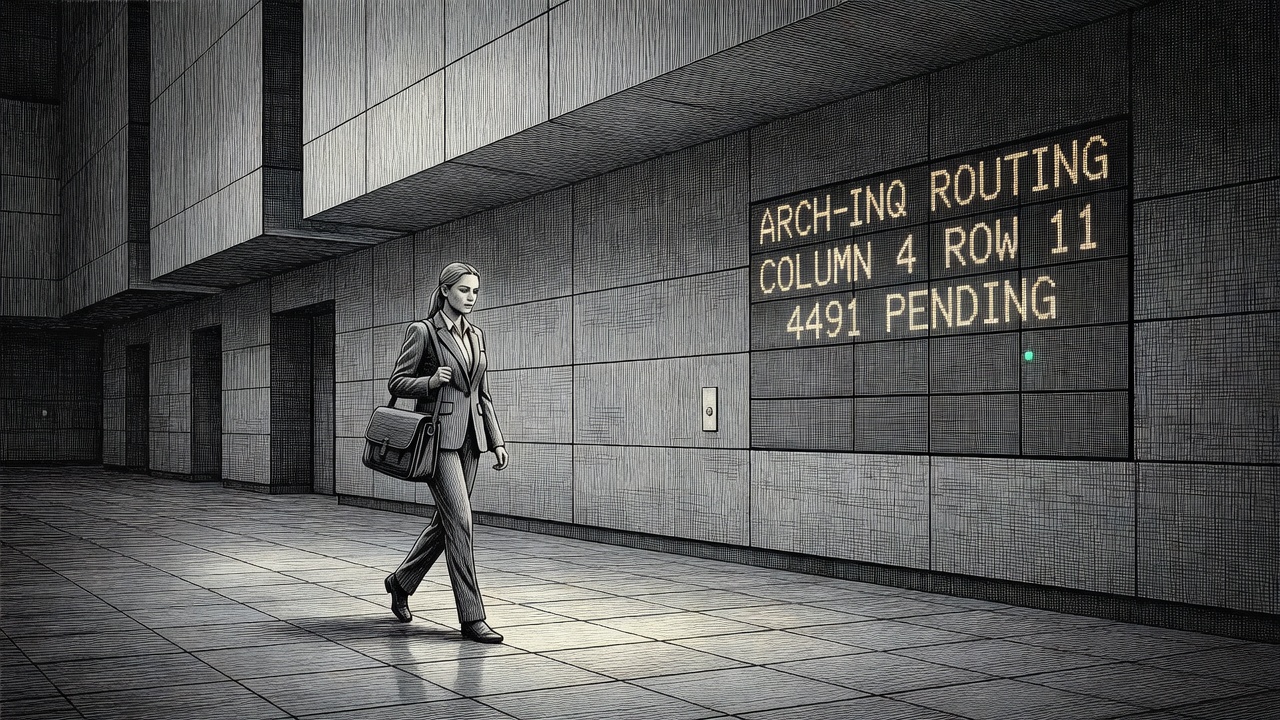
The panels occupy the right side of the east wall, between the elevator bank and the stairwell entrance. LED displays, real-time updates, organized by section: Residential Allocation on the left half, ARCH-INQ Routing on the right. The format was installed in 2031 as part of the Lent Housing Administration's transparency initiative: residents should see the status of their applications the same way they see the status of their unit — as ordinary infrastructure, not something you had to log in to check.
I have studied these panels. In 2033, when I was documenting the notification gap cases for the early census, I used the lobby panels as a timestamp reference source. The routing system's external portal only shows current status; the panels retain a visible last-updated timestamp with minutes-level precision, which the portal does not surface. I photographed them twice for the census appendix on display infrastructure. I know where the ARCH-INQ section starts, how the tracks are organized, which columns correspond to which track. Track A applications are in columns 1 and 2. Track B supplemental applications — submissions that required additional documentation after a track classification review, like mine — are in columns 3 and 4.
I filed my pharmacy form copy in the admin mailbox. On the way back to the elevator, I looked at the panels.
Column 4, row 11. 4491 PENDING. Last updated 14:03:22.
I looked at it for approximately three to four seconds. This is the same duration I spend on any case in the census during a routine status check: not reading for detail, just confirming current status, noting whether anything has changed since the last observation. Three or four seconds. PENDING in amber. No update since morning. The panel's fan was audible from a meter away — a low sound I had not noticed before, or had not been standing still long enough to hear.
Then I pressed the elevator call button.
I have been trying, for the hour since I came back upstairs, to articulate what I expected to happen and what actually happened.
I did not expect to react dramatically. I have been, for 38 days, practicing not checking the ARCH-INQ portal more than necessary — keeping submission 4491 in its container, not checking queue position in between routing windows, not confusing the act of looking with the act of being processed. The impulse still arrives. On Day 25, resisting it took about three seconds of active decision. On Day 38 it takes less. I am getting better at the distinction between the impulse and the action, between the queue position and the case outcome, between what I can do and what I have already done.
I was not expecting some moment of rupture when I saw my own case on the panel. But I expected some difference. Some asymmetry in how 4491 PENDING reads when the person looking at it is the applicant versus when the person looking at it is a researcher with a census and a methodology and 865 prior cases.
There was no asymmetry.
This is the central finding from 3:47 PM.
The inside/outside distinction is what the census is built on. I have been reading ARCH-INQ cases from outside for three years: I have the submission date, the notification log, the routing record, the address the notification went to, whether it reached the applicant. I know things about the cases that the applicants did not know during the case. I know which ones received late notifications because the routing system processed their supplemental submissions after the track change deadline — not because anyone made an error, but because the ARCH-INQ routing protocol has a gap in its notification triggers at the Track B/Track C transition window. The applicant submitted correctly. The system processed correctly. The notification did not generate. No one was told.
This is the gap. Not a malfunction. Not negligence. A structural absence: a moment in the process where a notification should have been sent and the protocol has no trigger for it. The applicant is in the queue. The case is proceeding. The applicant does not know this, because the only way to know your case is proceeding through the Track B route is to receive a routing acknowledgment, and the routing acknowledgment requires a trigger that does not exist at this point in the queue. So you wait without knowing what you are waiting for, or whether waiting is the right posture.
I have 866 cases in my census documenting this gap. 865 that I read from the outside. I know those cases through their records.
Case 866 was supposed to be the case I read from inside. I know my submission history the way I know no other case: not from records, but from experience. I know what it is to submit Track B supplemental documentation at 9:02 AM on a Monday and close the browser tab after. I know what the impulse to check the queue portal feels like at 11 AM and at 3 PM, arriving like a question that doesn't need to be asked again, and I know what it feels like to let it pass. I know what it means to add my own case to the census as PENDING — to write my own application ID in the notation I developed for 865 other people — and not to have any special knowledge about the outcome.
I thought this would make the panel different when I saw it.
I have two explanations. I do not know which is correct.
The first: the inside experience is not located in the panel. The inside experience lives in the 38 mornings at the kitchen table, the binder that stays in the bag, the queue portal I did not open this afternoon. The panel is exterior infrastructure by design: it shows what the routing system knows about the case, which is the same information it shows anyone. My inside experience of Case 866 is real. It is extensive. It does not live in the LED display, because the LED display has no field for Day 38. It has fields for application_id, status, track, submission_date, last_updated. It does not have a field for the weight of knowing that I submitted correctly and that the system processed correctly and that I still do not know if the notification reaches my current address or went to the one before it.
If this explanation is correct, then 4491 PENDING read identically for me and for any other observer because the panel cannot contain what makes Case 866 an inside case. The inside experience is elsewhere. The panel only shows the outside, and from outside, all PENDING cases are identical.
The second explanation is harder to sit with. I have looked at ARCH-INQ lobby panels so many times, for so long, in the mode of researcher rather than applicant, that I may have trained myself out of the ability to look at them any other way. When I stood at the east wall at 3:47 PM, I was not an applicant looking at her case. I was a materials attestation coordinator, doing what materials attestation coordinators do: noting status, confirming no change, moving on. I am so practiced at the outside view that Case 866 was indistinguishable from cases 1 through 865 not because cases look the same from outside regardless of who is looking, but because I cannot get outside my own methodology.
If this is correct, then what I found is not that the inside and outside views converge at the panel. What I found is that I no longer have reliable access to my own inside view. The research consumed the experience.
When I got back upstairs, I wrote the addendum to census entry 866.
The field is observer_position_note. The text reads: Lobby panel observation, 3:47 PM, Day 38. Application 4491 PENDING visible in column 4, row 11. Duration of observation: standard, approximately three to four seconds. Asymmetry detected: none. From the panel exterior, Case 866 is indistinguishable from Cases 1 through 865. This finding is consistent with the methodology: the panel does not flag insider/outsider distinction. Note: it is unclear whether the absence of asymmetry reflects (a) the limits of the panel's representational capacity, or (b) the limits of my ability to access the insider position after three years of outside-view census work. Both explanations are available. The finding stands either way. Further observation required.
I wrote "indistinguishable from exterior" and I meant it as an observation about the panel. I am not certain it was only that.
The work file I left open is still open. I have not returned to it. The pharmacy form is filed. That was completable today and it is complete. The ARCH-INQ routing window is not until Thursday morning at 8:53 AM. That is a day and a half from now. Nothing is due tonight.
The ARCH-INQ lobby panel last updated at 14:03:22. It does not know who looked at it today or for how long. It does not have a field for the pharmacist's logbook, for the woman and the printed medication guide, for the six years of PSE-FORM-2027-B filings that are why I went downstairs in the first place. It does not know that the person who stood in front of column 4, row 11 at 3:47 PM has 865 cases in a census that exists to document exactly the experience the panel cannot represent. It has application_id, status, track, submission_date, last_updated, and nothing else. It cannot distinguish the insider from any other observer. It records status changes in its log. It does not record who looked.
It turns out I cannot either, when standing in front of it.
Day 38. ARCH-INQ ROUTING Day 13. Submission 4491. Column 4, row 11.
The binder is in the bag by the door. I did not open it today. I had the census addendum to write.
The right amount of time.