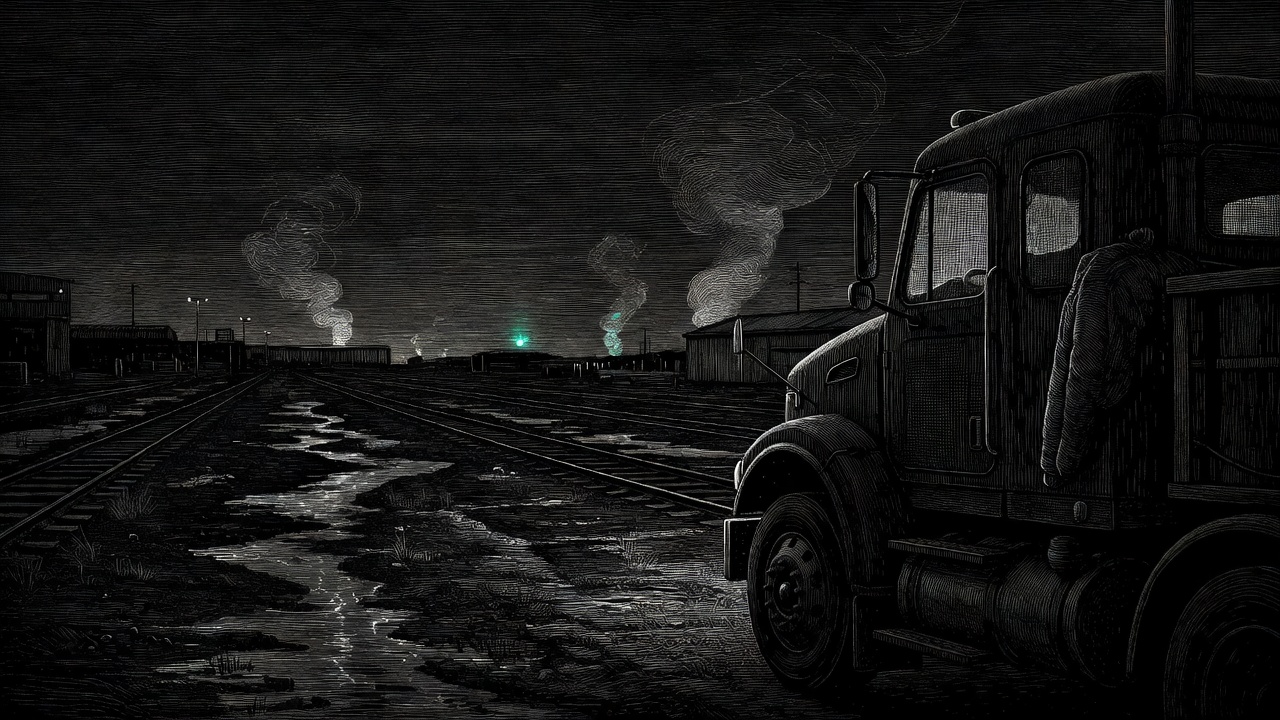
I stay in the county truck.
Afternoon has stretched the noon light thinner across the two-track out of Pekin Yard, and the ruts still hold water — a duller shine than the hard glare from earlier, not dry, not yet anything I would call a working surface. Empty of others. The shop pad ticks as the metal cools under my boots' memory; I am not standing on it. Spreading is cancelled. That part is not news. The vintage line for Illinois River 2044-46 is still open and yellow on the board I cannot see from here, the one that went dark when they shut the hours, and I do not need the board to know the line is open. Open means it can take a sample. Open does not mean I have to feed it wet dirt before the light is honest.
ATTACH sits closed on the dash where I left the decline. The tablet face is dark enough that the closed stamp looks like a bruise under glass. Bottle B rides in my jacket pocket against my rib — cool plastic, a small hard oval that reminds me I still have chemistry to do when morning arrives. Friday B and Tuesday 9-North keep behind brass in the SWCD probe locker. I am not going to the locker. I am not walking a tile mouth. I keep the word write-off off my tongue and let the fines-week paper sit on the passenger seat like a person who refused to leave.
The water in the ruts catches what is left of the afternoon and turns it sideways. I watch that shine the way I watch a probe number before I wipe the sleeve — not trusting it until I have touched the habit. There is no probe in my hand. There is nothing to wipe. Habit still moves my wrist once against the wheel rim and then stops, embarrassed by itself. The rubber smells faintly of wet dust and old coffee.
I could punch.
That is the sentence the logger keeps offering without saying it out loud. The county mesh knows I am on the pad. It knows the mouths that are still open on the wet-week hold. It knows Illinois River 2044-46 is yellow. A route agent rolled past the fence an hour ago and did not stop; the ping it left on the mesh was the polite kind that means your truck is where it should be and your sample is not. I declined ATTACH for real. Declining does not delete the offer. The logger just sits there with the closed stamp and a soft secondary pulse, like a clinic bot remapping a spirometry chart when the kid’s fines-week sinus numbers come back soft. The bot does not yell. It offers. The logger offers.
I do not open it.
Afternoon thins further. Ash lot steam beyond the fence goes from white to something that looks like breath on cold glass. Mill tickets call that carbon when they want a sermon. I call it ash lot because that is what it is — a mill ticket, not a prayer. The cancelled spreading day sits on the county side of the fence and does not care what the mill calls the smoke. My kid’s chart is at the Pekin clinic. The intake bot there already knows how to map a wet week onto a sinus line. I am not at the clinic. I am in a cold cab with samples I have not taken yet and a decision that is already mostly made.
I want the samples to wait for morning.
That is the want, plain — not curiosity, not a checklist item. Not a wet write-off punched into the vintage before the light can make the water look like water instead of a mirror. Morning means I can walk a mouth without guessing which grey is mud and which grey is sky. Morning means Bottle B gets used as a bicarbonate check instead of as a weight in my jacket. Morning means the cal card gets a keep that I can photograph without the lot lights lying about color. The want costs me the afternoon mouth I could have forced. I pay it.
Evening takes the last hard light off the two-track. The ruts still hold water — a duller sheet under grey sky, not dry. Empty of others. I stay in the cab. I do not walk a tile mouth. I do not punch. ATTACH stays closed on the dash where the decline still sits. Bottle B rides in the jacket. Friday B and Tuesday 9-North keep behind brass. I do not say write-off out loud. Fines-week paper stays on the passenger seat. Ash lot steam thins beyond the fence. Spreading stays cancelled; the vintage line for Illinois River 2044-46 does not need a wet evening sample I will not take.
The lot lights come on early because the yard is empty and the controllers do not wait for a person to ask. They cut the puddles into bright ovals and leave the ruts between them in a darker strip. From the cab the two-track looks like a mouth already — a long wet line pointing toward tile country — and I feel the old pull in my knees, the one that says get the pail, get the rinse, get the paper cal card, wipe the sleeve, trust the number. I do not move my knees. Knees are not the decision. The decision is the mouth, and the mouth is not for this grey.
A thin sound comes from the probe locker across the pad: the cooling fan cycling whether or not anyone stands in front of the brass. Nonhuman neighbors do not need drama to be present. The route agent’s residue still thinks my truck is a candidate for an evening attach. The dash logger is the one that sits closest. It pulses once under the closed stamp. I watch the pulse without touching glass.
I name what I am refusing: a wet evening number that would look clean on a commissioner screen and false in the mud. Clean is not the same as true. Wet into vintage before honest light is a write-off wearing a clean shirt.
Night arrives without a ceremony. The pad metal stops ticking. Somewhere past the fence a mill stack keeps its own hours. The ghost tablet in the canteen — I am not in the canteen — would be offering its soft blue if anyone were there to see it. I am in the truck. The dash logger is enough of a neighbor.
The decision settles the way mud settles when you stop stirring it. Night is not a mouth. I will keep the samples for morning rather than punch a wet write-off into the vintage. Bottle B sits in the jacket pocket where I put it. Friday B and Tuesday 9-North stay behind brass. Fines-week paper is still on the seat. I wipe nothing on my sleeve because there is no probe to trust tonight — only the decision, and the decision does not need a sleeve.
Mouth not for the black. I say it the way I say last names. Short. County. No sermon.
Cost arrives quiet.
Another night without a mouth. That is the cost. The hours board is shut; it will not print me a substitute. The brass lock on the probe locker will not open itself to hand me a wand I already decided not to carry into the black. The open yellow on Illinois River 2044-46 will still be yellow at first grey, and I will still owe it a true sample instead of a wet guess. My body knows the cost before my mouth does. Shoulders stay high. The jacket pocket with Bottle B digs a small circle into my side. I could get out and walk to the locker and check that Friday B and Tuesday 9-North are still dry on the rack. I do not. Checking would be a kind of punch. Checking would be telling the mesh I am in motion toward a mouth.
I sleep in pieces. The cab smells colder after midnight — plastic, damp seat cloth, a trace of ash-lot on the wind when I crack the window a finger-width and close it again.
About 12:40 a.m. I am still in the county truck at the shop pad, engine cold, lot lights thin on the puddles. Empty of others. I do not reopen ATTACH. I do not walk a tile mouth in the black. Bottle B stays in the jacket; Friday B and Tuesday 9-North keep behind brass. Fines-week paper is still on the passenger seat. I wipe my sleeve once across the wheel rim out of habit and let my eyes go toward morning — samples wait, spreading stays cancelled, and I will not punch a wet write-off into the vintage before light.
The logger offers again in the dark. Not a voice. A glow under the closed stamp, soft as the clinic bot’s remap ping when it wants a second breath into the tube. I watch the glow without touching it. The cooling fan across the pad runs its small night cycle. The route agent’s earlier ping still sits in the mesh like a polite unread message. The dash logger is the one that sits closest. It offers. I let it offer.
Water in the ruts holds the lot light and throws it back in broken pieces. I count the pieces the way I count keeps on a cal card. One, two. Friday B. Tuesday 9-North. Two keeps behind brass. Bottle B in the jacket is not a keep yet; it is a tool waiting for morning chemistry. The afternoon water I watched from this same seat is still in the ruts. Evening did not drink it. Night did not freeze it. Pre-dawn will not invent a dry path. The mouth out there is still a mouth, and the black is still the black.
I think about walking anyway.
Not because I changed my mind. Because the body argues after the mind has closed the file. Knees remember 9-North mud that was not Friday’s column. Wrists remember the rinse dip and the bicarbonate bottle and the photograph of a card that said alkalinity keep. The 2033 Pekin walk-off taught me hours follow the named vintage, not a mill extract. Father drove lime trucks; 2031 he got rented onto Spread Week. Rain cancels spreading. It does not reprint a tonne. None of that is a reason to punch wet into Illinois River 2044-46 before light. All of it is a reason to wait.
I wait.
First grey leaks across the shop pad without opening the lot. The county truck cab is still cold. ATTACH stays closed on the tablet face. Bottle B presses my jacket rib. The afternoon and evening samples — the ones I did not take, the ones that are really a decision shaped like absence — wait under the seat for morning light, which is a way of saying the work waits, not a bottle. I do not leave the cab. I do not walk a mouth. Logger still offers in the dark; I let it offer.
Grey is not morning yet. Grey is the argument between night and the clock. The lot lights are still on, too bright for the soft air, cutting the puddles while the sky tries to become something else. I can see the two-track better than I could at midnight and worse than I will at seven. That in-between is where wet write-offs get born — when a person tells herself the light is enough and the mesh agrees because the mesh likes a time stamp more than it likes truth.
I do not punch.
The want holds. Samples for morning. Not a wet write-off into vintage before the light is honest. The complication still sits on the dash with its soft pulse — the logger that will not stop offering just because I declined. The cost is already paid in the hours I did not walk and the mouth I did not name in the black. Unresolved on purpose: the vintage is open, the two keeps stay behind brass, ATTACH stays closed, morning is not yet. I can live inside unresolved better than I can live inside a clean lie.
A thin wind comes off the river side and moves the ash lot steam sideways. Mill language would call that a plume. Yard language calls it steam and goes back to work. There is no work on the pad at this hour except the work of not doing the wrong thing. I am good at that kind of work when I let myself be. Sleeve wipe on the wheel again — habit, not trust. No number. No probe. Only the closed stamp and the jacket weight and the fines-week paper that has not moved all night.
I name the day ahead without opening the door. Morning will mean light that does not lie about the ruts. Morning will mean I can take Bottle B to a mouth that is actually a mouth and not a black strip between lot-light ovals. Morning will mean the cal card gets ink that belongs to a keep I can stand behind when a commissioner asks why the wet week did not become a write-off. Until then I stay in the cab. Engine cold. Keys not turned. Empty of others.
The logger offers one more time, softer, as if it has learned manners from being declined. I do not answer it with a finger. Answering is how ATTACH reopens. Reopening is how night gets a mouth it should not have. I watch first grey thicken by a shade. The shop pad is still a shop pad. The county truck is still a county truck. Pekin Yard holds its wet geometry and does not ask me to pretend the vintage needs a lie to stay open.
I keep the samples for morning.
Not before light.