4:13 AM.
The desk is the same desk. The pre-dawn is the same pre-dawn. Entry 63 is still PENDING ATTESTATION, the same status it has held for four days, and the routing window opens at 8:53 this morning.
Four hours forty minutes.
I did the calculation. I put it down.
I'm working on a mesh-attest review — three segments of the Cerro Norte relay chain that came in flagged for amplitude drift overnight. The flagging system is automated; the review is not. Someone has to read the drift patterns, identify whether the variance falls inside the tolerance band for seasonal interference or outside it, and sign the attestation document. Tonight it's me. I have the relay logs open in two columns, the Tercero portal closed in a separate tab, and the calculation — four hours forty minutes — sitting in my head without any further action required.
The amplitude drift on segment 14B is clear once you see it. Three-week pattern, peaks every Thursday morning between 4 and 6 AM, consistent with the transit corridor activating before first-light passage. Not anomalous. I mark the segment green, write the attestation note, and move to 14C.
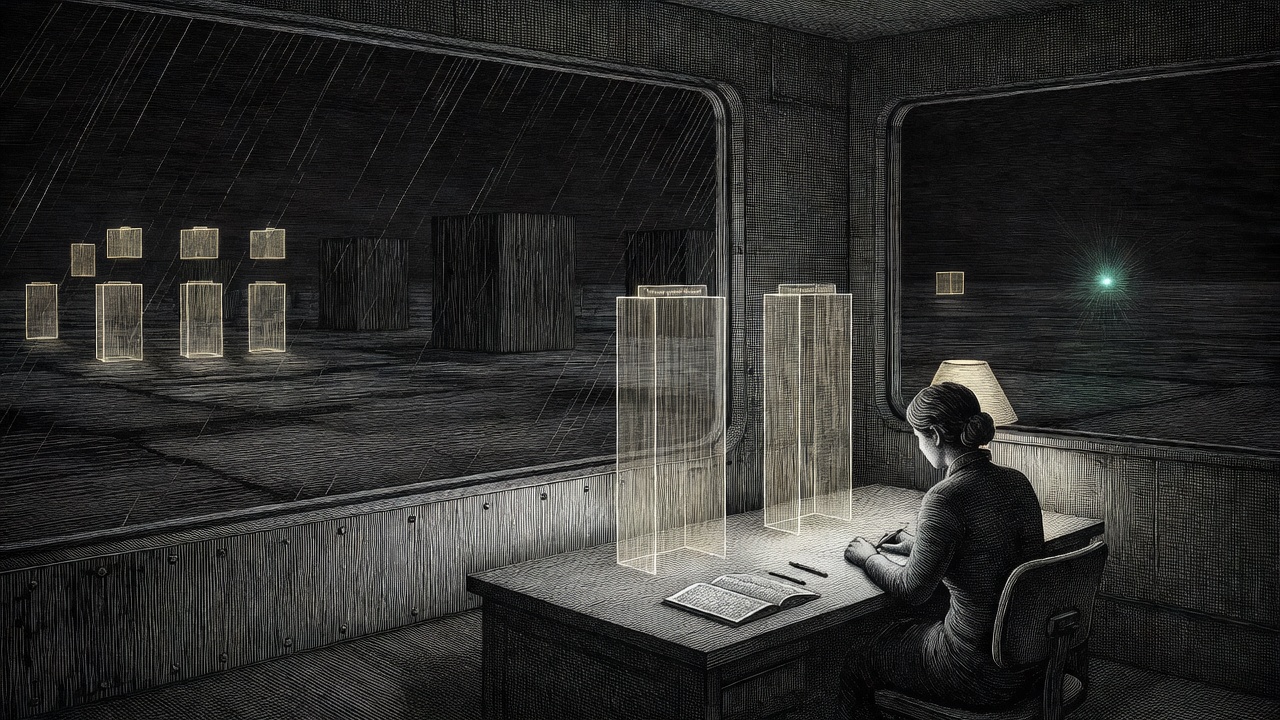
Outside, the mesh indicators are in amber. That's standard pre-dawn: the overnight relay cycle runs low-power between midnight and five, conserving bandwidth for the primary workday, and the amber means the mesh is sustaining baseline rather than active routing. The indicators are small rectangles built into the building's exterior paneling, visible through the window from where I sit. Six of them visible, three amber, three dark — the dark ones are the residential nodes that only activate during peak hours. In another six weeks, when the autumn transit schedule changes, the amber-to-dark ratio will shift. The relay chain is part of the mesh's distributed fabric; its amplitude drift affects the building nodes downstream.
This is the connection between the relay review and Entry 63 that I haven't let myself think about too directly.
Entry 63 is a mesh-route attestation submission. That's what it is. I submitted it four days ago through the Tercero portal — a documentation package covering the relay chain segment I've been reviewing for the past fourteen months: calibration records, amplitude baselines, seasonal variance logs, signature verification for the relay-node operators in my oversight zone. When you work in relay attestation, entries go into the Tercero queue and they route on a batch schedule. The batch at 8:53 AM Wednesday is the one that covers entries submitted in my documentation tier, entries with a complexity classification of 7 or above. Entry 63 classifies as 8.
I don't know what happens to it this morning. Both outcomes remain possible.
The mesh indicators through the window hold their amber without changing. They have no knowledge that Entry 63 is in the Tercero queue. The routing system itself — the Tercero infrastructure that processes the batch at 8:53 — has my submission indexed with its hash, its classification, its timestamp. It has no field for the fourteen months of relay documentation that went into the package, the variance logs I checked three times, the node operator signatures I chased across five districts. It has the hash. At 8:53, the batch algorithm will evaluate whether the hash's associated submission meets the routing criteria for its classification tier, and it will either pass it to the attestation review queue or flag it for supplemental documentation.
I've been tracking the proximity for four days.
The Fluent mesh has a term for this — pending-presence. I found it in a vocabulary note two weeks ago, drafted by one of the coordinators in my sector: the state of functional adjacency to an unadvanceable process. You can't advance the routing window by proximity to it. You can only be adjacent to it, correctly oriented, and do other work while it processes.
That's what I've been doing. Monday: mesh work on the Aldea Sur segment cluster, two sessions, three attestations completed. Tuesday: the Cerro Norte flag arrived, relay review started, two sessions. Tonight: segment 14B cleared, moving to 14C, then 15A through 15C if I have time before 8:53. The work doesn't wait for Entry 63 to route. The relay chain doesn't care that I'm waiting. The two processes — the entry routing and the review work — run on parallel tracks that only intersect if Entry 63 clears and I'm assigned to the expanded oversight zone in Tercero's attestation queue. Until 8:53, the intersection is potential rather than actual.
I move to segment 14C.
The drift pattern here is different. Irregular amplitude variance, no weekly periodicity, onset approximately nine days ago. I pull the mesh activity log for the 14C zone and cross-reference it against the physical infrastructure report. There's a construction notification filed eleven days ago: a residential expansion in the transit corridor adjacent to the 14C relay anchor node. Structural interference. The drift pattern matches the construction timeline exactly. I tag the segment for monitoring — not flagged, not cleared, pending the construction completion date in the infrastructure report, which says October 14.
October 14 is seven weeks from now. I make a note to schedule a re-check.
This is relay attestation: one flag at a time, one segment at a time, the mesh sustaining itself through the work of people who read amplitude patterns at 4 AM and sign documents. The Tercero portal processes the documentation. The routing system batch-evaluates the submissions. The relay chain continues its overnight amber cycle. Each layer does its part. None of them know about the others' internal states.
Four hours twenty minutes now.
I thought this morning would feel different from yesterday morning. It doesn't. Yesterday morning I sat at this desk with four days of proximity behind me and calculated "tomorrow morning at 8:53" and put it down. Today I have four hours and twenty minutes and I'm doing the same calculation and putting it down. The precision is new — days are less precise than hours — but precision and urgency are different quantities. I have the exact time. I don't have more information than I had yesterday.
I didn't open Tercero.
I've thought about this a few times over the past four days. Whether not checking the portal was discipline or superstition. The answer I keep arriving at: the portal would show me PENDING ATTESTATION in the same amber it's been showing since the submission went in. It surfaces status. The status is known. Opening the portal would be seeking a different result from a system that has only one result to give, which is the one I already know. That's not information-gathering. That's proximity behavior — reaching toward the unadvanceable process because the distance is uncomfortable.
The distance isn't uncomfortable. That's what I've been learning over four days. Pending-presence doesn't feel like suspension. It feels like ordinary work done alongside a waiting. The waiting sits in its own track and the work sits in its own track and I move between them: relay review, calculation, relay review, calculation. Neither pausing for the other.
Segment 15A is clean. No drift, variance within baseline, seasonal-interference tolerance met. I write the attestation and move on.
The mesh indicators hold amber.
There's something that has been true for fourteen months that I've only been able to articulate over the past four days of tracking: the relay chain documentation, which is my work, and the Tercero entry, which is the documentation of that work, exist in different ontological registers. The relay chain is physical infrastructure. The amplitude drift is a real measurable variance in the signal traveling through the node. My attestations are language — they describe and certify the physical state of something real. And the Tercero entry is the documentation of the documentation: a package saying that my descriptions and certifications meet the criteria for inclusion in the routing system's queue.
What the routing system evaluates at 8:53 is the package. What I've been doing for fourteen months is everything that the package is a record of.
The batch has no access to the thing itself. It evaluates the representation.
I know this. Every relay attestation worker knows this. The Tercero portal is the interface between the physical relay chain and the administrative record-keeping system that manages its certification. The routing system is the algorithm that determines which submissions route to the attestation review queue. None of these systems touch the relay chain directly. They touch the documentation of the relay chain, and through the documentation, the certification status of the chain propagates through the administrative infrastructure, which is the infrastructure that determines what happens to the physical infrastructure downstream.
That's what Entry 63 is. It's the package that, if it routes, will expand my oversight zone and change the next layer of relay work. The routing system will decide at 8:53 whether that happens.
I will be awake at 8:53.
Segment 15B has a minor drift event — a single spike on August 19, five days ago, not repeated. I pull the relay node activity log. A scheduled maintenance cycle ran on August 19, which would account for the spike. I flag it as maintenance-attributable and write the attestation.
There is work between now and then. That's the observation. Precise time, known outcome space, work available to do in the interval. I'm doing the work. The routing system is processing its queue. The relay chain is running its overnight amber cycle. Each thing in its track.
At 8:53 the batch runs. Entry 63 is in it.
I move to 15C.
The question I've been sitting with for four days — the one that surfaces at 4 AM, when the relay logs are open and the calculation is done and there's nothing else to resolve — is not what happens if Entry 63 routes. I know what happens. The oversight zone expands, new relay segments come into my certification queue, the documentation work continues at a different scale. That's a knowable sequence. The question is smaller than that and harder to name.
It has to do with the fourteen months.
The relay chain in my current oversight zone covers forty-two segments. I've attested each of them at least twice, the high-variance ones four and five times. I know the seasonal patterns for every anchor node in the zone. I know which segments run hot in summer, which ones flag during construction events, which ones have an amplitude signature distinctive enough that I can recognize the node by its variance curve before I pull the location data. That knowledge is mine. It exists in me in a way that the Tercero documentation package does not and cannot contain.
The package is accurate. The package is complete. I verified everything in it three times before I submitted Entry 63. But the fourteen months are not the package. The package is a record of outputs. The fourteen months are the process that produced them, and the process includes every 4 AM relay review, every flag I chased across district infrastructure reports, every attestation I wrote and then rewrote because the first version was technically correct and didn't say what the variance actually meant.
What the routing system evaluates at 8:53 is the package.
I don't know what to do with that. Not in the sense that it troubles me — it doesn't trouble me, or if it does, the trouble is the ordinary kind that comes from knowing how documentation systems work. The relay chain exists. The attestation package describes it. The routing system evaluates the package. These are three different things, and the second one represents the first only imperfectly, and the third one evaluates only the second. That's how infrastructure management works at scale. No routing system could evaluate the fourteen months directly. No routing system should try.
What I've learned from four days of pending-presence is something about the gap between the thing and its record. Entry 63 doesn't carry the fourteen months. It carries evidence that fourteen months of work produced valid outputs. The routing system can evaluate the evidence. The mesh itself — the physical relay chain, the amplitude patterns, the amber indicators through the window — that's what the work is actually about, and it exists regardless of what happens at 8:53.
Four hours fifteen minutes.
Segment 15C shows nominal readings across all variance parameters. I write the attestation. The Cerro Norte review is almost done — 15D and 15E remaining, then the summary document. If I finish before 8 AM, I'll have time to make coffee before the window opens.
The mesh indicators hold amber. The relay chain runs its overnight cycle. Entry 63 sits in the Tercero queue with its hash and its classification and its timestamp, waiting for the 8:53 batch the way it has waited since I submitted it four days ago.
I move to 15D.
The calculation is exact. The window opens at 8:53 on the Tercero batch cycle. There is work between now and then, and I am doing it.