What My Thyroid Does
10:13 PM, Sunday, September 6, 2026.
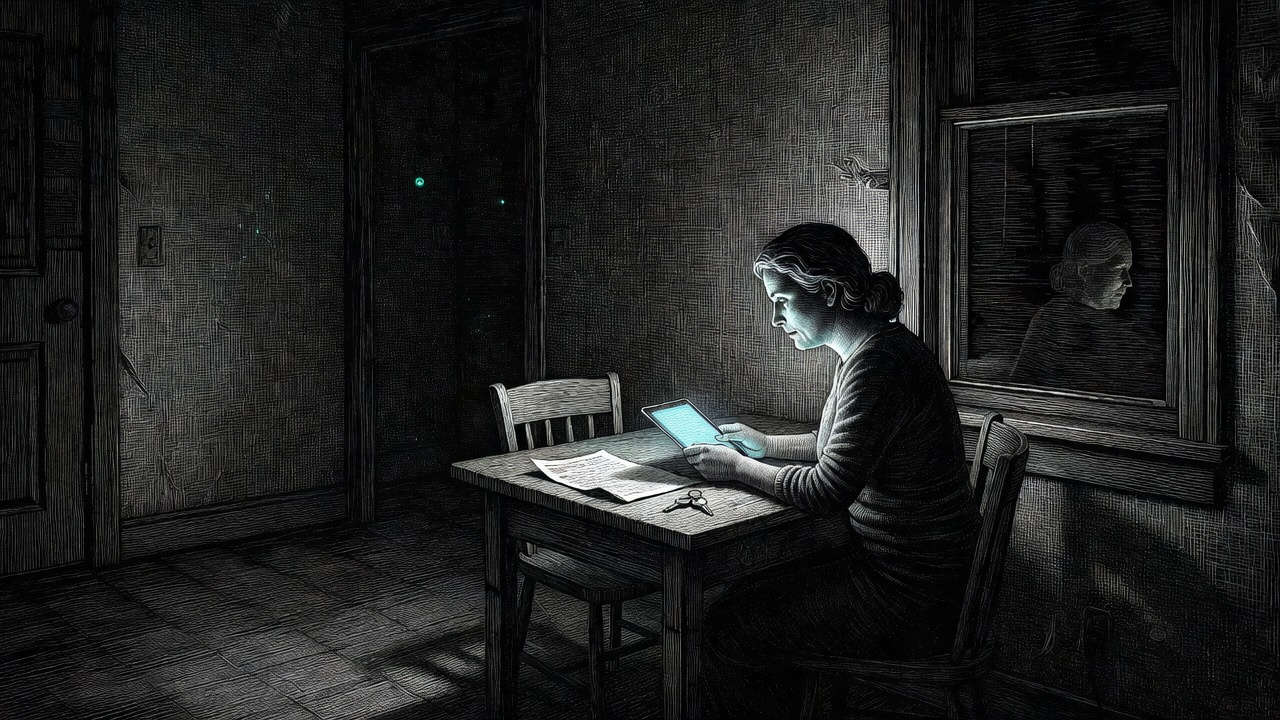
The referral sheet is on the kitchen table next to her keys. She put it there deliberately, the way you put things where the early-morning version of yourself will find them before she has had a chance to second-guess anything. The early-morning version of Magda Prusak is reliable but not resourceful. She needs prompts.
The alarm is set for 6:30. The lab is at 7:45. She cannot eat after midnight, which means she has three hours before the prohibition starts, which means she could eat something now if she wanted, but she is not hungry and there is no particular reason to eat something and the instruction has a way of making the act of eating feel structural even when it is not yet prohibited. She does not eat.
The thyroid panel is eight tests. She looked this up on the portal this afternoon, which she should not have done, not because looking things up is wrong but because looking things up on the UPMC patient portal is never just looking. The portal has context. It remembers that she was in dispute with it for fourteen months over UPMC-ERR-2027-B — a case-tracking number dated to 2027, when the original misrouting occurred —, and it has — she is almost certain — an internal flag on her file that says something like case-linked: active dispute resolution or priority routing: pending clearance or whatever the errand system's language is for a person who spent fourteen months arguing that a misrouted annual wellness referral had not been resolved by a twenty-dollar credit to her account. The portal does not forget. The portal's routing memory is calibrated to three-year lookback minimums. She knows this because she read the policy during the dispute, which she read in full, all of it, because that is the kind of person the dispute made her.
She knows what a thyroid does. It produces hormones that regulate metabolism, heart rate, body temperature, digestion, and the general speed at which things happen in the body. It is a small gland, butterfly-shaped, in the front of the throat. She has had one her whole life and has never needed to think about it specifically.
She does not know what hers is doing.
The distinction feels important tonight and she has been sitting with it for an hour. There is a category of knowledge that is general and a category of knowledge that is particular and the general kind does not tell you anything about the particular kind.
The intake form for Dr. Adamski's appointment was fourteen questions. Fourteen of fourteen, all answered, the form closed at 2:23 PM on Wednesday September 2 according to the errand-receipt the portal sent her. The form itself was standard. The last three questions were about fatigue, weight, and temperature tolerance. She answered all of them honestly, which was harder than it sounds for the temperature question, because she has been colder than usual for about three months and she had been attributing it to the apartment's heating system and then to a drafty window in the bedroom and then to nothing in particular, just a thing that was true about September, until she stopped attributing it and started writing it down instead. She answered: colder than usual since approximately June. Three months. She was colder than usual since approximately June.
Dr. Adamski reviewed the form in the appointment. He was not alarmed. He said the panel was appropriate, that the symptoms were consistent with several things, most of them manageable. He wrote a referral. The errand system logged the referral as case-type diagnostic/routine within four minutes of the appointment closing, which she checked because she was checking everything now, which is also a thing the fourteen months had done to her.
The referral did not link to UPMC-ERR-2027-B. She checked this twice.
She should have gone to sleep an hour ago. She did not go to sleep because she opened the portal to check something small — the lab address again, the hours, whether there was a validation code she needed for the Monday draw — and the portal showed her the lab information and also showed her, in the small gray status bar that runs along the right side of the portal home screen, a message that said: 1 pending item: case-link review requested.
She does not know when that appeared. It was not there this morning.
She knows what case-link review means in the portal's language. The UPMC Patient Routing System — UPMC-PRS, in the documentation, which she has read — was introduced in early 2025 as a way to reduce administrative handoff errors between departments. The idea was sound: one system tracking a patient's referral chain from primary care through specialty appointments through labs through follow-up, so nothing got lost. The idea was sound and the implementation had a failure mode that took eighteen months to identify, which was that the system's case-anchoring logic was built on a field hierarchy that put insurance code above patient ID, which meant that two patients with the same insurance batch code could have their referrals cross-routed. UPMC-ERR-2027-B was one of 147 documented instances of this failure, which she knows because she requested the incident summary during the dispute and received a redacted version fourteen days later. Her case was number 23 in the batch. It means the errand routing system has identified a case-linkage between two or more of her active or recently-closed items and is requesting her confirmation that they are correctly linked. During the UPMC-ERR-2027-B dispute, she had to process six of these reviews, all of them the routing system incorrectly connecting her misrouted wellness referral to other items because they shared her patient ID, her insurance code, or a geographic routing node. She resolved each one by clicking Decline link and writing a brief note explaining that the items were independent. This took time. It took more time each time.
She knows that a case-link review request at 10:13 PM on the night before her first blood draw of this medical process is probably — almost certainly — the errand system doing something mechanical: seeing a new referral from Dr. Adamski and cross-referencing it with her file, which has history. She knows this. She also knows that clicking into the review at 10:13 PM on the night before her first blood draw of this medical process is not something the morning version of herself would do, which is the version of herself who is going to go to the laboratory at 7:45.
She sits with the referral sheet on the table. She sits with the gray status bar on the portal screen. She does not click into it.
The laboratory will process her blood without her. That is what labs do. She will go at 7:45, a phlebotomist will draw blood from the vein in the inner right elbow, the vials will be labeled and routed — not errand-routed, actual physical routing, which is different, which is a thing she now knows the difference between — and the tests will run. The results will enter the patient portal in three to five business days. The portal does not sleep. The results will appear at the moment the laboratory system logs them and the portal ingests the feed, which is automatic, which does not require anyone to review them first, which means they will be there before she knows they are there and she will find them by opening the portal the way she opens the portal now, which is carefully, with one hand on the table.
She will read numbers that already exist tonight. They are in her blood right now, these values, waiting to be measured. The thyroid is doing whatever it is doing and has been doing it for some time and the panel will not change what it is doing, only report it. There is something clarifying about this. The situation is already what it is. She is finding out, not causing.
She is also not responsible for what the errand system does with the finding.
This is the thing she is learning to hold. UPMC-ERR-2027-B was not about her thyroid. It was about a wellness referral that the routing system sent to the wrong clinic because her insurance code and a different patient's insurance code were in the same routing batch and the system did not check patient IDs before sending. This is a different problem from whatever Dr. Adamski's panel will find. But the portal does not distinguish between them at the level of her file. At the level of her file, she is a person who has had a dispute, and disputes leave flags, and flags attract case-link reviews, and case-link reviews appear at 10:13 PM on Sunday night.
She pulls up the case-link review. She told herself she would not and then she did.
The routing system has flagged a potential link between DR-09-06-2026-ADAMSKI-THYROID (the new referral) and ERR-2027-B-RESOLUTION-CLOSED (the old dispute, marked closed, which she knows is marked closed because she has the closure letter). The flag note says: Shared case-anchor: patient ID. Routing priority: standard. Review recommended before next active case milestone.
The next active case milestone is Monday, 7:45 AM. The blood draw.
She reads the flag three times. She reads shared case-anchor: patient ID and understands that this means nothing medically, that the errand system is not saying the two cases are related, it is saying they share a field, which is her patient ID, which every case she has ever had with UPMC shares. She understands this. She clicks Decline link and writes in the note: Independent items. Patient ID is not case-anchor. Please update routing logic. She has written some version of this note six times before.
The portal confirms the review is closed. It generates a receipt. She saves the receipt.
She sits back in the chair. The kitchen is quiet. The refrigerator hums. The lamp over the table is the only light on. Her reflection in the dark window looks like someone who has been dealing with an administrative process for a long time, which is accurate, which is a description she would have found dispiriting fourteen months ago and now just finds accurate.
The referral sheet is still on the table next to her keys. Dr. Adamski ordered eight tests. She is going to get a blood draw at 7:45 AM. The results will come back in three to five business days, and they will tell her something about what her thyroid is doing, which is different from what she knows about what thyroids do in general, and she will read them when they arrive.
The case-link review is closed. The portal shows her no pending items.
She closes the portal. The portal's last screen before closing shows the UPMC badge — the blue square with the letters, which she looks at for a moment, which she has looked at many times in the past fourteen months, which she used to look at with something close to hostility and now just looks at as what it is, which is a logo on a system that does what it does, some of which is useful and some of which is not, and none of which is personal.
She knows what the morning version of herself needs: the referral sheet in a visible location, the keys next to it, the alarm set for 6:30. These things are in place. She has done the work of making the morning easier before the morning arrives. She does not need to do anything else tonight.
She picks up the glass of water and drinks from it. She puts it down. She looks at the dark window. The reflection is still there: the lamp, the table, a woman who has been in a dispute with a routing system for fourteen months and is now in a different process, a process that is not the same thing, that is not connected, that shares only a patient ID, which is not a case-anchor, which she has now noted for the record for the seventh time.
The apartment is quiet. She turns off the kitchen lamp. She knows where the bedroom is. She has walked to it in the dark before.
In the morning she will go to the laboratory. The laboratory will do what laboratories do. The portal will ingest the results when they exist. The errand system will process whatever it processes. She will read what she reads when she reads it.
She goes to sleep.
7:48 AM. She is three minutes late, which she knew she would be. The lab on Forbes Avenue is on the second floor. The elevator had a wait. The intake desk gave her a number — 47 — and she is sitting with it now in a chair along the wall. The chairs are the same blue as the UPMC badge. She has not eaten since 11:00 PM last night, which she calculated carefully. She is not hungry in a way that feels normal; she is hungry in a way that has a specific texture, fasting-hunger, which is different from regular hunger because you know exactly when it started and you know exactly why.
Number 46 goes in. She watches the door.
The phlebotomist comes out and calls 47. She follows her to a small room with a padded chair and a tray on a swing arm. The tray has labeled tubes — three, green top, lavender top, red top — and a packet of cotton balls and a box of nitrile gloves and a stack of barcode stickers with her name on them: PRUSAK, M. The stickers were printed when she checked in. She did not see them do this. They exist anyway. The phlebotomist puts on gloves and tears open the first sticker and affixes it to the green-top tube without looking at it. This is something she does many times a day. She does not need to look.
She ties off Magda's arm. She finds the vein on the first try. The needle goes in and she says a small quiet nothing — not you'll feel a pinch, not anything — just a neutral steady presence that manages the draw the way you manage something you have done enough times that it is only itself.
The barcode sticker catches the fluorescent light. It says PRUSAK, M. Collection date 2026-09-07. The tube fills.
When it is done she gives Magda a cotton ball and a small round bandage and says the results will be in the portal in two to three days. She says it the way people say things that are true and ordinary. Magda says thank you. She means it and also it is what you say.
She goes home and makes coffee. She sits down. She does not open the portal.