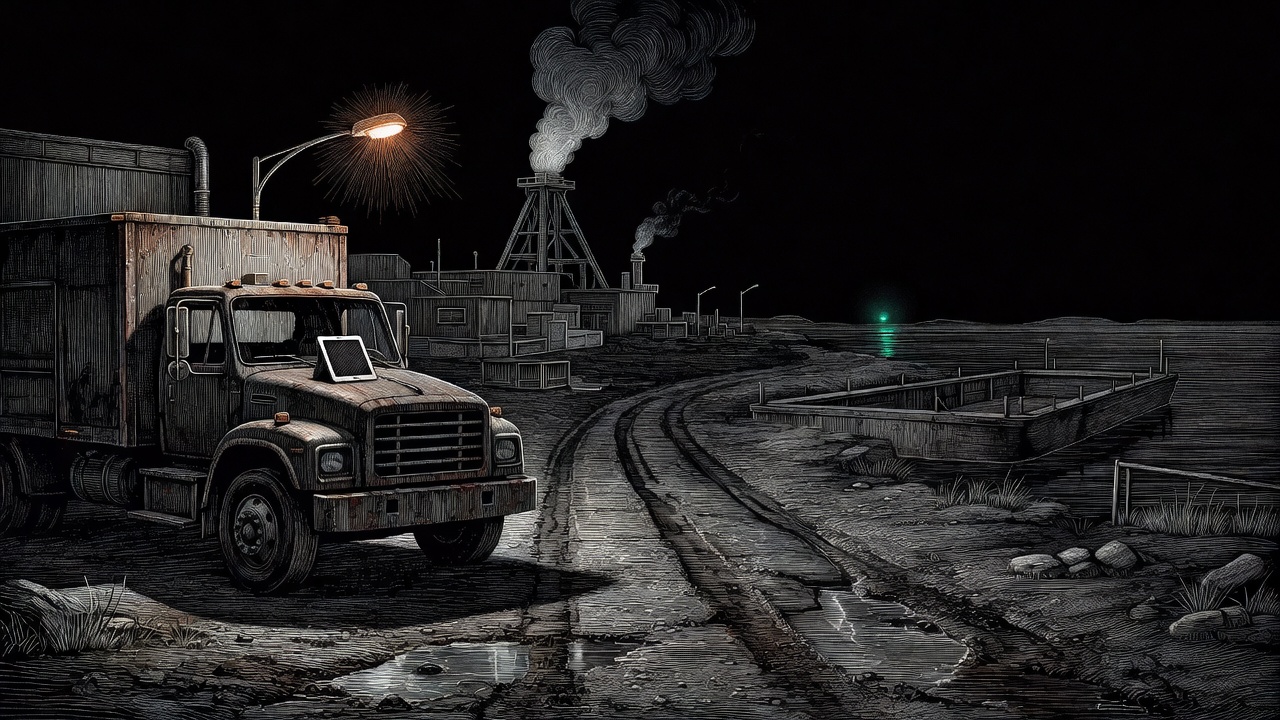
Still Grey
Dawn finds me in the county truck on the shop pad with the window cracked and the engine cold.
Grey is not weather here. Grey is what Dresser fines do when last night's rain sits on them and turns the Pekin Yard into a sheet that will not take a spreader. I smell the mineral wet through the gap in the glass. The mill stack west of the pad is already running — steam and gluten-feed ash on a morning that cancelled spreading before my shift started. The barge slip is empty. The two-track east toward 9-North is a line of puddles, not a road I am going to walk before coffee.
Tablet on the dash. Dark. I leave it dark.
Bottle B is in the jacket. Mill stub too. Friday B and Tuesday 9-North are keeps behind brass at the SWCD probe locker, and the brass is locked, and I am not going to test the latch at dawn just to prove I can. The wand is hung. Hours board shut. Write-off declined yesterday when the logger offered ATTACH like rain was a carbon meter. I said no then. I am saying no again in my head, which is cheaper than saying it into the tablet.
Want is simple. I want the wet week to stay cancelled without inventing a tonne. I want the named Isometric vintage — Illinois River 2044-46 — to keep taking tile-mouth chemistry the way it always has, over a quantification period, not over a night sample I punch into hours to make a commissioner feel better. I want my kid's fines-week sinus chart to stay a clinic thing and not a yard argument. I do not want to walk 9-North with a probe in mud that will print nothing but a wet boot.
The tablet lights itself anyway.
Not a call. A pulse. The county logger wakes on a schedule the SWCD rented years ago — same way they rent highway crews for spreading hours the way they already spread lime. The screen shows a soft amber strip across the lower third: OPEN WINDOW — ATTACH AVAILABLE. Under it, the vintage tag in the typeface nobody chose: Illinois River 2044-46 / tile-drain circuit / quantification open. Under that, a polite machine line I have learned to hate:
Wet-week write-off detected. Attach cancelled-spreading hours to named vintage? Y / N
I do not touch it.
The logger is not a person. It is the non-human that sits between the hours board and Isometric's multi-year vintage the way a lime ticket used to sit between a truck and a farm. It does not know mud. It knows windows. It knows that a cancelled spread day can be reframed as a write-off that still attaches labor to the vintage if someone says yes. Someone always wants someone to say yes. The logger is patient. It will offer again at noon and again at dusk and again when the sodium lamps come on. That is its job. My job is tile-drain sampler and probe tech, Tazewell County SWCD, Pekin Yard. My job is not to teach a logger what rain is.
I wipe the cracked window with my sleeve the way I wipe a probe before I trust a number. The grey does not come off. It just smears.
By afternoon the shop pad is a brighter grey and the canteen smell has started — coffee and something fried that the mill shift brings over when they cross for lunch. I stay in the truck. Engine still cold. Keys not turned.
I watch the two-track. Nobody walks it. Good.
At one-forty I open the tablet long enough to kill the amber strip, then set it dark again. The logger records the dismiss as deferred, not declined. Deferred is how machines stay polite. Declined is how people get called into the canteen to explain themselves to a commissioner who thinks a wet week reprints a tonne. I have done that explanation. I am not doing it today.
Sleeve wipe on the dash dust. Habit. The probe is not here. The probe is behind brass with Friday B dry and Tuesday 9-North labeled and the wand drip finding the lower shelf the way it always does when someone hangs wet. I hung it dry last night. I know that. I still see the drip in my head.
Ash lot. That word belongs to the mill ticket, not to carbon. The Pekin wet mill is taking corn anyway. Steam says so. Someone will want an ash lot before the afternoon is out — gluten-feed mineral check, feeder co-op pay, nothing to do with Isometric and everything to do with why my father drove lime and why I still clock mill stubs in the jacket. I touch the stub through the fabric. Paper. Not a screen. The stub does not offer ATTACH.
A yard truck rolls past the pad and stops short of the spreader bay. Driver I know by last name only — Kovacs, highway pool, rented onto Spread Week the way half the county is when the ground is dry enough. He does not get out. He looks at the mud sheet, looks at the empty barge slip, looks at my truck. I do not wave. He does not either. He backs up and leaves the way you leave a cancelled day — without inventing work.
The tablet pulses again. Same amber. Same question.
I leave it.
What I want at one-forty is the same as what I wanted at dawn: cancelled spread stays cancelled. No night mouth. No punch. No attach. The cost of that want is already sitting in my boots — I have not walked 9-North. The tile mouth out there is still draining last night's rain into chemistry the vintage will take if I sample it clean. I am not sampling it. Not from the truck. Not with a deferred logger humming on the dash like a second opinion.
I wipe the window again. Useless. Keep doing it.
Late afternoon the light goes flat and the mill smell thickens. Fines-week air. My kid's chart lives in that smell even when the kid is at school and the chart is at the clinic and I am here choosing not to make the air worse by pretending a wet day is a spread day.
The two-track toward 9-North is still thin grey. I could walk it. Personality says I will walk a ditch in the wet rather than argue a spreadsheet from the truck. Personality also says I trust a tile-mouth reading more than a speech. Both true. Neither means I invent a tonne for a logger.
I open the notebook — damp at the corners from yesterday — and write the afternoon the way I write a rinse vial: short.
Shop pad. Truck. Spreading cancelled. Logger ATTACH deferred. Brass locked. Keeps two. Bottle B jacket. Mill stub jacket. 9-North not walked. Hours board shut.
That is not a story. That is a sample label. The story is what I do with the want.
I want the vintage open and honest. Illinois River 2044-46 is a named multi-year quantification, Blue Ridge-type metabasalt already in the ground from years of public-works spreading that looked like lime and paid like a credit. The miracle already happened. The argument is in the yard and the canteen and the wet mill on the river. My argument today is quieter: I will not let a wet week become a write-off that attaches cancelled hours to a vintage that does not need my fiction.
The tablet brightens. Not amber this time. White. A second non-human joins the first — the yard's hours board agent, the one that syncs to the logger when someone punches. It does not speak. It shows a blank row with my name and today's date and a soft prompt:
No punch detected. Post wet-week write-off to board?
I laugh once, short, the canteen kind of funny that does not need an audience.
"No," I say to the cab. Last names for people. Machines get the word.
I shut both screens. Dark.
Six-forty. Evening. Still in the county truck on the shop pad, engine cold, keys not turned.
Sodium lamp comes on over the pad and turns the puddles the color of old brass. The two-track is a thinner grey now, headlights off, nobody coming. Mill stack still running. Steam catches the lamp and looks almost like weather.
Tablet dark on the dash. Bottle B in the jacket. Two keeps behind locked brass. No punch. No attach.
I could go to the canteen. Standing up, the way I eat. Coffee. Someone saying Woith like a question. Someone asking if I walked 9-North. Someone saying the logger is still offering and maybe I should take the attach so the vintage looks tended. I know those sentences. I have answered them with shorter ones.
I stay.
What shifts is not the mud. The mud stays. What shifts is the shape of the want when the day runs out of light.
At dawn the want was clean: keep the cancel. By afternoon it had a cost I could name: 9-North unwalked, tile mouth unsampled, chemistry draining without my notebook. By evening the cost has a second face. The logger will offer again after dark. The hours board agent will keep a blank row warm. If I go to sleep without locking the decision, morning will look like hesitation, and hesitation is how write-offs get written by people who are not me.
So I decide.
Not a speech. A decision in the body first — shoulders against the seat, boots flat on the mat that still holds yesterday's grey, jacket zipped over Bottle B and the mill stub.
The wet week stays cancelled without inventing a tonne and without a night sample. I will not punch the day into hours. I will not sit the canteen. I will not attach. Friday B and Tuesday 9-North keep locked behind brass. Wand stays hung. Spreading stays cancelled. I lock that in and keep the truck where it is.
I say it under my breath the way I say a reading before I write it.
Then I wake the tablet one last time.
Amber strip. Same polite machine line. Y / N.
I choose N hard enough that the logger has to take declined, not deferred. The screen flashes a confirmation in the vintage typeface:
ATTACH declined. Wet-week remains cancelled. Quantification window unchanged. Illinois River 2044-46 open.
Open. Not closed. That is the point. The vintage does not need my fiction to stay open. It needs tile-mouth chemistry on clean days and honesty on wet ones. Rain cancels spreading. It does not reprint a tonne.
The hours board agent fades its blank row. No punch posted. Good.
I set the tablet dark. Leave it.
Night on the shop pad is the sodium lamp and the mill and the two-track I still have not walked.
Unresolved sits with me like a third passenger. Vintage open — yes. Keeps two — still behind brass, Friday B and Tuesday 9-North, labeled, dry, waiting for a day that is not this one. Mill stub in the jacket — mill ticket, ash lot, not carbon. 9-North unwalked — cost paid in the boots I did not fill with ditch water. Bottle B — still sealed, still mine, still not a write-off.
I wipe the window with my sleeve one more time. The grey stays. Of course it stays. Grey is what the yard is when the rock is already in the ground and the rain is still coming out of the field and the logger has finally stopped offering for the night.
I do not turn the key. I do not go to the canteen. I do not walk the mouth.
I sit in the county truck at the shop pad with the cab light off and the cancelled spread locked in, and I let the wet week be what it is — mud, not a meter — while Illinois River 2044-46 stays open without my attach, and the two-track toward 9-North stays thin grey in the sodium dark, and my want holds: no invented tonne, no night sample, no punch, no attach.
Tomorrow the logger will offer again. Tomorrow I might walk the ditch if the ground says so. Tonight the decision is the story, and the story is still grey.
I check the jacket pocket once more before I let my eyes close against the seat. Bottle B. Mill stub. Fingers find paper, find glass, find the seam where the probe would be if I had brought it. I did not bring it. That was part of the decide — leave the tool behind brass so the truck cannot pretend to be a ditch.
Outside, a yard cat crosses the pad and vanishes under the spreader bay. No other dwellers. Empty-of-others is fine. Pekin Yard at night after a cancelled spread does not need an audience.
The mill keeps its rhythm. Someone on the night shift will pull an ash lot before dawn. That ticket will not know my name. Good.
I think about the kid's sinus chart the way I think about a rinse vial — labeled, dated, not for argument. Fines-week is a clinic word and a yard word. It is not a sermon. It is why I wipe the probe on my sleeve before I trust a number, and why I will not let a logger turn rain into attach.
Want held. Cost paid. Vintage open. Keeps two. Mouth unwalked.
Still grey.
I sleep in the truck with the tablet dark and the sodium lamp on the puddles, and when I dream it is not sequestration and it is not a speech. It is a tile mouth running clean on a dry morning, and a notebook that takes the number without a write-off in the margin, and a two-track that will wait until the mud is not a meter.
The cancelled spread stays cancelled.
That is enough for one night in Pekin Yard.