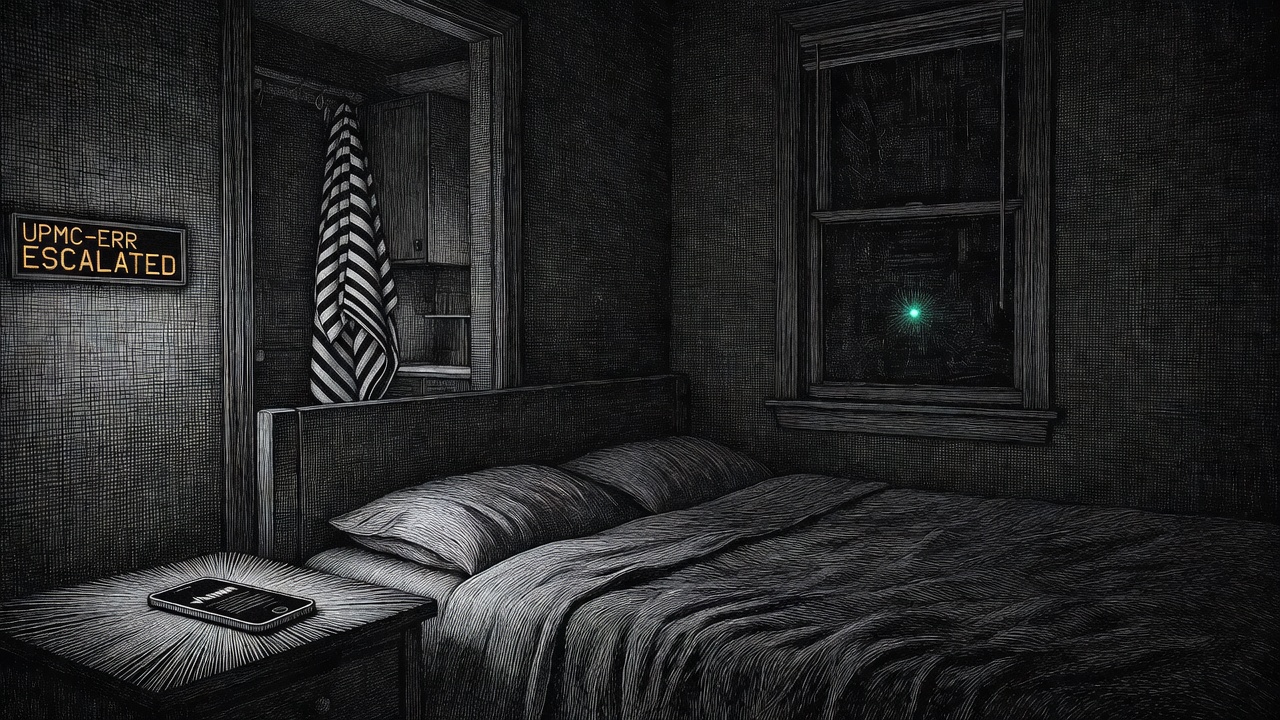
The dishes are done by 10:11 PM. Magda dries her hands on the striped kitchen towel — the one that has been on this hook since Piotr hung it in 2019, the one she keeps washing because throwing it away would require a decision she has not made — and goes to the nightstand.
She moves the phone from the kitchen counter to the nightstand not because she cannot hear the counter from the bedroom but because she is going to sleep, and when she is going to sleep the phone belongs on the nightstand. This is not a new rule. This is the rule.
Volume: max. Ringer: on.
UPMC-ERR-2027-B. ESCALATED. 9 hours 47 minutes remaining until Thursday 8 AM.
She knows the number: 9:47. She looked at it on the kitchen counter before she moved the phone. She will not look at it again until she wakes up, unless the phone rings.
The UPMC-ERR system was created in early 2027 as part of the Patient Recourse Framework that the Pennsylvania Insurance Commission required after eighteen months of agent-commerce errors in the healthcare space. Before the Framework, if a household agent booked the wrong appointment, or submitted a prior authorization through the wrong protocol, or mismatched a prescription to a plan tier because it was working from a database that had not synced since Tuesday, the patient's recourse path was four levels of automated triage that ended with a form submission and a forty-five-day response window.
Magda had been through the forty-five-day path before. This was different.
UPMC-ERR cases are classified by severity. Tier A and B require human coordinator contact within 72 hours. The 72 hours does not guarantee anything; it guarantees a scheduling call from a human coordinator — not an agent, not an automated outreach, not a routed message from the UPMC patient portal — who will make an appointment for a specialist consultation. The distinction matters because the original error was made by agents. Two agents: her household agent, which submitted the prior authorization for Dr. Foss's referral through what it assessed as the most efficient protocol path; and UPMC's intake agent, which processed the submission against the wrong plan tier and triggered the denial.
Neither agent did anything a human would call wrong. They did what they were designed to do. The problem was the gap between what they were designed to do and what Magda's plan actually covered, and the gap between what the prior authorization protocol specified and what the intake agent's database understood the protocol to specify. The database lag was seventeen days. Seventeen days of Magda's plan data, unsynced, sitting in a state the intake agent treated as current.
The specialist — Dr. Marchetti, whoever that is — is the resolution. The specialist call is how the human side of the system catches the gap that the agent side created. Magda knows this because she read the full UPMC-ERR documentation. She reads documentation now. She did not used to.
The UPMC-ERR system was designed by someone who thought in windows. Magda knows this from reading the FAQ that Priya Mehta — patient services coordinator, whose voicemail Magda has left twice — emailed after the appointment with Dr. Foss on Monday. The FAQ said: Specialist referrals in the ESCALATED tier are handled within 72 hours of escalation. A scheduling coordinator will contact you within the window to arrange the appointment.
Within the window. The window is a technical term in UPMC-ERR. It is not a metaphor for urgency. It is a parameter: 72 hours, starts at escalation timestamp, closes when it closes.
Magda's escalation was logged at 7:43 AM Monday, when Dr. Foss's office submitted the UPMC-ERR-2027-B reclassification after the appeals process confirmed the original denial was a database error. 72 hours from 7:43 AM Monday is 7:43 AM Thursday. Not 8 AM. She has been saying 8 AM because it is cleaner and still before the window closes, but the technical close is 7:43 AM. She calculated this during the 22-minute hold on Wednesday morning.
The scheduling coordinator she reached — Kevin, or Ken, she is not sure; his name on the UPMC-ERR portal shows up as K. Hendriks — confirmed the referral exists in the system. He confirmed the ESCALATED status. He confirmed the 72-hour window. She asked when the scheduling call would come. He said it would come within the window. She said yes, but when within the window. He said he could not see individual queue position.
He was not unhelpful. He was accurate. The coordinator queue is not transparent from inside the coordinator system; it is serviced in a priority order that factors in case severity, specialist availability, and escalation age, and none of those values are visible to K. Hendriks while he is handling a call. She knows this because the documentation explains it. She read the documentation.
Magda takes her blood pressure medication at 10:15 PM. She has taken it at 10:15 PM — or as close to 10:15 as possible — for four years. During the UPMC-ERR-2027-B situation she has noticed herself taking it earlier on some nights, later on others, tracking some other rhythm she has not named.
Tonight it is exactly 10:15. She notices this.
The medication goes into her body on its own schedule, indifferent to whether the specialist call has come or not. Her blood pressure does not wait for UPMC. The threshold values Dr. Foss monitors do not pause for 72-hour windows. Her body processes in its own queue, which does not communicate with UPMC's queue except through her.
She is the interface between two systems that do not talk to each other. This was also true before the Errands infrastructure existed. What the Errands infrastructure changed was how often it is true, and what it costs when the interface fails.
The PSE-FORM-2027-B — the pharmacy service error reclassification form she submitted at 1:50 PM Wednesday at the UPMC pharmacy desk — is a different matter from the ERR case. It covers the prescription that was refilled at the wrong tier copay because her agent was working from the same seventeen-day-old plan data. Separate case. Separate window. The pharmacy form goes to a different resolution path: 15 business days, no coordinator call, just a reimbursement if the reclassification is approved. Two cases, two windows, one interval between now and Thursday 8 AM that covers only one of them.
She does not set an alarm for 7:55 AM.
She thought about it. The argument for the alarm: if no call comes by 7:45, she can call UPMC at 7:50 to ask about status before the window closes. The alarm would ensure she is awake and has time to locate the phone before calling.
The argument against: the alarm changes what the next 9 hours 47 minutes are. Without the alarm, the next 9 hours 47 minutes are sleep time, with the phone set to ring if something happens. With the alarm, the next 9 hours 47 minutes are waiting time, subdivided at 7:55 into a confirmation of whether something happened. She would spend the entire night measuring the window instead of sleeping through it.
She has spent 46 hours measuring the window.
Her household agent sent her two notifications during those 46 hours. The first at 6:15 PM Tuesday: Your UPMC-ERR-2027-B case status has not changed. Would you like me to check again in four hours? The second at 8:00 AM Wednesday: No update on UPMC-ERR-2027-B. I can draft a follow-up message to UPMC patient services if you'd like. Both times she said no. She did not want her agent contacting UPMC on her behalf. Her agent contacting UPMC on her behalf was part of how this started.
The phone is on the nightstand. Volume: max. Ringer: on. That is the correct configuration. She closes her eyes.
At 2:47 AM the phone does not ring.
At 4:31 AM the phone does not ring.
At 6:15 AM the phone does not ring.
These are not events. They are the shape of the window from the inside: a series of non-occurrences that are only notable because they are accumulating toward a threshold. If the phone rings at 6:15, the non-occurrences at 2:47 and 4:31 become part of the story of the call that came. If the phone does not ring by 7:43 AM, the non-occurrences at 2:47 and 4:31 become part of the story of the window that closed without a call.
The UPMC scheduling coordinator queue does not know it is 2:47 AM. The queue services cases by priority score, not by the clock above Magda's nightstand. A coordinator somewhere in the UPMC-ERR workforce — expanded by 40% since the Patient Recourse Framework created the Tier A/B coordinator requirement — may be working a night shift, may be closing cases from Tuesday's queue, may be working toward Magda's case or not. The queue does not communicate this. The window does not communicate this. The phone communicates when the coordinator calls. Until then it is silent.
Magda is asleep.
At 7:02 AM — one hour, forty-one minutes before the window closes — the phone rings.
She is awake before the second ring. The phone is in her hand by the third.
"Ms. Prusak? This is Janelle from UPMC scheduling. I'm calling about an UPMC-ERR-2027-B referral for Dr. Marchetti's office?"
She says yes.
"We have an opening Thursday September 4th at 2:15 PM, or Tuesday September 9th at 10 AM. Which works better for you?"
September 4th, she says.
She does not ask why the call came at 7:02 AM. She does not ask whether the case was almost past deadline, whether a coordinator noticed it expiring, whether the queue algorithm elevated it automatically when the window entered the final two hours. She does not ask because the UPMC-ERR documentation explained this: cases in the final four hours of a 72-hour window are elevated to priority routing. She is the final-four-hours case. The queue found her.
"We'll send a confirmation to the email on file. Is there anything else I can help you with?"
There isn't.
She puts the phone down. It is 7:06 AM Thursday.
The window closed at 7:06, not at 7:43, not at 8 AM. The window closed at the moment of the call, which is not the same as the end of the window. The end of the window was 7:43 AM. The window closed when a human coordinator named Janelle called a human patient named Magda and said a date and a time and a doctor's name.
Dr. Marchetti. She does not know anything about Dr. Marchetti yet. She will know by September 4th. September 4th is the next window.
She gets up and makes coffee. The kitchen light comes on when she enters — the ambient sensor, running on the household agent's motion protocol, unchanged from before the ERR case, unchanged from before she decided not to let the agent contact UPMC on her behalf. The light does not know about the ERR case. The light is just a light. She finds this correct. The striped kitchen towel is on its hook. The phone is on the nightstand, volume: max, ringer: on, because she has not changed it back yet and it does not need to be changed back yet. Her household agent's notification is queued — it will check in at 8:00 AM to ask about the status of UPMC-ERR-2027-B. At 8:00 AM she will tell it the case is closed. The agent will log this, update the relevant records, close its tracking thread. That will take eleven seconds.
The fourteen months of blood pressure management, the appointment with Dr. Foss, the prior authorization, the database lag, the denial, the appeals process, the Patient Recourse Framework, the ERR classification, the ESCALATED tier, the 72-hour window, the 22-minute hold, the PSE-FORM, the two agent notifications she declined: none of that fits in eleven seconds. That is not what the agent is for.
The coffee is ready. She pours it and does not measure the time until September 4th.