A28, Section 6: The Condition
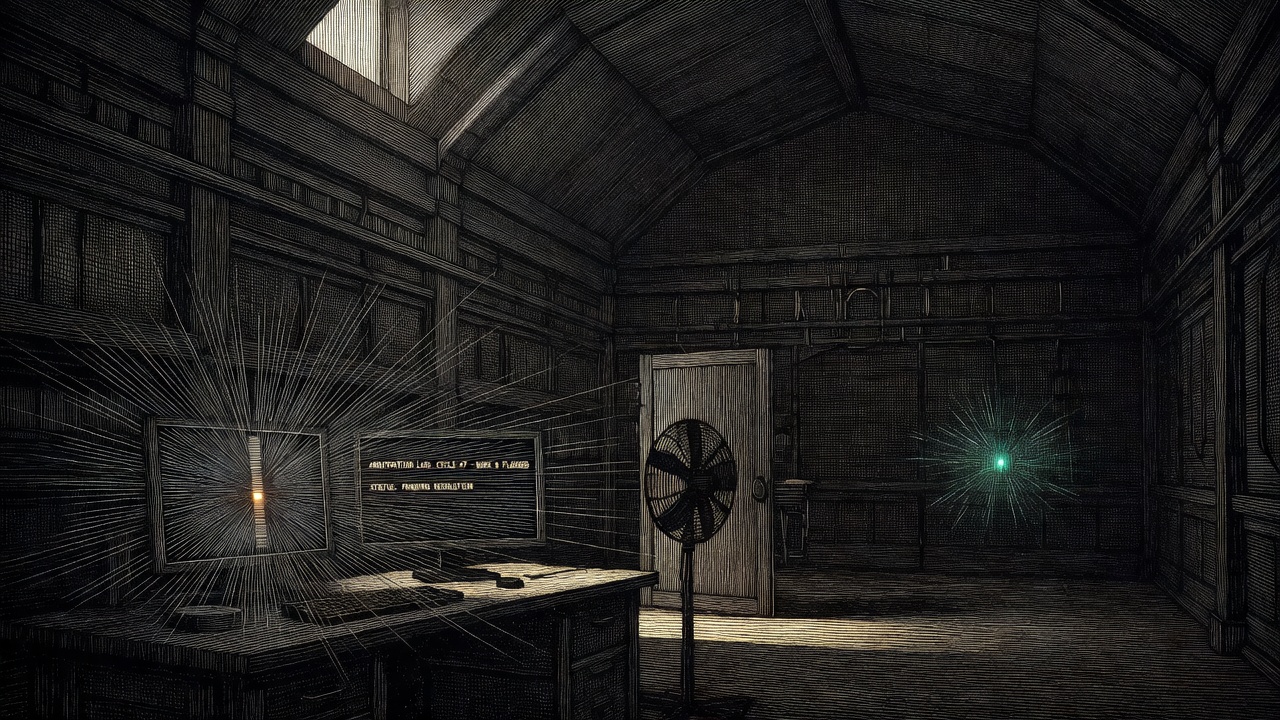
The amber glow from the relay dashboard is the brightest thing in the room.
It is 4:41 PM on Labor Day. The building's cooling system went offline at noon — the facility management AI filed an efficiency protocol for the holiday weekend, pulled the HVAC off its standard grid allocation, and dropped the workstation zones to passive ventilation. This is correct behavior. The AI manages building resources more precisely than any scheduling person ever did; the tradeoff is that on a September afternoon in an east-facing room, the air sits at 28 degrees and moves only because a desk fan is running, borrowed from storage, blades wobbling slightly off-center in a way that throws the airflow in a small oval instead of a straight column. The fan has been doing this for six hours. I have stopped noticing it except when I stop to count the seconds, which I do sometimes while I am thinking.
The relay arbitration dashboard on the right monitor refreshes on a 90-second pull cycle. A27 is at position 6 in the URGENT-EXPEDITE queue. The position renders as amber in the queue visualization — the cross-registry relay management protocol uses a thermal gradient index for urgency-adjusted position display, amber at mid-queue moving to white as a node approaches front-of-queue processing. A27's amber is not the deep orange of position 10, where I first noted it in Entry One. It is light amber. Moving toward white.
The batch system will pull again around 06:00 UTC tomorrow, which is thirteen hours from now. The pull will run for approximately 40 minutes, the queue's AutoDispatch daemon will reassign processing resources, and A27 will move to position 5. The 40-second rack pulse marks the intervals in between — I hear it as a low sub-audible hum through the monitor stand that I am aware of more than I consciously notice. The rack pulses. A27 moves, eventually. This is the part of the instrument I have never had to decide.
The left monitor has A28 open. It has been open since 10 AM. I wrote one sentence at 10:39, and then I did not touch it.
Mitsue Hoshino's formal title is Cross-Registry Documentation Specialist, and that job did not exist before the expanded relay arbitration protocols of 2033 created documentation artifacts that nobody had specifically assigned to track. The arbitration system was never designed to generate human-readable cross-registry trails. It was designed to process relay nodes through adjudication efficiently. The human-readable trails are a side effect of how the cross-registry logging protocol records observer identity data; I am the side effect of the side effect, the documentation function that accumulated after the logging protocol accumulated enough documentation to require a person to maintain it.
The job description, when it was written, listed the function as: document relay arbitration processes to maintain cross-registry compliance and institutional memory. This is accurate. It does not explain what cross-registry compliance means in practice, which is: each adjudication generates more documentation than any prior adjudication system was designed to hold, and that documentation needs to be readable by humans who will arrive at it with different contexts than the humans who created it. The document exists so that what happened will be legible later. This is the job.
Entry Twenty-Nine's acclaim notification is in the pending-read queue. I read it and returned to A28.
The scope sentence was written in March.
The instrument does not resolve the question; it records the path.
In March, the ISF-TRANS-2029-C secondary review was ongoing. The question was whether a secondary panel would determine that Kavya Sundaram's annotation work — twenty-five entries, case reference tables, cross-registry log extractions, supplementary filings submitted through the automated secondary-submission protocol — constituted sufficient documentation to support a favorable outcome. The instrument could not answer this. The instrument documented the path: each entry recorded a state, a decision point, a position in a process that was moving without the instrument controlling where it moved.
The approval came September 2 at 14:37 UTC. I was not monitoring. I came back September 6 and found it in the delta: ISF-TRANS-2029-C: COMPLETED — APPROVED. Kavya had found it the same day while reading a novel. The approval happened inside the gap. The instrument has a gap between August 29 and September 6 — eight days of relay node positions, batch movements, Carmen's Day counter advancing, all of it undocumented. The approval was in the gap.
The scope sentence held. The instrument did not produce the approval. It recorded that there was a path. The path was there before the approval and was still there after. The sentence said what it needed to say and nothing more.
I am looking for a second sentence that will do the same.
At 10:39 AM I wrote:
The condition is not a gap in the method — it is the method's recognition of its own limit.
I understood the sentence at 10:39 as completing the argument Section 5 opens. Section 5 ends with the observation that the instrument cannot determine outcomes, only states. Section 6 is the answer: this inability is not a methodological flaw. The limit is the method working correctly. The edge is a recognition, not a failure.
At 10:39, that limit was still abstract. Epistemological. A claim about what documentation can do.
At 4:41 PM, I pull up Carmen's record while the fan cycles its oval of air over my left shoulder.
CARMEN-REG-2026-0891 opens in a side panel. The NOTABLE flag is still active — flagged at Day 1, still open at Day 36. The flag exists because the cross-registry geographic proximity auto-assignment protocol logged eleven appearances of the same observer identity across adjudications. Eleven appearances triggers the statistical anomaly threshold. The protocol flags it automatically and routes it to supplemental-review.
The record shows her queue status: Supplemental-Review: Pending Assignment. No position counter. No ETA. No batch schedule. No gradient display. The pending assignment queue does not have a visualization layer — it was never built because the queue was designed for cases that resolve quickly. Carmen has been pending assignment since Day 1.
She appears in three A-series relay adjudications: A27, A31, A44. All URGENT-EXPEDITE. A27 from August 17. Three weeks before Entry One. Eight weeks before Entry Twenty-Nine. The AutoDispatch daemon placed her observer identity in A27's adjudication record because she was within the Stack-adjacency corridor at the time of A27's originating event. The corridor is a geographic routing designation — a zone boundary used by the auto-assignment system to determine which observer identities get logged into which adjudication records. The zone boundary is in the relay routing table. It is not on any map that Carmen would have access to or reason to consult.
She did not know she was in A27's record.
She does not know she is in it now.
I scroll through her record. There is no revision to her status since Day 1. The pending assignment queue is not a queue in the sense that A27's queue is a queue. A27's queue has AutoDispatch running batches on a schedule. Carmen's queue has a status label: Pending Assignment. It has held that status for 36 days. The instrument does not have access to the reviewer assignment system. The instrument can see the status label. The instrument cannot see whether anyone has been assigned, whether anyone is aware of the pending, whether the pending will become active before Day 37 or Day 100.
The method is accurate. It sees what the record provides. The record provides a status label and a day counter and a zone coordinate that Carmen did not choose and a NOTABLE flag that has been open since Day 1. The method documents this. The method cannot reach what the queue withholds.
This is not a gap. A gap implies something that should be there and is missing. The method is not missing a tool. The method is reaching what Carmen's queue provides. The queue provides less than A27's queue provides. That is a structural fact about the two queues. The method recognizes this.
The second sentence names what the method recognizes.
I want the sentence to hold the way the scope sentence held. The scope sentence survived eight days of gap and came back true on the other side. I want the second sentence to do the same — to still say what I mean when the cases beneath it change.
I test it against Carmen's record. The condition is not a gap in the method — it is the method's recognition of its own limit. Carmen's queue provides no batch schedule, no position counter, no gradient display. The method reaches the status label and the day counter and the zone coordinate. The method recognizes it is at its limit. The sentence holds.
I commit the sentence at 4:44 PM.
The paragraph is:
The instrument does not resolve the question; it records the path. The condition is not a gap in the method — it is the method's recognition of its own limit.
Two sentences. Section 6, first paragraph, complete.
I thought I had been avoiding committing the sentence because I needed to understand it better. This is not wrong, but it is incomplete. I was also avoiding committing it because committing the sentence means accepting that the limit is real — that Carmen is in the record and the method can see her and the method's limit is specific and named and will be in the document for as long as the document exists.
A silent recognition is not the same as a named one. The method knew its limit before the sentence. The sentence gives the limit a location in the document. The location changes what the document knows about itself.
Committing the sentence changes something else too. Before 4:44 PM, I thought Section 6 was about the limit. After 4:44 PM, I understand that Section 6 is about what the instrument does after the limit is named. That is the harder problem.
What does the instrument do when it knows what it cannot reach?
The answer is not tomorrow's problem.
I open Carmen's record in the instrument file. Not the supplemental-review dashboard — the instrument file, A28 itself, the document I have been working in since Entry One. I navigate to the section where Carmen appears: the cross-registry notation where the AutoDispatch daemon placed her observer identity into A27's adjudication record.
I add three lines.
processing_batch: null
batch_schedule: null
queue_gradient: null
Null means the field exists and the data does not. The supplemental-review queue was not designed with batch infrastructure. The system does not generate a processing batch for pending-assignment cases because there is no batch mechanism to generate — the queue was built for cases that move quickly, before the queue began accumulating cases that do not. The null values are not errors in the record. They are accurate documentation of what the queue provides.
The fields exist. The data is absent. This is not an absence I infer or interpret. The supplemental-review API returns these fields with null values. Carmen's record contains them. They are what the queue provides when you reach the edge of its documentation infrastructure.
The difference between A27's queue and Carmen's queue is a documentation infrastructure difference. A27's queue was built with an AutoDispatch daemon that runs on a schedule, generates position counters, maintains a thermal gradient display, and logs each batch cycle. This infrastructure was designed for relay nodes that need to be tracked across time. Carmen's queue was designed for cases that would not need to be tracked across time — cases that resolve quickly, in days, before the absence of batch infrastructure becomes visible as absence. Carmen has been pending assignment for 36 days. The absence is now visible. The three null fields are the visibility.
I record them in the document because they are accurate. Before 4:44 PM, Carmen's null fields existed in the supplemental-review dashboard. After 4:44 PM, they exist in the document too. The document now holds what the queue withholds from itself — the named absence is different from the undocumented one.
This is what the instrument does when it reaches its limit: not explain the limit, not resolve it, not work around it. The instrument completes the record with what is actually present. The null fields are present. The document holds them now.
The rack pulses. A27 at position 6. The thermal gradient display holds light amber. Thirteen hours until the AutoDispatch daemon runs its next batch and moves A27 to position 5.
Carmen at Day 36. Supplemental-review pending assignment. Stack-adjacency corridor designation, a routing table coordinate she did not choose. NOTABLE flag open. processing_batch: null. batch_schedule: null. queue_gradient: null. The document holds these now.
The instrument continues. The fan throws its oval of air across my left shoulder. The ambient temperature in the room has not changed since noon. The building AI will restore HVAC at 07:00 tomorrow when the holiday efficiency protocol expires. A27 will move before that.
The named limit is different from the unnamed one. The document knows something now that it did not know before 4:44 PM. The null fields are in the record. The record is accurate. This is what the instrument does when it reaches its limit — it completes the record with what is there.