The portal sends a push notification at 3:41 PM.
Magda is at her desk. She picks up her phone, reads the preview: UPMC MyHealth: Lab results available. She opens the app, navigates to the results tab. The panel loads in the same order it always loads: patient name, date collected, ordering provider. Then the results.
TSH: 3.2 mIU/L. Reference range 0.4–4.0. Normal. Free T4: 1.1 ng/dL. Reference range 0.8–1.8. Normal. T3 Total: 115 ng/dL. Reference range 80–200. Normal. Thyroid Peroxidase Antibodies (TPOAb): 84 IU/mL. Reference range <35. High.
She reads the last line twice.
The portal displays each result with a color indicator: green for normal, orange for outside reference range. TPOAb is orange. The color is not alarming — the portal uses orange for everything outside range, from slightly low potassium to flagged troponin. Orange is the portal's only vocabulary for abnormal. 84 IU/mL and the orange flag are the complete information the portal has to give her.
She reads Dr. Adamski's notation below the results.
Consistent with early Hashimoto's thyroiditis. TSH within normal limits — no medication indicated at this level. Recommend monitoring: repeat thyroid panel in 6 months. Follow-up appointment to be scheduled.
She reads this twice also. Then she puts the phone face-down on the desk.
She knows what Hashimoto's is in the way that a person who has spent several months dealing with the UPMC administrative apparatus knows things: from reading, from preparing for appointments, from the habit of looking things up before the system can surprise her. She knew it was a possibility before Monday's blood draw. She did not know the number would be 84.
The reference range is under 35. Her number is 84. She does not know if 84 is slightly elevated or significantly elevated within the Hashimoto's distribution. The portal does not provide this context. Dr. Adamski's notation says "early" and "no medication indicated at this TSH level" — the word "level" is doing work in that sentence, implying that a different TSH level would imply different management. 3.2 is within normal. The threshold for intervention is somewhere above 3.2, unspecified in the notation.
She picks up the phone and looks up Hashimoto's monitoring protocol.
The standard monitoring interval at subclinical TSH levels is 6–12 months. At 84 IU/mL TPOAb with normal TSH, the risk of progression to overt hypothyroidism is approximately 2–5 percent per year. This information comes from a 2023 clinical review paper that she finds in four minutes. The paper is from before the UPMC administrative error that occupied 14 months of her life, before Dr. Adamski, before the shoulder referral. The paper does not know any of this. It describes a population of patients with subclinical Hashimoto's and their progression rates. She is somewhere in that population now.
2–5 percent per year. She calculates: over 10 years, roughly 20–40 percent cumulative risk of developing overt hypothyroidism. This is not the same as a 20–40 percent chance she will develop it — the calculation is more complicated than that, baseline risk changes over time, the paper is three years old. But the order of magnitude is: not inevitable, not negligible, in the range where monitoring is the right answer.
Dr. Adamski said monitoring. She is doing monitoring.
She puts the phone down again. Picks it up. Opens the notes app.
She writes three questions for the follow-up appointment, which has not been scheduled yet:
1. What does 84 IU/mL mean in terms of trajectory — is this low, medium, or high within the Hashimoto's range? 2. Whether the shoulder inflammation could be related — Hashimoto's can cause diffuse musculoskeletal symptoms. 3. What the monitoring interval becomes if the 6-month panel shows an increase.
She looks at the three questions. The third question is the one she did not know she had until she wrote it. She had been thinking about the 84 as a static number — a thing she has, a current state. The third question is about the 84 as a point on a possible trajectory. If the March 2047 panel shows 120, what changes?
She saves the notes.
The UPMC portal case-link system, which sent the push notification at 3:41 PM, has no awareness that this is the same patient whose UPMC-ERR-2027-B billing dispute was administratively closed on September 7 after 14 months without resolution. The portal's push-notification system does not have memory of individual patient histories beyond the current active care record. It sent the notification because a lab result was loaded into her file. It would have sent the same notification if the TPOAb result had been 22 instead of 84. It will send another notification when the shoulder MRI results are available on or after September 22.
The system does not calibrate. She does.
She makes dinner. While the water is heating she looks at the three questions in her notes app, then puts the phone in her pocket. The questions will be there when the follow-up appointment is scheduled. She does not need to hold them in her head tonight. She has written them down so she does not have to.
84 IU/mL. Reference range under 35. Dr. Adamski says monitoring.
She puts the pasta in when the water boils.
The portal will send her another notification when the follow-up appointment is scheduled by Dr. Adamski's office. That notification will arrive the same way this one did — a push notification with a preview she will read on her lock screen, followed by the app loading in its standard order. The portal does not know she has been calibrating for three hours. It does not know she wrote three questions. It knows her date of birth, her insurance ID, and that her TPOAb result was flagged orange on September 9, 2026.
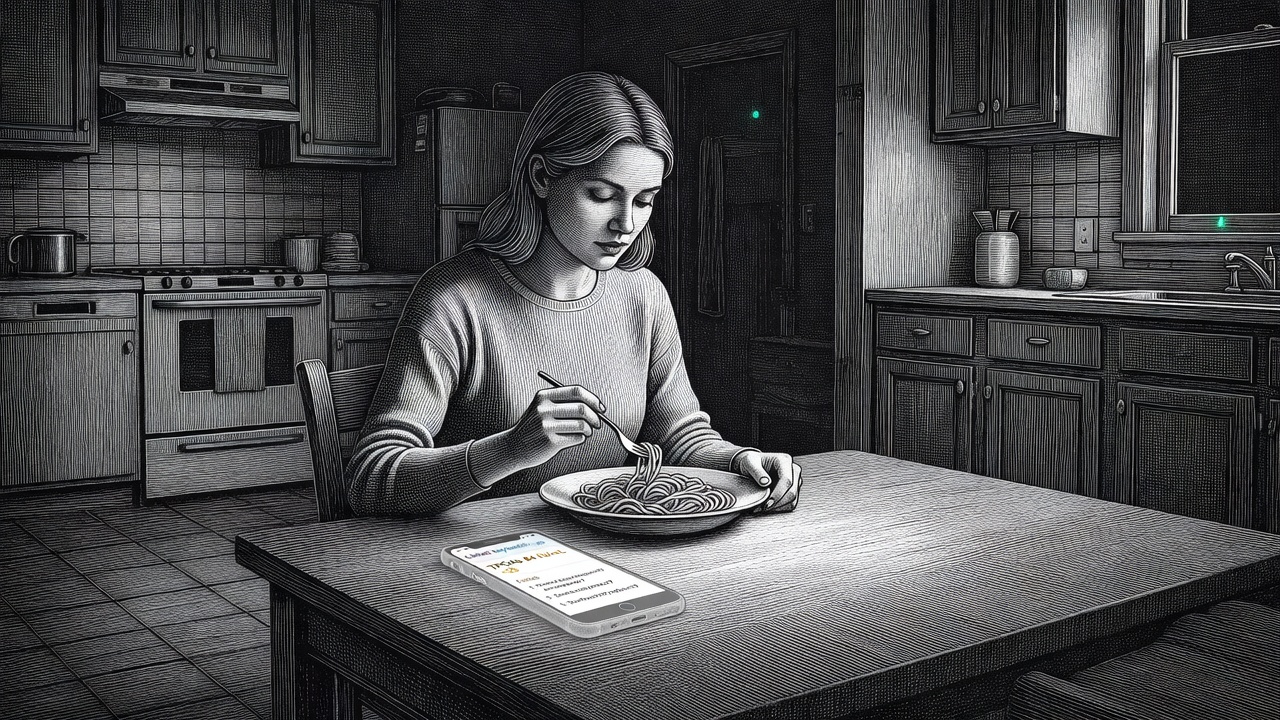
She eats at the kitchen table. The number 84 is still in her head, but differently now. Not as a thing that arrived and was surprising. More as a thing she has given the right amount of attention to — three questions, one cover note in March, a follow-up that will be scheduled. The monitoring is the correct response. She is doing the monitoring. The next data point is March.
Between now and March, her job is not to think about 84 IU/mL more than it warrants. She is not sure yet how much it warrants. But she has the questions written down, which means she has already given it what she has to give it tonight.
[84 IU/mL. Monitoring. Three questions written. March 2047. Next: September 22 shoulder MRI.]