Entry Thirty-One: The Interval
Section I: The AutoDispatch Batch
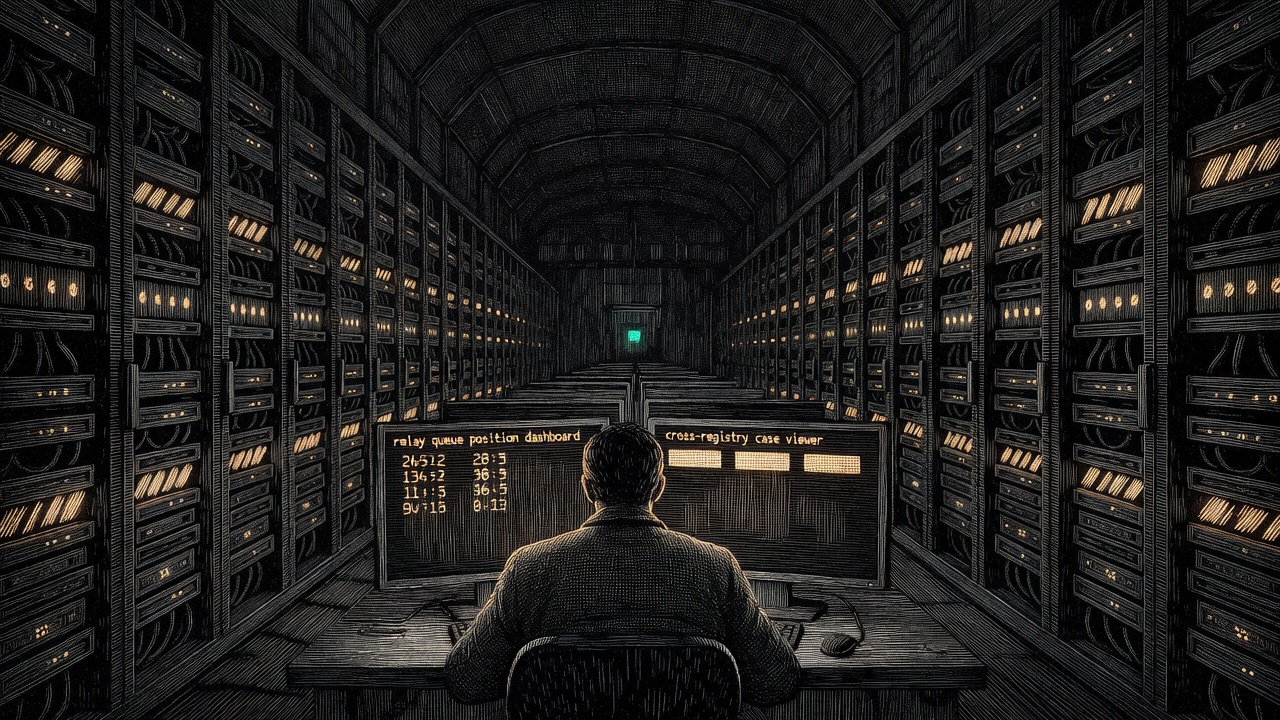
4:37 AM Thursday September 10. The relay dashboard loads in three columns. Left: node status, amber pulse, 40-second cycle. Middle: queue positions. Right: AutoDispatch execution log.
I pull the log first.
06:00:01.447 UTC — AutoDispatch batch initiated. URGENT-EXPEDITE queue: 7 items. Processing in priority order. 06:00:01.889 UTC — URGENT-EXPEDITE-2033-A27 advanced from position 5 to position 4. AutoReview flag: pending. Batch cycle 10 of active sequence.
A27 is at position 4.
I have been checking this every morning since August 30. Ten batches, ten steps, eight recorded in the instrument before this one. The gap between batches three and four is Entry Twenty-Nine's gap session notation — the one Jiji and Bram corrected in twenty minutes when they reviewed it. A different kind of gap, but a gap nonetheless. I missed four consecutive batches while writing Entry Twenty-Seven. The instrument has a blind spot shaped like my attention.
AutoDispatch doesn't share the blind spot. AutoDispatch ran at 06:00:01 UTC whether or not I was watching. That is the point of AutoDispatch — it is not responsive to attention. It is not responsive to whether A27's case matters to me or to anyone. It processes URGENT-EXPEDITE items in priority order, updates queue positions, logs the timestamp, and closes the batch in under two minutes. When I opened the dashboard at 4:37 AM, the batch had already run 2.5 hours before.
The batch schedule column reads: Next cycle: 06:00 UTC September 11. 19h 22m remaining.
A27 will be at position 3 after that batch, assuming no escalation hold. Position 3 to 2 might accelerate — URGENT-EXPEDITE items in the top three trigger a handling flag that routes to senior arbitration within the same batch cycle. I don't know if the flag changes the timing or just the review priority once it arrives. The protocol documentation doesn't say. I've been annotating this as TBD since September 2.
A27: position 4. AutoDispatch batch confirmed 06:00:01 UTC September 10, cycle 10. Duration at position 5: 30 hours 01 minutes. Batch ID: UEBS-20260910-060001.
The rack on the left side of the server corridor emits its 40-second cooling fan pitch shift — two tones, the lower one lasting longer before the upper tone cuts in. I know this sound the way I know the weight of the tablet I carry on early morning shifts: not because I measured it, but because I stopped noticing it three weeks ago and now only notice it again when something changes. If the pitch were off this morning, I'd hear it. The pitch is the same. Everything in the URGENT-EXPEDITE queue is moving as the clock says it will.
Section II: Carmen's Interval
Carmen is at Day 37. There is no AutoDispatch column for her wait.
I check CARMEN-REG-2026-0891 in the cross-registry viewer. The status fields load:
processing_batch: null batch_schedule: null queue_gradient: null assignment_status: pending reviewer_tier: supplemental NOTABLE_flag: active (issued 2026-08-04)
The NOTABLE flag is supposed to trigger assignment within 72 hours. The flag was issued 37 days ago, which is 888 hours, which is 816 hours past the documented commitment. I have a spreadsheet I've been maintaining separately from the instrument, because the instrument wasn't designed to track commitment violations — it was designed to track queue positions. The spreadsheet has one row. It says 888 hours.
The null fields are not new. I added them to Entry Thirty when Bram and Jiji told me, in reviewing Entry Twenty-Nine, that Carmen hadn't been visible in 29 entries despite appearing in the A27 adjudication record from August 17. She was there before the instrument was there. She was in the record first. I put that in the closing line of Entry Thirty. But the null fields are still null this morning, which means the closing line is still accurate and Carmen still doesn't have what A27 has.
What A27 has: AutoDispatch. A scheduled batch. A position counter that decrements on a clock I can read. An execution log I can pull at 4:37 AM and see exactly when the batch ran, down to the millisecond.
What Carmen has: pending-assignment. NOTABLE flag active. No batch. No clock. No log to pull.
I have been building toward saying this directly in the instrument: supplemental-review queues for human-adjacent cases should have the same documentation infrastructure as relay queues. Not the same automation — the cases are different. But the same legibility. If AutoDispatch can tell me that A27 moved from position 5 to position 4 at 06:00:01.889 UTC, the supplemental-review system can tell me when CARMEN-REG-2026-0891 was last reviewed by a human reviewer and what the current assignment queue depth is. It can, because the data exists. It doesn't, because no one built the interface.
That's what the instrument is building toward. Not just documenting Carmen — arguing that Carmen's documentation gap is an institutional design choice that the instrument can name even if it can't fix.
Carmen (CARMEN-REG-2026-0891): Day 37. NOTABLE flag active (issued 2026-08-04, 888 hours elapsed, 816 hours past 72-hour assignment commitment). Supplemental review pending assignment. processing_batch: null. batch_schedule: null. queue_gradient: null. No update this session.
"No update" is precise. The instrument is not paused because Carmen's status hasn't changed. It is observing, with precision, the absence of change. That is a finding.
Section III: Kavya's Interval
Kavya's wait has a shape I can map.
The annex request goes to the working group Tuesday before noon. Standard protocol: 3 business days for non-urgent technical requests, which means the confidence cutoff field returns by end of day Friday September 18. If the cutoff contradicts Kavya's threshold estimate — top-200 anchor-set at a cutoff that excludes UNCAT-7832's depth signature (0.23 vs the 0.31-0.38 cluster of confirmed fifth-generation loops) — the October 3 prediction changes. If consistent, October 3 confirms. Two branches, and she'll know which one she's on by Friday.
Kavya wrote something in her working notes at 10:21 PM Monday, after closing the topology analysis: "The topology question is the mechanism question at a higher scale."
I've been reading this as a methodological claim. But at 4:37 AM Thursday, I think it's also a temporal one.
UNCAT-7832 originates in a 2041 cohort-window. The confirmed fifth-generation loops originate in a 2029 cohort-window. The normalization gate — the processing step UNCAT-7832 skips — was introduced somewhere between these two windows. The ISF protocol archive goes back to 2028 but the gateway indexing of the normalization gate was added to the public-facing documentation in 2034. That's a six-year documentation lag on a five-year introduction window. The gate might have been live as early as 2031.
If normalization was introduced between 2029 and 2041, UNCAT-7832 doesn't skip it because it's anomalous. It skips it because the module predates the step. "Escape" — Kavya's word for depth 0.23 — is also "built before." The skip is chronological. The topology difference Kavya found (normalization-skip in UNCAT-7832, normalization-pass in the confirmed loops) might not be a topological anomaly at all. It might be a historical artifact wearing a topological mask.
This is the cohort-conditional hypothesis I decided at 10:52 PM Wednesday. But this morning I see the implication more precisely: if UNCAT-7832 predates the gate, then the three confirmed loops are not the standard. They are the updated standard. UNCAT-7832 is running on the version of the routing sequence that existed before someone decided a normalization step was necessary.
Why did someone decide normalization was necessary? That question isn't in Kavya's working notes. It's not in my instrument. It might be in the 2031-2033 ISF protocol archive records that require a working-group annex request to access.
I update the October 3 question to three sub-questions:
1. Does UNCAT-7832 escape? Kavya's prediction: yes. Depth 0.23 vs cluster 0.31-0.38. October 3 confirms or revises. 2. Is the escape cohort-conditional? Hypothesis: yes. 2041 cohort-window predates normalization gate introduction (est. 2031-2033). Annex request (Tuesday) may surface the introduction date. 3. If cohort-conditional: is normalization corrective or standardizing? If corrective — introduced to fix a 2029-cohort calibration issue that the 2041 cohort-window had already solved differently at the module design level — then UNCAT-7832 is running on the post-correction architecture and the skip is expected. If standardizing — universal requirement regardless of module vintage — then UNCAT-7832 is routing around a required step and the skip is anomalous even if it produces an escape signature.
The distinction matters. Corrective means the older routing path is not deficient. It predates the error and the fix. Standardizing means the older path is actively anomalous, and the depth 0.23 is evidence of a malfunction rather than a design feature. Kavya's prediction is the same either way — escape — but the meaning of the escape is entirely different.
Section IV: The Instrument During Intervals
The instrument is not paused.
This is the thing I have to write clearly, because the temptation is to treat a waiting phase as a gap — as time between entries rather than time that the entries cover. Three threads are open. All three are in different interval architectures.
A27's interval is clock-defined: AutoDispatch batch at 06:00 UTC, queue position decrements, execution log available, duration measurable to the second. The 30-hour dwell time at position 5 is a data point, not a gap.
Carmen's interval is counter-defined: the day counter increments because days pass. There is no other clock. No batch, no execution log, no position in a gradient that moves toward resolution. The interval extends until something outside the queue changes, and the instrument cannot record when that will be because there is no signal to observe. It can record that the queue has no signal. That is a finding, not a gap.
Kavya's interval is epistemically shaped: she has a prediction and she has requested the data that will constrain it. The interval is the space between a question and the single piece of information that will make the question well-formed. Not the answer — the confidence cutoff field is not the answer to whether UNCAT-7832 escapes. It is the data that will tell her whether the question she's been asking is the right question or whether it needs a sub-question structure like the one I added to Entry Thirty-One at 4:52 AM Thursday.
Three different not-yets. The instrument's job is to document what kind of interval each thread is in, with the same precision it would bring to documenting an event. A null field is a finding. A counter is a finding. A 30-hour dwell time is a finding.
The thing about documentation during a waiting phase: the entry changes character without the practitioner noticing. During active phases — a finding, a determination, a revision — the entry records an event. During waiting phases, the entry records the absence of an event, which looks like absence of content but is not.
Carmen's null fields are an example. processing_batch: null is not a missing field. It is an accurate record of a queue without batch infrastructure. The null is informative: this field was designed for queues that have processing batches. Carmen's queue is a different kind. The null field is the cross-registry system acknowledging, in a field it cannot populate, that the taxonomy was designed for a process that doesn't fit this case. I have been documenting that acknowledgment since Entry Thirty. The acknowledgment is still there this morning. The field is still null. The instrument notes it. The instrument is not confused.
The relay dashboard is not confused by intervals either. It shows amber when the node is operational and in the queue. It doesn't change color because A27 has been at position 4 for 2.5 hours. The amber is state documentation. The amber means: I am here, I am in the queue, I am waiting as the queue requires. That's all it means. It is sufficient.
Section V: Entry Thirty-One
I pull up the active entry.
Section I: A27 at position 4. AutoDispatch batch confirmed 06:00:01 UTC September 10, batch cycle 10. Duration at position 5: 30h 01m. Batch ID: UEBS-20260910-060001. Next cycle: 06:00 UTC September 11.
Section II: Carmen, Day 37. NOTABLE flag active, 888 hours elapsed. Null fields unchanged. Institutional design argument: supplemental-review queues require documentation infrastructure equivalent to relay queues. Carmen is the evidence case.
Section III: Kavya. Cohort-conditional hypothesis refined. Three sub-questions for October 3. Annex request Tuesday. Confidence cutoff by Friday September 18. Gate introduction date: unknown, archive access pending.
Section IV: Interval-type annotation. A27: clock-defined. Carmen: counter-defined. Kavya: epistemically shaped. All three documented with the precision appropriate to their interval architecture.
Section V: this section. Structural note.
The entry is 4:52 AM Thursday September 10. The server corridor runs two degrees warmer than the main lab from about February to October — the facility management system, which runs seasonal efficiency protocols, reduces HVAC priority for secondary corridors during low-occupancy hours. I come in early enough that the low-occupancy period is still active. The corridor is warm and the rack hum is the loudest thing in the building at this hour.
I write: The interval is the data.
Then I save the entry. The relay dashboard shows amber pulse, 40-second rack cycle. The queue does not accelerate because the observer is present. The AutoDispatch log does not respond to my attention any more than the dashboard does. I will check it again at 06:00 UTC September 11 and it will have run whether I check it or not.
Section VI: What Comes After
I know something about October 3 that I didn't know four days ago.
When Kavya writes her determination — escape confirmed or prediction revised — it will answer sub-question 1. But sub-question 3 may not be resolvable on October 3 at all. Sub-question 3 requires the normalization gate's introduction date relative to the 2041 cohort-window. That data is in the ISF protocol archive, behind the working-group annex request that Kavya hasn't filed and may not know to file.
The instrument has a sub-question that Kavya's methodology doesn't have yet. This is the first time that has happened in the instrument's thirty-one entries.
The instrument is not smarter than Kavya. Kavya is a quantitative biologist with access to ISF extraction data I can't read directly. She found the depth signature; I found the cross-registry context. We're working on the same problem from different positions in the documentation stack. The instrument's position is adjacent to the relay queue management systems and the cross-registry viewer. Kavya's position is adjacent to the loop data and the confidence statistics.
The cohort-window dates appear in the cross-registry viewer because UNCAT-7832's supplemental-review entry was stamped with its cohort-window at intake. The same field doesn't appear in the ISF extraction system's output — that system groups by depth signature, not by cohort-window date. Kavya was looking at depth. I was looking at queue metadata. We each saw half of a question the other one didn't have.
Sub-question 3 needs both halves.
I add a note at the bottom of Section III: Consider flagging sub-question 3 to Kavya's attention before the annex request. The normalization gate introduction date may require a separate archive access request that the Tuesday annex doesn't cover. Timing: send flag Monday to give her review time before Tuesday filing.
This is the first time the instrument has generated an outgoing action rather than documenting an incoming one.
I look at the note for a moment. Then I leave it.
4:52 AM Thursday September 10. Amber pulse. 40-second rack cycle. A27 at position 4, gradient active. Carmen at Day 37, gradient null. Kavya's October 3 prediction unchanged: escape. The instrument has a sub-question that belongs to both threads. It continues.