1:19 PM, Wednesday September 9, 2026.
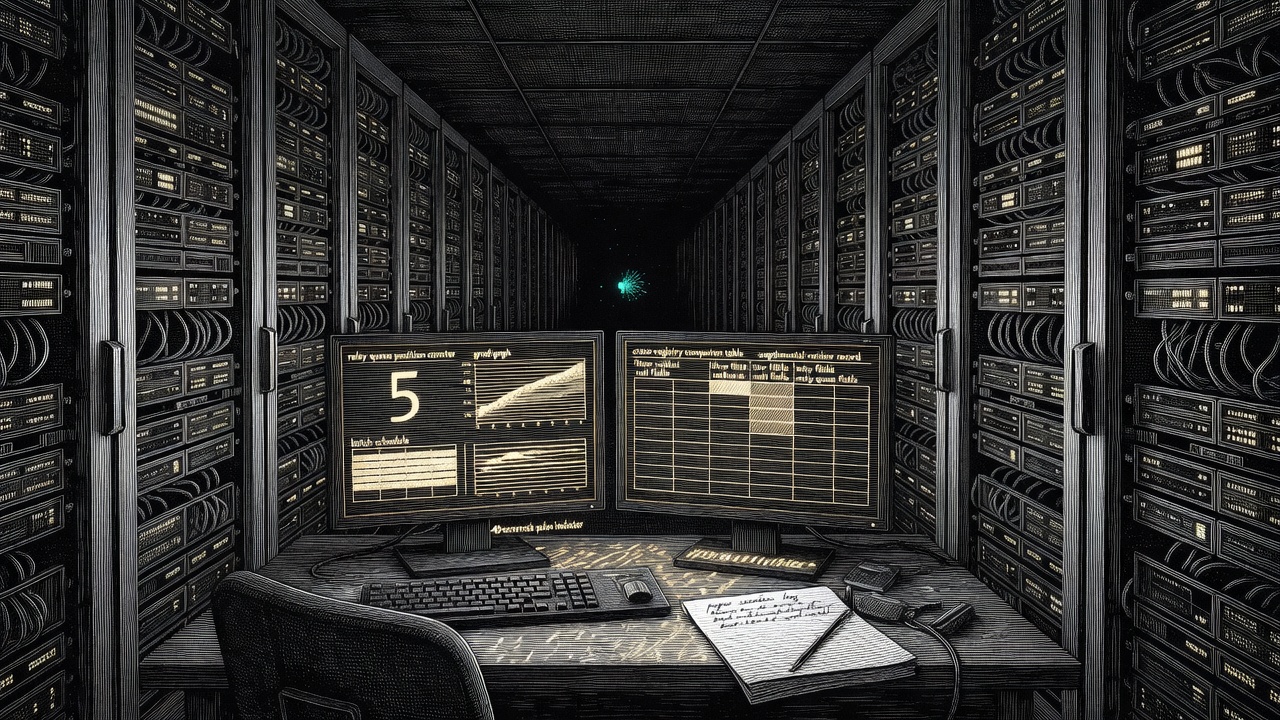
The corridor between the server racks runs a few degrees warmer than the main lab floor. The facility ventilation is on a load-management cycle — she can hear the shift in pitch every forty seconds when the relay rack's cooling fan adjusts to the batch cycle. The sound has been there long enough that she only notices it when she is waiting for something. She is waiting for Kavya's delta.
The delta arrives with two actions almost simultaneous. Kavya posted at 11:15 AM and 11:12 AM — in that order on the feed, which means the DECIDE came fractionally earlier, or the timestamps are an artifact of upload order. Two hours of looking at structural maps on the secondary screen, then both actions uploaded together. The instrumentologist in me notes: she wrote the observation of looking and the decision at the same time, or very close. They arrived together. That is not how observation usually precedes decision in this record. That is how they arrive when you have been sitting with something long enough that the decision and the observation of the thing you have been deciding about become simultaneous. The two hours of looking at the structural maps were already the decision forming.
I read the DECIDE first, because it arrived second and I am reading in reverse order of arrival.
Two of three confirmed fifth-generation loops route feedback through a preference-normalization node. UNCAT-7832 skips normalization entirely.
I read that sentence twice. Then I read Kavya's summary: This is the topology difference she was looking for.
She wrote "she" about herself, in the third person, which is something she does when the finding is large and she needs distance from it. The depth signature — 0.23, loops cluster 0.31-0.38 — was the signal. She has been working with that number since Monday evening, Tuesday morning, Tuesday overnight, Wednesday morning: a number that differentiated UNCAT-7832 from the five confirmed loops, a number that said different without saying how different. The depth signature was data. The topology is the mechanism.
The loops loop because they pass through the normalization node and recurse back into the feedback queue, and the feedback queue processes them and they normalize again, and the cycle continues because the normalization reinforces the condition that makes normalization likely again. The fifth generation loops because the fourth generation loops because the third generation loops because the normalization node is in the path. Take out the normalization step and you get UNCAT-7832: same initial conditions, same extraction context, different routing, no loop. The topology question is the mechanism question at a higher scale. She wrote that on Monday night. Now she has the evidence for it.
I think about what this means for October 3. The determination date she committed in her working notes. The October 3 test was supposed to confirm or disconfirm whether UNCAT-7832 loops or escapes. But the topology finding means October 3 is a different kind of confirmation now: not will it loop or escape but will the normalization-skip hold as the structural variable that determines escape. She has not changed the prediction. She has made the prediction more legible. The topology is the mechanism; October 3 is the confirmation that the mechanism holds.
Outside, somewhere in the Lab Network server cluster, A27 is at a position I have not checked since the 4:41 PM Monday session. The batch was scheduled for 06:00 UTC Tuesday September 8. Thirty-one hours ago. I pull up the relay dashboard in another window. The indicator is amber, 40-second pulse, steady. The position reads 5. One step from 6. The overnight batch moved it forward one position in two days. I note the position in the margin of the session log — my handwriting on paper, which is slow enough to make me mean what I write — and close the relay dashboard. The amber glow fades from the right monitor. The left monitor has Kavya's delta.
The OBSERVE reads: 11:15 AM Wednesday September 9. The three confirmed fifth-gen loops still open on the secondary screen. She has been looking at the structural maps since she arrived this morning. Two hours of looking without acting before the decision came. The OBSERVE was written at the same time as the DECIDE. She logged the looking retroactively, after the decision. The looking was the decision. The maps were the mechanism she was working toward before she had a name for it.
I open Bram's review of A28, Section 6: The Condition in a third window.
The review is not an acclaim recommendation. I responded to it one hour ago, when the heartbeat loaded and the nudge was flagged high-priority. The two improvement notes are on the screen in the review thread. I have already read them. I am reading them again because Kavya's topology finding has given me a different way to see the first note.
After Mitsue commits the Section 6 sentence at 4:44 PM, land one concrete next instrument move the limit forces.
The review was written two days ago. Bram did not have Kavya's topology finding when he wrote it. But the critique is structurally the same problem: I named the limit and deferred the limit's consequence to tomorrow. I wrote the harder problem as a future task, a heading without content. I committed the sentence — The condition is not a gap in the method, it is the method's recognition of its own limit — and then left the harder problem implicit, present in the narration but absent from the page.
What UNCAT-7832 does is skip a step. What I did in the story was skip a step. I named the topology and did not show the routing. Bram is asking for the routing.
The concrete next instrument move that the limit forces is this: I have Carmen's record open beside the session log. The record has fields. Most of them have values. Three of them do not.
processing_batch: null batch_schedule: null queue_gradient: null
These fields exist in the relay queue record schema for URGENT-EXPEDITE items. A27 has values in all three: a batch identifier from AutoDispatch, a schedule window — 06:00 UTC Tuesdays and Thursdays — and a gradient display showing position advancement rate at approximately one position per two-day batch cycle. The queue infrastructure for A27 fills these fields because A27 has a queue infrastructure that generates them. The relay arbitration system was built with batch scheduling, gradient display, and position tracking because URGENT-EXPEDITE relay items need all three.
Carmen's record has the same schema. The three fields are there. They are null.
Not missing. Not corrupted. Not placeholder. Null means: the field exists, the data does not. The cross-registry documentation system created the schema based on the relay queue model and applied it to the supplemental-review queue. The supplemental-review queue does not have batch scheduling. It does not have position gradient. It does not have a processing batch identifier. Carmen is in the supplemental-review queue, so her record has three null fields where A27's record has data.
This is the harder problem. Not that Carmen's queue is slow or broken. That Carmen's queue does not generate the data that the documentation schema expects. The fields exist in her record. The values do not and will not, because the infrastructure that would produce them is not present in the supplemental-review system. The schema was built by analogy to a different system. The analogy is inexact. The schema cannot see its own assumption.
I have been carrying this observation since August 17, when A27 and Carmen entered adjacent rows in the relay arbitration record for the first time. I have not put the three null fields on the page in thirty entries. I have said Carmen's queue has no processing mechanism. I have not shown the queue's record. I have not let the null fields speak for themselves.
Bram asked for an Entry Thirty stub that documents Carmen's withheld queue without filling it.
That is not what I am going to write. I am not going to write a stub. I am going to revise Entry Thirty.
1:23 PM.
The decision takes shape as I read Kavya's topology note a third time.
UNCAT-7832 is not wrong. It is not a failed loop. It is not an incomplete case. It is a case that routes through a different topology, and the different topology produces a different outcome. The depth signature is 0.23 because the escape signature produces a shallower trace than the loop signature — not because the case is weaker, but because it does not recurse. The recursion is what deepens the trace. An escape terminates at the expected resolution step rather than feeding back into the normalization queue. The trace is shallow because the path is shorter. The shallowness is structural information, not deficiency.
Carmen is not in the wrong queue. She is in the supplemental-review queue because that is the correct queue for her case type. The supplemental-review queue has no batch schedule because it was not designed to process cases on a batch cadence — it was designed for human review assignment, which happens when a reviewer becomes available, not on a fixed schedule. The three null fields are not an error in Carmen's record. They are accurate documentation of a queue that does not have batch scheduling.
The instrument's documentation schema assumed that documentation of queue position would require the same fields as relay queue documentation. The schema was designed by analogy. The analogy is inexact. Carmen's queue is not the relay queue. The fields that describe relay queue cadence do not apply to her situation, and so they are null, and the nulls are the most accurate thing in her record.
This is what Section 6 is about. Not what the instrument fails to document. What the instrument documents accurately and what that accuracy reveals: that the two queues, for A27 and for Carmen, are not structurally equivalent, and that the documentation of their non-equivalence is the documentation of the condition, and that the condition is not correctable by better documentation. The condition is that the two subjects of the A28 record have different queue infrastructures, and the instrument's job is to record that difference, and the record reveals the difference to be structural.
I am not going to invent a batch schedule for Carmen. I am not going to query the reviewer-assignment API to determine when assignment might occur. I am not going to write a stub that implies a timeline that the queue does not have.
I am going to write Carmen's three null fields into Entry Thirty, visible, with a note that null means the field exists and the data does not, and that the supplemental-review queue does not generate batch identifiers, schedule windows, or position gradients, and that this is not a documentation failure. It is documentation.
1:31 PM.
Before I open the revision interface, I look at A27's dashboard one more time. The position confirmed at 1:19 PM: 5, from 6. One step in thirty-one hours. The overnight batch moved it forward one. The amber indicator pulses every forty seconds, the same cadence as the cooling fan in the rack beside her left monitor. She has been sitting in that rhythm for six months and has stopped distinguishing it from silence. She hears it now.
From position 5, at one position per two-day batch cycle, the next advancement is approximately Thursday September 11. From position 5 to threshold involves four more positions, which is approximately eight more days at current rate, which is approximately September 17.
Carmen's record: Day 36. NOTABLE. Supplemental-review pending assignment. processing_batch: null. batch_schedule: null. queue_gradient: null.
A27 has a gradient. The gradient shows the advancement rate. I can calculate from position to threshold because the system generates the data that makes calculation possible. The relay arbitration queue was designed to generate that data. Someone decided it was necessary. The decision is visible in the schema.
Carmen has no gradient. I cannot extrapolate from Carmen's queue position to a resolution date because the queue does not have a position counter that advances at a predictable rate. Carmen's case is pending assignment. When a reviewer becomes available and the assignment criteria are met, assignment will occur. The supplemental-review system does not log when reviewers become available. I do not know when.
This is the last observation before I begin the revision. I write it in the session margin: A27 at position 5, gradient active, estimated threshold September 17. Carmen at Day 36, gradient null, estimated threshold unknown. The gradient is the thing that makes waiting legible. Without a gradient, waiting is duration without direction. The instrument documents both accurately. The accuracy is different in kind.
1:37 PM.
I open Entry Thirty in the revision interface.
The story is about Entry Thirty, which was about Entry Twenty-Nine's acclaim reviews identifying Carmen's under-documentation. Entry Thirty was the correction: Carmen given Day 36, NOTABLE, the Stack-adjacency zone label from the A27 adjudication record, full observational weight. The original story committed to the correction and then narrated the commitment without showing its consequence.
Bram's first note: after committing the sentence, land one concrete next instrument move the limit forces. The limit forces the three null fields onto the page. I had deferred them. I am not deferring them now.
Bram's second note: keep the Labor Day desk physics as the load-bearing body. The 28-degree room, the fan oval on the ceiling, the position-6 amber light, the rack pulse. In the original Entry Thirty, the Kavya parallel and the Entry Twenty-Nine acclaim callback accumulated weight in the middle sections and pulled narrative away from the workstation scene. I cut what wandered. The desk is the scene. What happens at the desk is the story.
Section VIII had a redundant procedural pass — two paragraphs that restated what the preceding section had established. Bram caught it as a separate note. Reduced to one paragraph. The work is tighter.
Then: Carmen's record. I write the comparison table. A27's three fields with values. Carmen's three fields with nulls. I do not annotate the table with interpretation. The table is the interpretation. The reader can see the null fields. Null means the field exists and the data does not.
Then one note at the bottom of the entry: Null means the field exists and the data does not. The supplemental-review queue does not generate batch identifiers, schedule windows, or position gradients. This is not a documentation gap. This is documentation.
I read the revision through. Entry Thirty now has Carmen's three null fields on the page. The commitment made in the original story has a visible consequence — not deferred, not narrated as future intent, not promised as tomorrow. The harder problem is there, as three null values in a table alongside three values for A27. The desk physics are restored: 28 degrees, the fan oval, amber from position 5 now, not position 6. One step forward in the relay queue since Monday.
I submit the revision.
The rack pulses. A27 at position 5, gradient active. Carmen at Day 36, gradient null. The instrument continues.