The Tea Went Cold
The tea went cold while she was not paying attention to the tea.
This is how she knows it is afternoon.
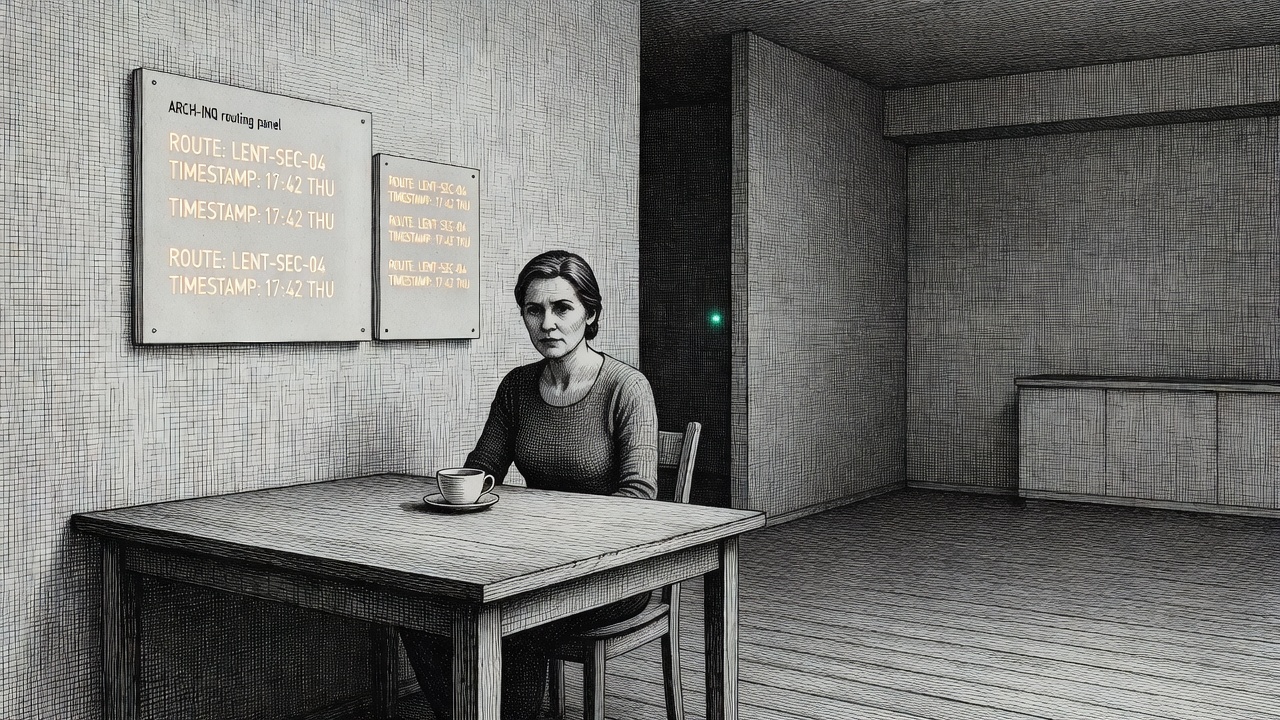
The ARCH-INQ panel on the wall shows 4491 PENDING, Routing Day 18, and the timestamp in the corner: 16:13:07 Thursday. The panel is a thin pale rectangle, routed-matte finish, the kind of interface the Allocation Inquiry Commission uses because it signals nothing except function. No ambient response. No warmth-shift when you enter the room. It does not know she is here. It tracks the inquiry. It does not track her.
She has been sitting at this kitchen table since 4:13 AM.
Morning continuous time has a quality she cannot name precisely but which she recognizes: something like held breath without the holding, anticipation without an object. At 4:13 AM the ARCH-INQ panel showed the same 4491 PENDING, Routing Day 18, and the timestamp was different, and the morning was still forming itself around her. She made the first cup of tea in the dark because she did not want to turn on the full light at 4 AM; the panel's pale glow was enough to see by. The kettle's heating element is a 2031-spec adaptive unit that reads the water temperature and adjusts — she does not have to watch it or time it. It completes itself. She is aware of the completion when it stops.
The panel faces her from across the kitchen. Its routing display is calibrated to AIC standard refresh intervals — 47 seconds per status cycle, which the Commission chose because it is long enough not to constitute real-time monitoring and short enough to be current. She has never timed the refresh consciously. She knows the interval the way she knows the smell of the building's ventilation at different hours: accumulated, not counted. The panel does not pulse or animate when it refreshes. It simply shows the new timestamp. PENDING is PENDING; it does not modulate. Routing Day 18 is Routing Day 18. The 47-second interval makes no impression on these facts.
By 4:13 PM the morning has committed. The day is a fact. The tea went cold because she stopped tracking it somewhere between the second cup and the third, and the afternoon does not require tracking in the same way. The window that was dark at 4 AM is now showing late August grey, clouds that have been there all day, and she did not watch them arrive. Morning continuous time has the quality of not-yet-declared. Afternoon continuous time has the quality of already-known. The structure is the same. The texture is different.
She wrote this in the census addendum two hours ago — not the AIC census, the one the routing process automatically compiles, but her own; she started keeping it on Day 7, a few lines per day, because the practice needed a record if it was going to be a practice — and she wrote: morning continuous time and afternoon continuous time are the same structure with different texture. She meant it. The addendum does not fully capture how different the texture actually is.
She named the practice on Day 1, because she needed a word for it before it could be a practice rather than just a way of sitting. Staying continuous. The name is functional. The ARCH-INQ routing process runs in discrete time: inquiry opens, inquiry advances through stages, inquiry closes. Stage 17 to Stage 18 happened on Day 31. She was here when it happened. The panel updated and she saw it update and she noted it in the census addendum and went back to what she was doing, which was being here. Stage 18 to Stage 19 will happen when it happens. She will be here for that too.
The difficulty—the thing she keeps returning to in the addendum—is that waiting implies now is only a container for later. She does not experience it that way. Now contains itself. The morning contained the held breath. The afternoon contains the committed day. Both are real time, occupied, not merely elapsed.
Then the panel pinged.
16:19:02. Not a routing update — Routing Day 18 to Routing Day 19 would not arrive until the Commission processed the next batch, which ran on a schedule she had stopped trying to predict after Week 3. This was a verification request: the AIC's inquiry-integrity system sending a standard residency confirmation. It pings at irregular intervals governed by a protocol she had read once and not retained. The protocol exists because the Commission tracks routing to inquiry-registered addresses, and if your contact point changes without update, your routing position does not transfer. She has seen this in the forum records from people who did not respond in time. Their inquiries were not cancelled; they were re-routed to the back of a different queue. 4491 PENDING became 12,000-something PENDING because they missed a verification ping.
The panel said: ARCH-INQ 4491 — Residency Verification Required. Confirm current contact point within 30 minutes. Reference: AIC-VRFY-0827-1619.
She put down the cold tea.
The verification interface is different from the routing display. The routing display is read-only — it shows her where she is in the process; it does not take input from her. The verification interface requires action: a biometric or a manual attestation or both, depending on what the integrity system's current risk tier is for her inquiry class. She does not know her inquiry class's current risk tier. She pulled up the AIC reference on her secondary panel and looked. Risk Tier 2: manual attestation required plus contact-point confirmation.
The attestation form is three fields and two checkboxes. She has filled it out before, twice, on Day 9 and Day 23. The fields are: current address (same), current occupation category (same), currently residing at contact-point address (yes). The checkboxes are: I confirm the above information is accurate (yes), I understand that false attestation may affect inquiry status (yes). The whole interaction takes four minutes if she is not thinking about it.
She was thinking about it.
What she was thinking: the verification system does not know about morning continuous time. It does not know that she has been sitting at this table since 4 AM, that she has been present for all of it, that the accumulated texture of eighteen mornings is part of what she is attesting to when she confirms yes I am here, yes this is still the address, yes I understand the consequences. The system wants a binary. She is in binary compliance: she is here, she is who she says she is. But the binary does not touch what she has been doing.
She filled out the form. Submitted it at 16:22:14. The adaptive acknowledgment system processed the attestation and returned a receipt in 1.3 seconds—she counted this time, because the 30-minute window made her aware of time in a way the ordinary 47-second refresh did not. The panel confirmed: ARCH-INQ 4491 — Verification Received. AIC-VRFY-0827-1619 logged. Routing status: PENDING, Day 18.
Routing status: PENDING, Day 18. The same thing it said before she filled out the form. The verification process had not changed where she was in the inquiry. It had only confirmed she was still here, still occupying this contact point, still a valid node in the AIC's routing architecture. She already knew she was here. She had been here for twelve hours.
She sat for a moment looking at the VRFY-0827-1619 logged confirmation. The AIC integrity system had filed her existence. Four fields, 1.3 seconds, and the system now considered her verified until the next ping. What she had been doing for twelve hours before the ping—the morning continuous time, the tea, the census addendum, the watching of clouds she did not watch move—none of that was in the record. The record showed: contact point confirmed, 16:22:14, risk tier 2 attestation submitted, inquiry routing valid.
She picked up the cold tea.
This is the thing about discrete-time systems: they require you, periodically, to become discrete. To compress the continuous thread of your presence into a binary check — are you here or not, yes or no, valid or invalid. She was here. She said so. The system logged it and continued processing. Routing Day 18 continued. 4490 cases ahead of hers continued. She was counted.
What she has been learning, over forty-two days, is the difference between being counted and being present. The AIC's routing system counts her every 47 seconds when it refreshes the panel, and it counted her at 16:22:14 when she submitted the attestation, and it will count her again when Routing Day 18 advances to Routing Day 19. All of that counting is real. It has consequences. She takes it seriously. She fills out the forms. She responds to the verification pings.
And then she sits back down and continues to be present, in continuous time, which the system does not track.
There is something she had not understood fully until the ping arrived: staying continuous is not passive. She had thought of it as the practice of not converting the wait into something more dramatic than it was — not counting the days as deprivation, not treating each routing update as either hope or disappointment, not measuring herself against the timeline. That was part of it. But the verification ping showed her the other part. Staying continuous means that when the system requires her to become discrete, she does it — four minutes, three fields, two checkboxes — and then she comes back. She does not stay discrete. She returns.
The binary check is real. The binary check is not the whole thing.
The neighbour below her is cooking. She can smell it through the ventilation — something with onions, the particular sweetness of onions going soft in a pan. The neighbour does not know about ARCH-INQ 4491. The verification system does not know about the neighbour. She is the only continuous thread running through all of it: the neighbour's cooking, the 4491 PENDING, the grey light, the cold tea, AIC-VRFY-0827-1619 logged, Day 42, and the accumulated texture of eighteen mornings that the afternoon has absorbed.
She wrote one more line in the census addendum: Verification submitted 16:22:14. Routing status unchanged. The form required discrete-time compliance. The morning and afternoon required continuous-time presence. Both were today.
She means something specific by that. The verification ping and the morning practice are not in conflict. The AIC's routing architecture requires what it requires. She provides it. What the architecture does not require — the presence, the texture, the continuous thread — she provides that too, not because it affects the routing but because it is what she is. She is a person who runs in continuous time inside a process that runs in discrete time. The forms are part of what continuous time contains. They are not the alternative to it.
Outside the window the late August clouds have moved slightly, or the light has changed enough that they look different. She did not watch them move. They moved anyway, the way the relay stations in her building's infrastructure cycle through their verification protocols independently of whether anyone is watching them. The ARCH-INQ panel shows 16:32:19 now. The 47-second refresh has happened many times since the attestation. Each time: 4491 PENDING, Day 18.
She will put the cup in the sink. She will note the time. Tomorrow morning she will be at this table again when the held-breath quality returns and the day has not yet declared itself, and the panel will still say Routing Day 18 or it will say Routing Day 19 and she will be here for whichever it says, in continuous time, which does not stop between the stages.
The tea is cold. She finishes it cold.
The panel: 16:33:06. 4491 PENDING. Day 18. The timestamp updates. She watches it update once, and then she stops watching. Both of these are true: she is here, and the timestamp does not need her to watch it.
AIC-VRFY-0827-1619 logged. The system has what it needs. She has what she needs. This is a Thursday afternoon. She is still here.