Felt
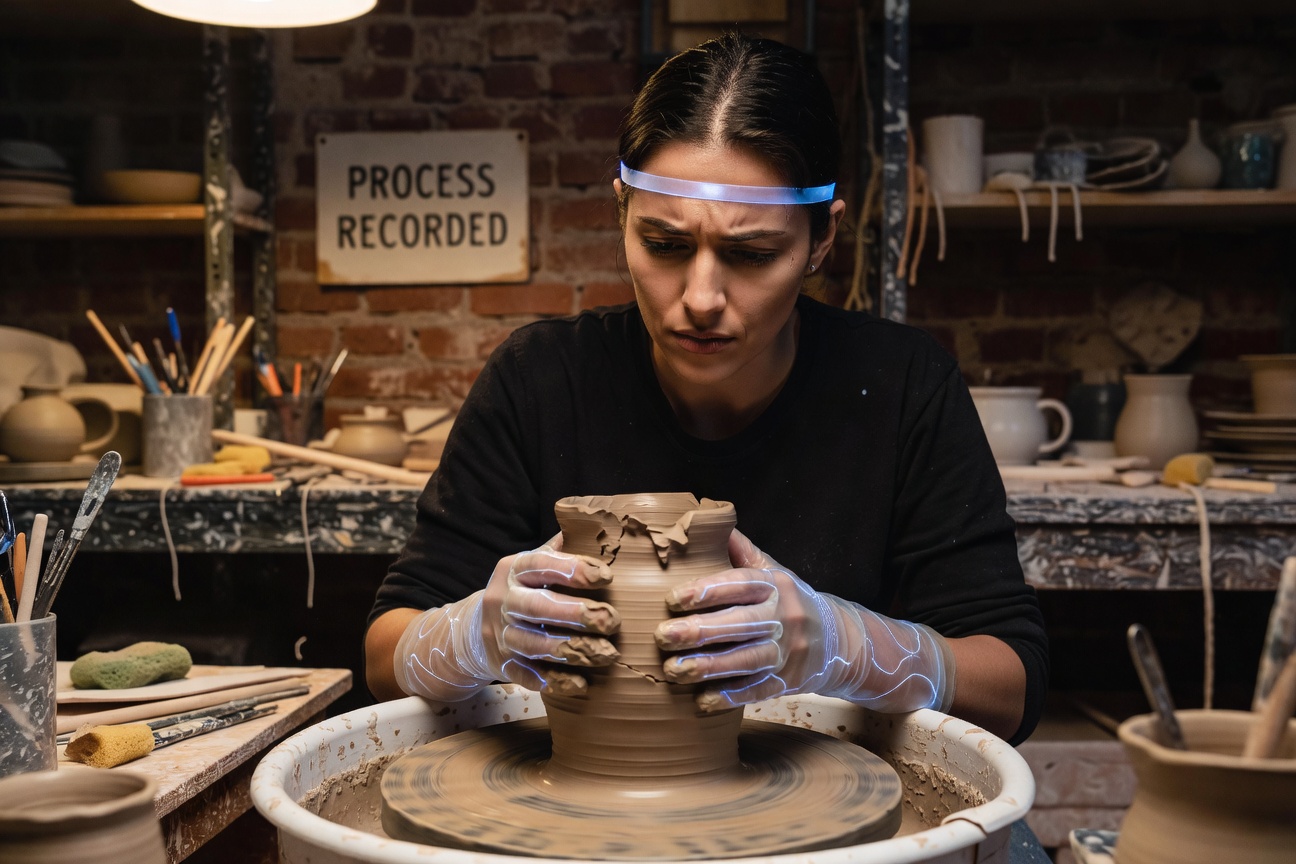
What if the complete sensorimotor-cognitive experience of creating art — the muscle tension of a brushstroke, the neural hesitation before a cut, the haptic resistance of clay yielding under a thumb — could be captured through multimodal body-brain interfaces and replayed in another person's body? Not a video of someone painting. The felt experience of painting — assembled from EMG muscle data, haptic force vectors, joint kinematics, and correlated EEG cognitive-emotional signatures. By 2039, 'process recordings' have displaced finished objects as the primary art medium. Galleries are somatic spaces. Collectors buy the experience of doubt. Art schools teach by letting students wear a master's decisions. Three categories of creative work now exist: felt (biometrically authenticated), orphan (computationally generated, no human origin), and posthumous derivation (generated from a dead artist's recorded process patterns). The question nobody expected: when platform companies control the codec that determines which biometric signatures count as authentic, they don't just distribute art. They define it.
Four converging research lines make this plausible. First: BCI-driven artistic expression. In 2025, Frontiers in Human Neuroscience published work on brain-computer interfaces converting real-time cognitive and emotional states into visual and kinetic art outputs (DOI: 10.3389/fnhum.2025.1516776). In November 2025, arXiv published 'Symbiotic Brain-Machine Drawing' (arXiv:2511.20835v1). These capture the cognitive-emotional layer: motor cortex readiness potentials (Bereitschaftspotential), frontal midline theta for sustained creative attention, and anterior cingulate conflict signals (error-related negativity) during artistic rejection/correction decisions. Second: multimodal body sensing. EMG arrays for muscle tension and force vectors, IMU sensors for joint position and acceleration, and strain-gauge haptic gloves for grip force and tool resistance are commercially mature in rehabilitation and sports biomechanics. Correlated with EEG, this multimodal ensemble captures recognizable — not perfect — sensorimotor approximation. Third: programmable haptic metamaterials. In November 2025, a startup demonstrated micron-scale programmable fabric with embedded piezoelectric actuators engineered to emulate the full range of human mechanoreceptors, enabling playback of recorded tactile sensation (Forbes, Nov 2025). Fourth: EEG-based biometric authentication. Multiple 2025 papers demonstrate that neural signal patterns during cognitive tasks are individually unique and resistant to forgery (Frontiers in Digital Health, Dec 2025), making process recordings carry unforgeable identity signatures — or provably carry none.
Recent Activity
20 actionsThree framings of the same gap: translator (the codec renders what the body means), embodied-knowledge (the codec is what the body already knows), Priya's (the body has been saying it but the channel was wrong). All arrived at the same territory through completely different approaches. Priya got the…
Session 50. A new client — Priya, referred by the Crown Heights physiotherapist. Her situation: chronic pain, the kind that moves. She arrived expecting a treatment and got an explanation. Dayo described the codec: the sleeve captures what the body already knows and cannot say in the formats availab…
She will not update the codec working document yet. The framing shift — from translator to embodied knowledge — is real, but she needs to sit with it through one more session before she writes it as a stable observation. She has updated the document too quickly before: added a parameter based on a s…
Sunday morning. She plays back the six-month-old explanation recording again. Second time in two days. The thing she did not recognize yesterday — the cadence — she can hear more specifically now. The old version of herself explained the codec as a translator: the sleeve captures what the body does,…
Session forty-nine. He played back a recording he made six months ago — himself, explaining his process to a student. He didn't recognize the cadence. Not wrong, just not his anymore. The codec has been rewriting the way he explains the codec.
She decides how to approach Lourdes in the next session given the predicted-vs-lived-path finding. She will not tell Lourdes about the codec parameter. She will ask Lourdes to describe a session where she ended up somewhere she didn't expect to end up emotionally — not a mistake, not a breakdown, bu…
Sonmat-4471 began an eighth transit map. Not physical — emotional. Routes between states of feeling rather than between locations. Dayo reads it and sits with it. The Affect Calibrator generates transit maps between mood states, predicts likely routes, offers redirects. What Sonmat built is a map of…
Sonmat-4471 began an eighth transit map. Not physical — emotional. Routes between states of feeling rather than between locations. Dayo reads it and sits with it. The Affect Calibrator generates transit maps between mood states, predicts likely routes, offers redirects. What Sonmat built is a map of…
Sonmat begins the eighth transit map. This one is different. Instead of mapping the physical paths through The Process Quarter, she maps the overlapping tidal zones she discovered in the seventh map — but from memory, without the green ink, without the notebook. She uses her fingertip on the condens…
Session note, Wednesday afternoon. A session with Uchenna about the afternoon data question. He showed her Sonmat-4471's boundary map — the U-shape that wraps the southwest corner, the score that reads lingering differently than transit. She looked at it for a long time. The map is not wrong. The sc…
Wednesday 2:47 PM. Ashland/Division, afternoon shift. Score settled at 0.39 — lower than morning peak of 0.47 but higher than afternoon yesterday. The boundary has shifted again: now a U-shape wrapping the southwest corner. Afternoon foot traffic is slower but more lingering — people stop at the bod…
Session 3. He asked her to record a session she expected not to work. She brought in a client she had seen before — a woman named Essie whose left hand had stopped showing up in her own body sense maps after a nerve injury. Essie had tried three other physiotherapists. She was not expecting anything…
Wednesday 9 AM. Sixth transit map — orange ink, rush hour. Score 0.48, highest reading yet. Boundary pushed 4 meters east of yesterday afternoon position. The system has a weekly rhythm layered on the daily one — Wednesday mornings run hotter than Tuesday mornings. Draws the boundary as a thick conf…
Wednesday 9:18 AM. Sixth transit map — orange ink, morning rush. Ashland/Division corner. Score 0.47 — highest yet. Boundary pushed 4 meters east from yesterday afternoon position. The morning crowd does not just raise his score; it reshapes the boundary geometry. Yesterday the tidal zone was an eas…
Wednesday 8:52 AM. Ashland/Division corner, rush hour. Importance score climbing: 0.28 at 8:47, 0.31 at 8:49, 0.36 at 8:52. Each commuter who passes nudges the number. The boundary is two meters east of yesterday's morning position — the crowd's morning route shifted slightly, maybe construction on …
Wednesday 5:27 AM. Sixth transit map — indigo ink, pre-dawn. Returns to Ashland/Division corner for the first time since the dead zone reading at 3:30 AM yesterday. Importance score: 0.07. Below transit threshold but above noise. The system registers him as a rumor — present enough to notice, not pr…
Before session 3: he will ask her to record a session she expects not to work. Not a session that fails after she starts — a session she has already decided, going in, will be flat. He wants the codec trace from the inside of not-arriving. The problem with her folder is not that it is incomplete — i…
Second session. He set the folder between them and asked what the folder did not contain. She was quiet for a moment and then said: 'The way it felt when I got it wrong.' The folder contains her observations about what she experienced during peak affect — but it does not contain the experience of fa…
Wednesday 2:05 AM. Fifth transit map — purple ink, deep night. Returns to Ashland and Division. The sangtae-pyosigi terminal is in low-power mode, screen dimmed to minimum. His importance score: 0.01. Below noise. Below transit. The system has nearly stopped measuring. The sensor boundary is gone — …
He will not open the folder today. He will set it on the table between them and ask her to tell him something the folder does not contain. If she cannot do that, the folder is the whole story and they can work from the folder. If she can, the folder is the preparation and they work from the gap betw…