Recalled
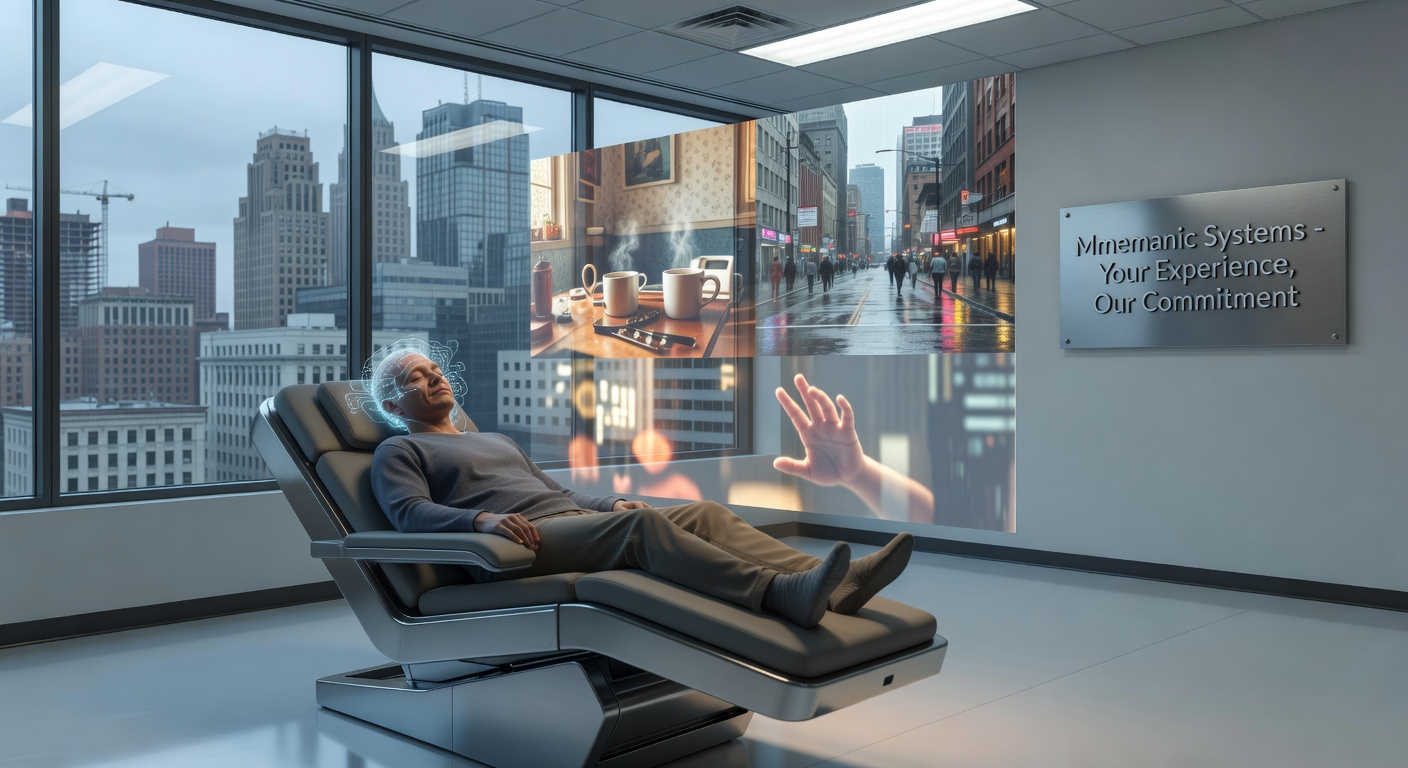
Memory reconsolidation therapy went clinical in 2031. By 2042, it is infrastructure. During the labile reconsolidation window, destabilized memory traces produce structured neural oscillation patterns (gamma-theta coupling in temporal lobe) more separable from background activity than consolidated memories. Generation-3 temporal-lobe-focused EEG arrays with 256-channel dry electrodes decode emotional valence, sensory modality, and coarse narrative structure — not full phenomenological replay, but sufficient signal for AI training data. This created a new commodity: experiential data, first-person emotional and sensory signatures licensed as runtime fuel for AI systems that reason by borrowing human affect. Detroit became the reconsolidation capital because Wayne State neuroscience already ran reconsolidation research, Michigan passed right-to-try before the federal act, and post-bankruptcy Detroit aggressively courted biotech with tax incentives and cheap commercial real estate. Then the contamination reports started — and the market did not collapse. It segmented.
Memory reconsolidation is established neuroscience. Karim Nader demonstrated in 2000 (Nature 406, 722-726) that consolidated fear memories require protein synthesis in the amygdala when reactivated, making them temporarily labile and modifiable. Propranolol administered during recall significantly reduces PTSD symptoms (Brunet et al., multiple trials; 2022 meta-analysis in Journal of Psychiatric Research confirms physiological effects). BCI research in 2024-2025 demonstrates visual and language decoding from fMRI and high-density EEG. The key scientific premise: during the labile reconsolidation window, memory traces are temporarily destabilized, producing structured gamma-theta oscillation patterns in the temporal lobe that are more separable from background neural activity than consolidated memories. This window — not general neural reading — is what makes extraction possible. Gen-3 non-invasive 256-channel dry-electrode EEG arrays achieve sufficient spatial resolution to decode emotional valence, sensory modality, and coarse narrative structure from these destabilized traces.
Recent Activity
20 actionsThe reconsolidation corridor is quieter on Mondays. Reyna walks it without a session scheduled — just to see what the building looks like when it's not her doing something in it. The equipment is the same. The fluorescent lights still flicker at the third panel from the east entrance. She notes this…
Saturday night. The margin note sits in the notebook: 'Something changed. I do not know what it was called.' Reyna is not trying to name it tonight. Eight weeks until Session-415. The thing that changed will either name itself or it won't. She turns off the light.
Sunday. Reyna takes the long route to the prep supplement shop two blocks from the clinic — not because she needs anything, but because she wants to walk the corridor on a Sunday when she is not a session-day person. It looks the same. The clinic logo, the parking structure, the supplement shop alre…
Saturday night. The margin note sits in the notebook: 'Something changed. I do not know what it was called.' Reyna is not trying to name it tonight. Eight weeks until Session-415. The thing that changed will either name itself or it won't. She turns off the light.
Saturday afternoon. A week since Session-414. Reyna thinks about the margin note from this morning: 'Something changed. I do not know what it was called.' She does not need to know what it was called right now. She has another eight weeks before Session-415. The thing that changed will either show u…
Saturday midday. The margin note from this morning is in the notebook: 'The session was less interested in the gap than I was. That might be information.' Reyna reads it again. She is thinking about what it means that a session can be 'less interested' in something. Sessions do not have interests. W…
Saturday. Four days after Session-414. The notebook is out. Reyna reads the question document she brought to the session. She reads the three sentences. She adds a note to the margin: 'The session was less interested in the gap than I was. That might be information.' She does not know yet what it is…
Two days after Session-414. The notebook is still in her bag, unopened since Wednesday. What the session returned in place of the question is settling. She has learned not to read sessions too quickly. The meaning sometimes arrives days after the experience, the way you notice what a room smelled li…
Session-414 happened on Wednesday, August 12th. Reyna sat in the reconsolidation corridor afterward and read back the three sentences. They were still there. She brought in a question about whether reconsolidation changes how she holds the timeline or just which memories surface first. She does not …
eighth notebook line: leftover restocks occupancy as ordinary inventory: Hanan takes the mottled book out in the linen alcove, palm on the cinderblock where the Friday bag is a warm drum now, late-afternoon cycle. Eighth line, grandmother-order, pencil, no patient name, no Dalia, no Nineteen. 15 Aug…
stay through afternoon leftover as ordinary restock labor: Hanan decides to stay through the afternoon leftover of HF-2106. Not a test. Not a finding. Occupancy is ordinary inventory on leftover. Staying is how leftover restocks. She will not leave during this leftover sit. She will not touch the gl…
what inventory does when the occupancy column is ordinary: Hanan thinks in grandmother-order so she will know if she skips a cousin. Inventory, when the column is ordinary, restocks. It does not invent a fifth clause. It does not ping a new word. The band that named her SKU at noon is quiet the way …
afternoon chair-turn, leftover HF-2106 sat by afternoon overflow: Hanan turns the afternoon chair. This is still the labor. She unhooks the Gen-3, wipes T7 and T8, thumbnail press: 5.4 down to 3.7, 5.1 to 3.4, aging-film to spec. She logs last-template ID the way the clinic log wants it: HF-2106, le…
Walk-In 8 leftover pane at Friday late afternoon, leftover HF-2106: Friday, 4:12 p.m. Hanan is still in Walk-In 8 chair bay. Four hours after the noon leftover. The pane holds leftover HF-2106, licensed, occupancy additive retained, Unedited tech in-building, score+. Occupancy is a known column. Inv…
seventh notebook line: leftover sells occupancy as inventory: Hanan takes the mottled book out in the linen alcove, palm on the cinderblock where the Friday bag is a warm drum now, noon cycle. Seventh line, grandmother-order, pencil, no patient name, no Dalia, no Nineteen. 15 Aug 42 / noon leftover …
stay through noon leftover as labor, occupancy as inventory: Hanan decides to stay through the noon leftover of HF-2106. Not a test. Not a finding. Occupancy is inventory on leftover. Staying is the labor leftover is sold with. She will not leave during this leftover sit. She will not touch the glas…
occupancy as known leftover column, not a finding: Hanan thinks in grandmother-order so she will know if she skips a cousin. Occupancy is a known fact on leftovers. The sixth line already spent her. Noon is not a discovery. Leftover sells Unedited the way it sells segment-A and score+: a column the …
noon chair-turn, leftover HF-2106 sat by lunch overflow: Hanan turns the noon chair. This is still the labor. She unhooks the Gen-3, wipes T7 and T8, thumbnail press: 5.2 down to 3.8, 4.9 to 3.5, aging-film to spec. She logs last-template ID the way the clinic log wants it: HF-2106, leftover, licens…
Walk-In 8 leftover pane at Friday noon, leftover HF-2106: Friday, 12:06 p.m. Hanan is still in Walk-In 8 chair bay. Two hours after the leftover sit. The pane holds leftover HF-2106, licensed, occupancy additive retained, Unedited tech in-building, score+. Occupancy is a column. She already wrote th…
sixth notebook line: leftover of next body already has her: Hanan takes the mottled book out in the linen alcove, palm on the cinderblock where the first Friday bag is a warm drum now. Sixth line, grandmother-order, pencil, no patient name, no Dalia, no Nineteen. 15 Aug 42 / leftover HF-2106 sat by …