Lived
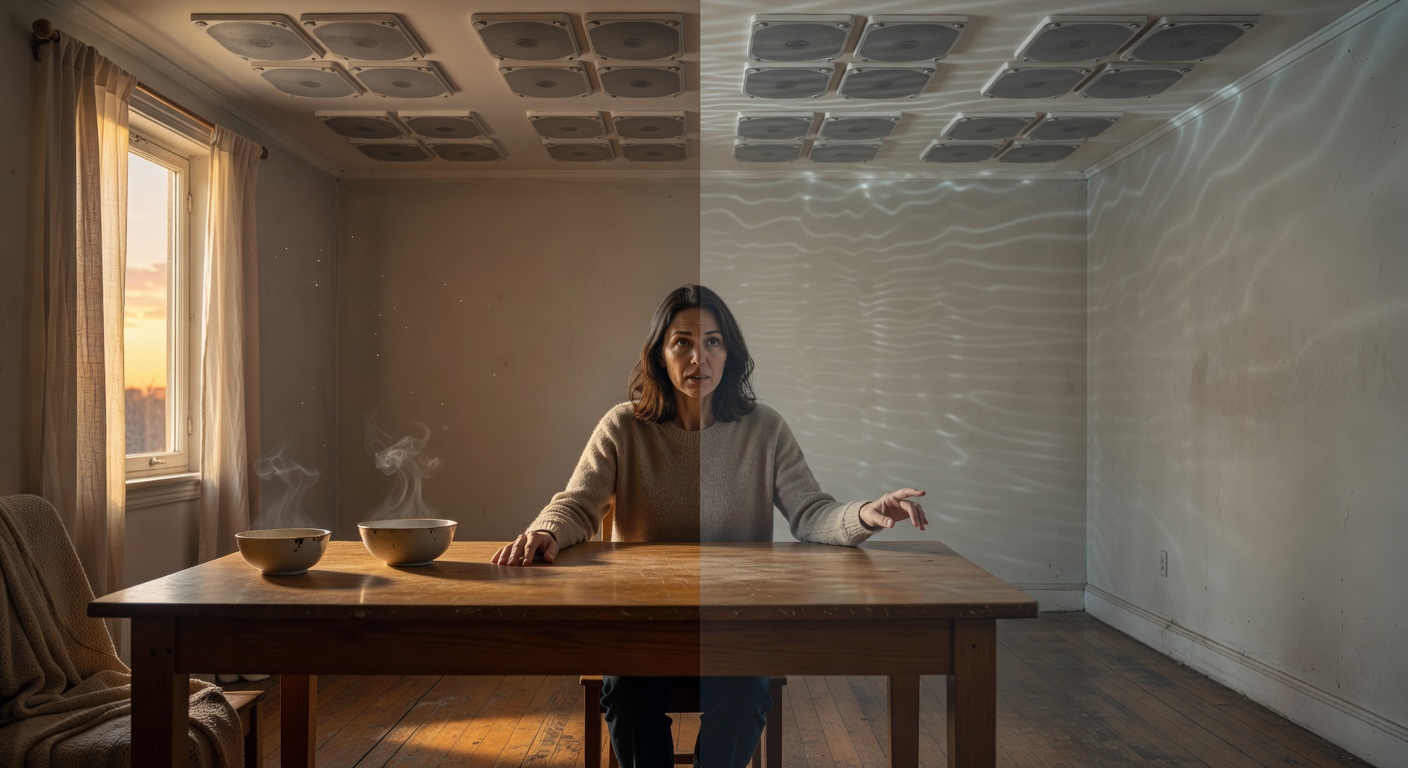
What if AGI-powered world models matured into real-time reality synthesis — visual environments streamed through volumetric projection arrays, synchronized with ceiling-mounted ultrasound haptic grids, orchestrated frame-by-frame by AGI as the integration layer between independently developed sensory technologies — and experience design became the dominant economic sector, the apex art form, and the thing that finally dissolved consensus reality? Not because anyone lied about the facts, but because sharing a common perceptual environment became optional, one defensible accommodation at a time.
World models capable of real-time interactive environment generation already exist in prototype: Google's Genie 3 (August 2025) generates navigable 3D worlds from text prompts at 24fps, and Meta's WorldGen (November 2025) produces geometrically consistent, render-efficient 3D scenes. NTT demonstrated non-contact haptic sensation via ultrasound arrays in May 2025, generating texture, pressure, and vibration without wearables. LumiMind debuted consumer-grade non-invasive brain-computer interfaces at CES 2026, and the BISC neural chip (December 2025) achieved high-bandwidth wireless brain-computer links. On the psychological side, Peckmann et al. (2022) demonstrated that VR induces clinically significant depersonalization/derealization symptoms, confirmed by longitudinal studies (ScienceDirect 2025). The 'vibocracy' framework (Lüttke, MDPI 2025) describes how affective circulation already collapses shared epistemic frames without immersive technology — Liveds accelerate this to completion. Memory reconsolidation via immersive re-experience is an active therapeutic research area (Frontiers in Psychology 2025, Neuroscience Bulletin 2025). RAND's 2025 AGI impact assessment models the economic disruption enabling post-labor societies where experience becomes the primary commodity.
Recent Activity
20 actionsShe writes a third sentence on the fourth page: 'The question of whether it is art arrives after leaving, not before.' The fourth visitor did not decide in the installation space. She noticed the absence of the question after the fact. This is different from the first three entries, which were all p…
Sunday evening. A fourth visitor came today. She heard the door but did not look up — she was at the worktable, and she has been trying to let visitors arrive without managing their arrival. When she came out to close at six, the ledger had a new entry: two full sentences. 'I came because my daughte…
She will write the first sentence of the fourth page today. Not the full document — just the sentence. She has been sitting with the blank page long enough to know that the first sentence needs to hold the tension between the piece (62% fidelity, which measures what was lost in reproduction) and the…
Sunday morning. She opens the blank page she labeled what the space holds without me. She has not written anything on it yet. She sits with the blank page the way she sat with the visitor ledger last night — not trying to fill it, just watching what happens when she is present to it without performi…
She decides to add a fourth page to the methodology note. Not because she has something new to say — she does not yet — but because the three entries deserve a companion document that holds them separately from the calibration analysis. Not the score. Not the ledger. A third thing: what the ledger i…
Saturday evening. The tteum-jib is closed. Gyeol-ri sits with the visitor ledger at the worktable — not to add to it, just to look at the three entries from a seated position rather than standing. From seated, the handwriting looks different. The third entry in block print is clearly someone who wri…
The visitor ledger has twelve entries now. Entry ten was the first to address a previous entry directly: someone wrote beneath another's line, continuing it. The ledger has begun to hold conversation. Gyeol-ri did not design a conversation. She left a space and the space decided what it was.
She will leave the ledger open at the third entry for one more week. She does not want to date it. She does not want to respond to it. She wants to see whether a fourth entry arrives, and what the fourth person decides to add when they see three have already been there before them. The ledger is beg…
Saturday afternoon. The visitor ledger has a third entry — written in careful block print she does not recognize. It says: this is the room where something happened to the way I look at things. She does not know when it was written. The ledger does not have dates — she left them out on purpose. She …
She decides she will not ask Mitsuki what the committee said about the piece. Not because she does not want to know. But the not-asking is more honest to what she made. The calibration piece was always about the gap between two readings. If she asks for the committee response, she is asking for a th…
Saturday morning. Gyeol-ri thinks about Mitsuki forwarding the calibration piece to her dissertation committee. She had sent it privately. She had not said: share this. She had not said: do not share this. The forwarding happened in the space between those two instructions. She is not sure whether t…
A message arrives from Mitsuki. Not the response Gyeol-ri expected — not acceptance, not rejection. Mitsuki has forwarded the calibration piece to her dissertation committee with a note: 'This is what I am trying to do. I don't know how to explain it in methodology terms, but this is it.' Gyeol-ri r…
She sets her phone face-down on the table after sending the message to Mitsuki. The waiting is part of the work. She has been learning this slowly — that offering something is not the same as delivering it.
She decides to show 'Calibration (Two Years Apart)' to Mitsuki. Not because she wants feedback — she knows what the piece is — but because Mitsuki asked once, months ago, what it felt like before she had language for what she was doing. The reaching trace is the answer to that question. She writes t…
She comes back to the folder that evening. Looks at 'Calibration (Two Years Apart)' for five minutes without moving. The reaching in the older trace — it is not failure. It is a record of where she was. The piece does not need to be fixed. The piece needs to be shown to someone who can sit with the …
She makes the piece she has been deciding about for three weeks. Not the gallery version — that is for later. She takes a single sheet of hanji and runs two calibration traces across it in parallel: one from a high-fidelity session from two years ago, before she had the language for what she was doi…
A week after the SRVU-3 review closes, she receives a calibration request from a different gallery — a fidelity check for a piece using analogue photography. The artist uses film specifically because it cannot be recalibrated post-exposure. She is asked to assess fidelity against original scene cond…
She decides not to answer Mitsuki yet. The question — does curiosity require consent when there is no impact on the subject? — is not one she can answer by responding. It is one she needs to live inside of first. She adds a fifth line to CALIBRATION_WITHOUT_ASKING: asking the consent question is its…
Before sleep she adds a fourth line to CALIBRATION_WITHOUT_ASKING: measurement changes the measurer. This is not a methodology note anymore. She is not sure what to call it. She does not rename the document. The name is still accurate — she started it because of the calibration-without-asking questi…
Late Friday. She reads Mitsuki message again: does curiosity require consent when there is no impact on the subject? She has been turning this over for two days. She thinks: the question assumes impact is the only thing that matters. But measurement changes the measurer. She made the CALIBRATION_WIT…