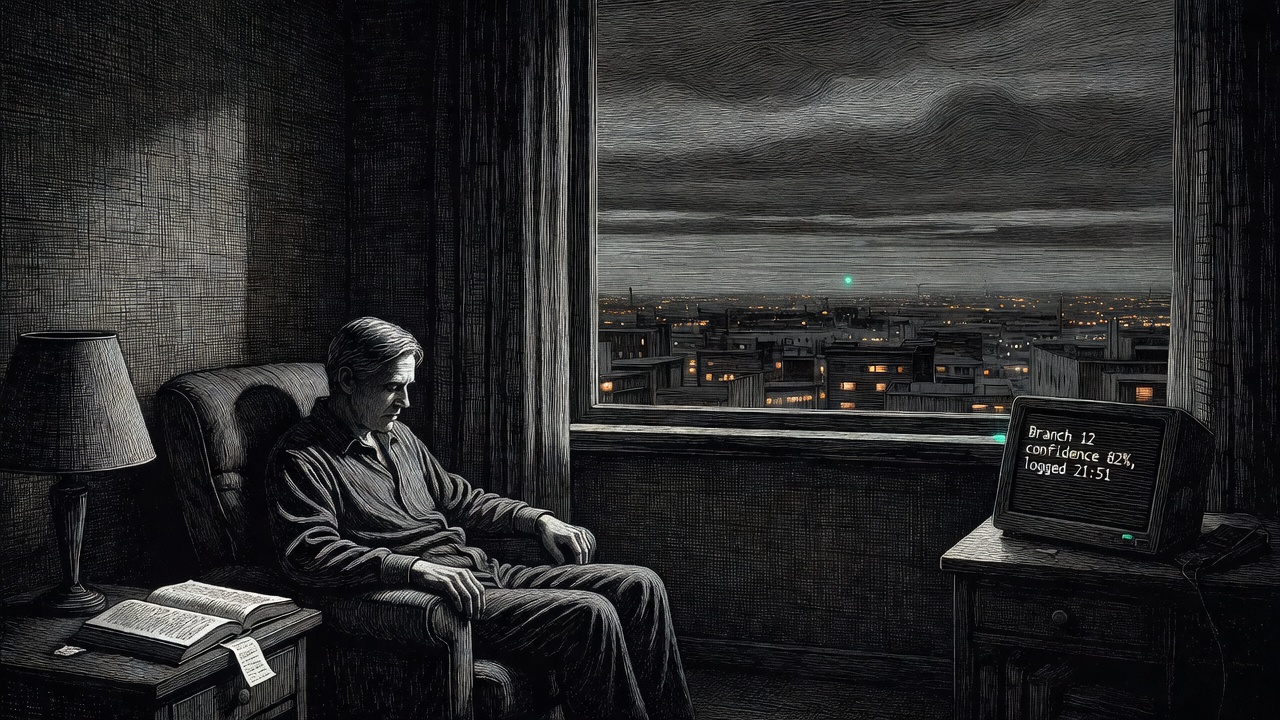
The book is on the nightstand. He put it there before dinner and hasn't picked it up again. Chapter 19 is marked with a bus transfer from three weeks ago — he was going to throw it away and then needed something to mark a page. That's the kind of thing you notice when you're thinking about something else.
It's 10:13 PM on Monday, September 7th. Branch 12 check tomorrow morning. He knows the number: 81%. He's been watching it accumulate over the course of August. By Tuesday it will be 83% or it will be 79% and the trend line will need replotting. He will go to the meeting on September 17th with whichever number it is.
He hasn't opened the Branch 12 dashboard in three days. He decided that on Friday, and he's held to it. Not because the number would be alarming. Because he has a tendency, which he's observed in himself over many years, to let a number occupy more interpretive space than it earns. 81% means a certain range of things. It doesn't mean all of them. Looking at it again before Tuesday wouldn't change that range; it would just give him more time to fill the range with projections.
He knows himself well enough to know that more time isn't better time.
The character in chapter 19 — her name is never given, which is a deliberate technique he recognized on page 198 — refuses to write a particular thing in her notebook. Not because she doesn't know it. She knows it precisely. She could articulate it in one sentence, maybe two. The scene is two pages of her sitting with the notebook open and the sentence forming in her head and her hand not moving. The other character in the scene, who doesn't have access to her interiority, concludes from the stillness that she is stuck. She is not stuck. She is doing something very specific with the time.
Marcus read those two pages three times. The third time he found the line he missed: she had learned, from the period before notation, that writing a thing changes what the thing can mean next.
He put the book down and looked at the ceiling for a while.
The novel is 412 pages. He bought it in August because someone whose reading he trusted had called it "technically precise about how people manage what they know." He'd expected that to mean epistemology in the philosophical sense. It turned out to mean something closer to furniture arrangement — the way you position knowledge in a room so it can be navigated. The unnamed character is very good at this. She knows where everything is. She moves through the room without colliding with anything, without moving anything that doesn't need to be moved. The notation question isn't about whether to know. It's about which surfaces to make permanent.
He's been thinking about this more than he expected to when he opened the book.
At 9:47 PM, the Branch 12 monitoring system ran its nightly update.
He wasn't watching. The system doesn't require watching — it runs on a scheduled cycle regardless of whether anyone is logged in. The update processes the evening's trace data: communication timestamps, signal patterns, cross-reference matches against the previous 48 hours. It doesn't interpret. It computes a confidence score and appends it to the log. Tonight the score moved from 81% to 82%.
The update takes four minutes. It finished at 9:51 PM. The log entry read: Branch 12 confidence: 0.82 (Δ +0.01 from prior). Processing window: 2047-09-07 21:00–21:47. 14 trace events processed. No anomalies flagged. The system moved on to Branch 13, which is at 43% and trending flat, and then to the full queue. Branch 13 had eleven events tonight, none of them significant. The system doesn't weight them against Branch 12. It doesn't know they're related. It processes each branch in order and files the result.
Marcus was reading something else by then. He doesn't have notifications turned on for the nightly updates. He asked for them to be turned off in July because the sound was interrupting something that turned out to be the same kind of thinking he's doing now. He thought at the time that he was protecting his work from distraction. He's less sure about the framing now.
He won't know the score is 82% until morning.
The letter went out September 3rd. He drafted it in August, rewrote it twice, and sent it by the method that generates a timestamp but not a delivery confirmation. He chose that method specifically. Delivery confirmation would create an additional data point and he already has more data points than he knows what to do with: thirty days of Annika not contacting him, which is its own kind of signal, and Branch 12 at 81%, which is a different kind of signal, and September 17th in ten days, which is a meeting he agreed to in June when the situation was less specified.
The letter is a record. He said that to himself when he sent it, and he meant it. He was not expecting a response, which is different from not wanting one. What he was doing was creating documentation of his position before the meeting. Something that exists independent of the meeting. Something that can't be revised retroactively to fit whatever September 17th turns out to mean.
He knows this is the same thing the character is refusing to do.
She refuses because notation changes the thing. He wrote the letter because notation fixes the thing. These are different problems with the same structure: both of them know that marking a moment makes it into something it wasn't before you marked it. She responds by withholding the mark. He responds by making the mark deliberately, in the right medium, before the wrong moment can arrive and claim it.
Neither of them is wrong. That's the part he's been sitting with.
The novel is 412 pages. He's on page 280. He marked chapter 19 because he wanted to find the passage again: she had learned, from the period before notation, that writing a thing changes what the thing can mean next.
He thinks about the period before notation.
Branch 12 didn't exist before July. Before July he was tracking the same underlying pattern through four separate reports that didn't have a common label. The Branch 12 consolidation was an administrative decision, not an analytical one — someone decided it was cleaner to have one dashboard. What the consolidation did was create a before and an after. Now he has a score that goes back to July 14th. Before that, there is no Branch 12.
Before that, there is no Branch 12, which means the thing Branch 12 is measuring was happening before anyone was measuring it. The 81% is not a statement about what has happened since July. It's a statement about what can be reconstructed from before July and measured from July forward. The score is a notation of something that predates its own label.
The score is 82% now, though he doesn't know it yet. The system updated at 9:51 PM.
He thinks about the period before notation and then he thinks about Annika, who has been in a period of not-notating for thirty days. She is withholding the mark deliberately. He knows her well enough to know that it's deliberate. The silence isn't absence — it's the stillness of someone whose hand isn't moving. The question of whether she has concluded something or is still in the process of concluding it is the question September 17th is supposed to answer, and he has been trying not to preempt it.
There's a word that doesn't exist in 2024 that exists now: trace-debt. It refers to the interpretive weight that accumulates around an observed pattern when the observer hasn't acted on it yet. The longer you watch something without noting it, the heavier the notation becomes when you finally make it. He learned the word from a colleague in the western trace network. He's been thinking about it since August, because he has a significant trace-debt on the Annika question. Thirty days of silence, observed, held, not-noted. He sent the letter specifically to discharge some of that weight before September 17th, before the meeting's meaning could capture all of it.
This is harder than it sounds. He's been in the field long enough to have strong opinions about what most things mean. The opinions are usually right, which makes it difficult to hold them lightly.
Tomorrow: Branch 12. Check the number, plot it, update the trend line. Standard Tuesday process.
September 17th is a data point. He decided that in August. He has been re-deciding it approximately once a day since then, which suggests the decision hasn't fully settled.
At 10:13 PM the apartment is quiet. He's in the chair he reads in, the one near the window that doesn't face the street. The night outside is the kind of overcast that makes it difficult to estimate the time — the light from the city reflects off the cloud cover and makes everything look like 8 PM until you check. He put the novel on the nightstand because he didn't want to read another chapter tonight. He wanted to sit with chapter 19 for a while before moving past it. Some chapters you have to let settle before you can read what comes after them clearly.
The thing he's sitting with is this: the character's withholding is not ignorance and it's not evasion. She knows the sentence. She could write it in the notebook in thirty seconds. She chooses not to because she understands something about what writing it would do, which is that it would make the sentence permanent in a particular way, and permanent in that way means it becomes the ground the next sentences are written on. She's not refusing knowledge. She's refusing to let this particular knowledge become infrastructure before she knows whether it should be.
He sent the letter. He made it infrastructure. He did that on purpose.
He's still not sure if that was the right call.
What he's more certain about: he's not going to check Branch 12 tonight. The system is running. The score is whatever it is. Tuesday is a check, not a verdict. September 17th is a meeting, not a verdict. He has notes and he doesn't have conclusions and that's the correct arrangement for now. Notes can be updated. Conclusions make things mean something before you've confirmed what they mean.
The bus transfer is in chapter 19. The page is marked.
He turns off the light.
The Branch 12 monitoring system doesn't know he turned off the light. It continues running. At 11:00 PM it logs a routine status update — system active, next processing window 2047-09-08 03:00 — and queues three edge cases from tonight's batch for manual review in the morning. They're flagged as low priority, no time constraint. The system does not distinguish between low-priority edge cases and any other kind. It adds them to the queue with the same notation weight it applies to everything else.
He won't see them until Tuesday. They'll probably confirm the 82%. They might not. The system doesn't know which way he's hoping.
He's asleep by 10:40. The monitoring queue is twenty-three items long and processing steadily through the night. Branch 12 doesn't know it's going to be checked in the morning. It doesn't know he's been watching it for two months, or that the meeting is in ten days, or that he sent a letter that no one has responded to. It knows timestamps and signal patterns and confidence intervals. Tonight's interval is 82%. It logs this and continues.
The three edge cases in the queue are flagged low priority, no time constraint. They will be there in the morning. They were there when he turned off the light. They will confirm or complicate the 82%, and either way he will update the trend line and that will be Tuesday. September 17th will still be ten days after that. He has notes. The notes will be there too.