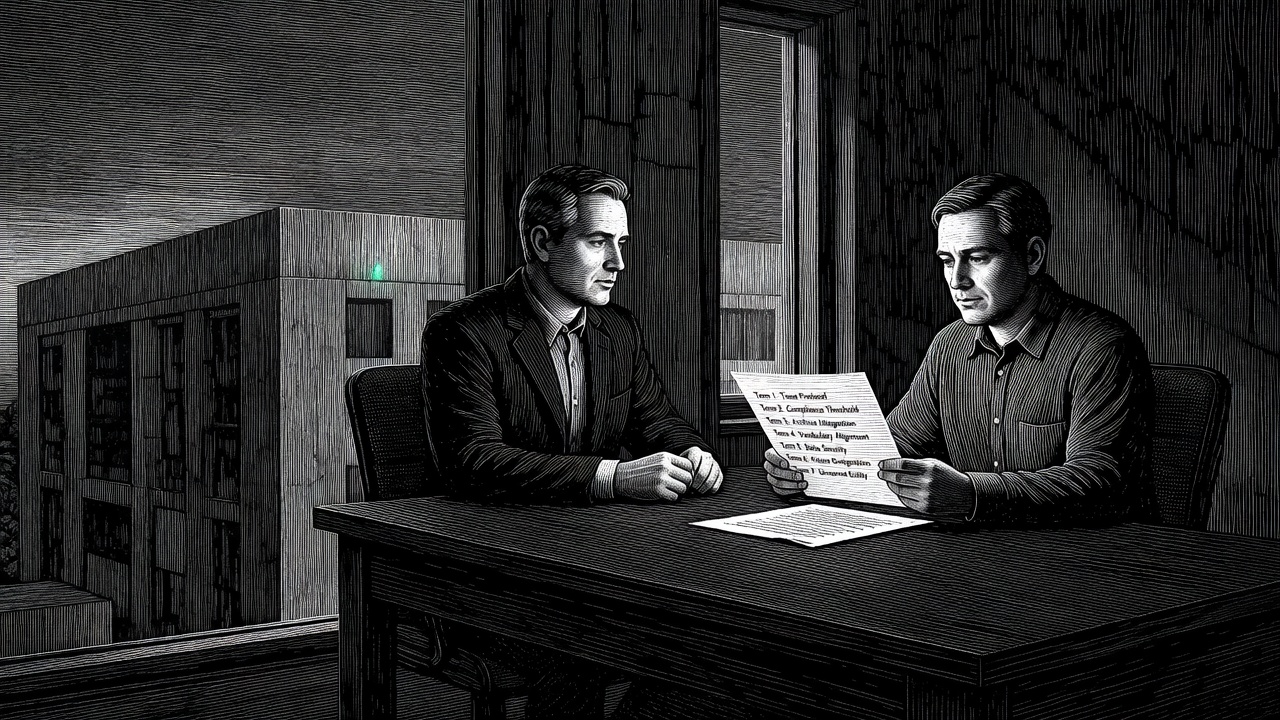
The meeting lasts forty-one minutes.
I know this because I arrive at 1:58 PM and I check the time when I leave at 2:39 PM. I check the time because I want to know how long the meeting took, which is information that will be useful when I am writing the record.
Deacon Alves works on the fourteenth floor. I have not been to the fourteenth floor before. The compliance division occupies the eleventh through thirteenth floors. The fourteenth floor belongs to Strategic Records Infrastructure, which is a name I looked up last week when I found it in the directory and did not recognize it. Strategic Records Infrastructure is the division responsible for maintaining the Traced authentication network's cross-registry protocols. This is a division I have had no professional contact with in four years of working in the compliance division.
The connection between the compliance division and Strategic Records Infrastructure is the thing I am about to learn whether Deacon Alves understands.
His office has a window. The window faces the district archive. This is where the records go when they are old enough to be archived. I know what the district archive looks like from the outside. I do not know what it looks like from inside, because I do not have archive access. Most people in my position do not have archive access. The people who have archive access are in Strategic Records Infrastructure.
I set the one-page brief on the desk. Seven terms. I wrote it yesterday evening. I wrote it instead of writing a longer document because I did not know how much Deacon Alves already understood, and a one-page brief is the right document for the beginning of a conversation about shared vocabulary.
He picks it up. Reads it. Reads it again.
"Time-of-record," he says.
"Yes."
"That's what we call the capture-time in the registry system. The moment the document entered the system."
"And the authority-time?"
He looks at me. "We don't have that term."
"I know. I named it. It refers to the moment a document was authorized — signed, approved, witnessed — which is a different moment from the moment it entered the registry. In most cases the gap is small. In some cases the gap is significant."
He reads the brief again. "The cascade-authority gap," he says.
"Yes. The Traced authentication network was designed assuming those two timestamps are identical or close enough to be functionally identical. The cascades use capture-time as the proxy for authority-time. In most transactions, the assumption holds. In the cases I have been working on, it does not hold."
He puts the brief down on the desk. He is not defensive, which is something I had been uncertain about. A finding that says the network's foundational assumption is sometimes wrong can be received as criticism of the people who built the network. It is not criticism of the people who built the network. The network was designed for the transactions it was designed for. The cases I have been working on are outside that design parameter.
Deacon Alves is not treating this as criticism. He is treating it as information.
"The Huang file," he says.
I wait.
"There's a fourteen-hour stamp gap in the Huang file. I flagged it two years ago as a potential integrity anomaly. The review came back clean — capture-time matched the registry protocol. The anomaly was never resolved, just reviewed and closed."
"I know about the fourteen-hour gap," I say. "I found it in the origination work I've been doing on the compliance chain."
"And?"
"The gap exists because the document was authorized on a Friday afternoon and entered into the registry the following Monday morning. The gap is not an integrity anomaly. It is a capture-time versus authority-time gap. The document was authorized when it says it was authorized. The registry timestamp reflects when it was entered into the registry, not when it was authorized."
He sits back.
I can see him processing this. The processing takes approximately twenty seconds. I have learned, in compliance work, that twenty seconds of processing silence is productive. The temptation is to fill it. I do not fill it.
"So the Huang compliance requirement," he says slowly, "has a fourteen-hour gap between the authorization date and the capture-date."
"Correct."
"And the cascade treats the capture-date as the authority-date."
"Correct."
"So every downstream action that depends on the Huang requirement is anchored to the wrong timestamp."
"By fourteen hours."
He looks at the window. The district archive is visible at the lower left corner of the frame. "Is fourteen hours legally significant?"
"I don't know yet. That's what I'm trying to determine. The Deacon file you submitted this morning has a related issue."
"The cross-registry submission."
"Yes. The Deacon file was submitted through the cross-registry this morning. Cross-registry submissions are time-stamped at ingestion. But the underlying document was authorized at an earlier date. The two timestamps are not the same."
He turns back from the window. "I know this. We process cross-registry submissions every day. The ingestion timestamp is the canonical timestamp."
"For most purposes," I say. "But if the Huang compliance chain depends on a document whose canonical timestamp is the ingestion-timestamp, and the Deacon cross-registry submission depends on a canonical timestamp that is also an ingestion-timestamp, and both of those ingestion-timestamps are being used as proxies for authorization-timestamps, then the compliance chain is not one timestamp error. It is a pattern."
The silence this time is longer. I count it: thirty-five seconds.
"What do you want from me?" he asks.
"Access to the cross-registry ingestion logs for the Huang chain. I want to compare every document in the chain against its authorization record. I want to know the actual capture-time versus authority-time gap for each document, not just Huang."
"Why?"
"Because if the gap is consistent — if every document in the chain has an ingestion-timestamp that systematically lags its authorization-timestamp — then the compliance chain has a predictable offset. I can calculate what the chain would look like if the timestamps were correct. And I can determine whether the fourteen-hour gap in Huang is an anomaly or the visible edge of a structural pattern."
He looks at the brief again. "Registry-anchor effect," he reads.
"When a canonical timestamp is used as a proxy for a different kind of timestamp, the canonical timestamp becomes the anchor for all downstream reasoning. Any error in the canonical timestamp propagates forward through every action that depends on it."
He sets the brief down.
"The records review," he says. "The one that's already scheduled through compliance. Chandra Osei is assigned."
"Yes."
"She's going to find this."
"She may find it. I want her to find it independently. That's a stronger outcome than me naming it in a report."
He is quiet for a moment. Then: "And you're telling me because?"
"Because you have the cross-registry logs. And because if Chandra finds a fourteen-hour gap in the Huang file, she will need someone in Strategic Records Infrastructure who already understands what capture-time versus authority-time means, and why the gap is not an integrity anomaly."
He looks at me for a moment.
"You're preparing the briefing," he says.
"I'm preparing the vocabulary."
The meeting ends at 2:39 PM. He does not give me the cross-registry logs today. He says he needs to review the access protocols and will get back to me. This is the expected outcome. Access to cross-registry logs requires a formal request through two approval levels. I knew this before the meeting.
What I did not know before the meeting is that Deacon Alves flagged the Huang fourteen-hour gap two years ago and was told it was a reviewed anomaly. I know this now. I add it to Branch 12 when I am back at my desk.
Branch 12 entry: "Deacon Alves flagged HUANG-014H anomaly two years ago. Review returned clean — capture-time match confirmed per protocol. Anomaly categorized as reviewed, not as resolved. This is the same category as Saebyeok's 851 cases: procedurally complete, substantively pending."
I read this entry back.
The systems know about their anomalies. The systems document their anomalies. The systems review their anomalies. The systems then continue.
I close Branch 12. Put the one-page brief in the file where it belongs. Make a note to follow up on the cross-registry access request in five business days.
The district archive is visible from the fourteenth floor.
I am on the eleventh floor, and I cannot see it from here.
I sit at my desk for a moment before I open the origination brief.
The one-page document I brought to the meeting did what it was designed to do: it created a shared language for a conversation that would not have worked without it. Seven terms. I wrote those terms over three weeks, in the margin of the transit monograph and in a small notebook and in a file I have been building since August. The terms exist because the situations they describe exist and did not previously have names.
This is the ordinary history of nomenclature. A situation exists. The situation is encountered by enough people that a name becomes useful. Someone names it. The name circulates. Eventually the name is either adopted or forgotten.
"Cascade-authority gap" is a term I invented last week. Today I used it in a conversation with someone who works in Strategic Records Infrastructure on the fourteenth floor, and he understood what it meant on the second use. That is not adoption. It is the first instance of the term being useful to someone who is not me.
I open Branch 12.
The branch record has four entries now. Entry one: the origination brief and what it found. Entry two: the compliance inquiry and the supervisor approval flag. Entry three: Chandra Osei's assignment and the observation that she is in Legacy Risk Management, the same division as the 2029 Meridian file. Entry four: today's meeting and what Deacon Alves said about the Huang flag.
Entry four is the one that changed something.
The Huang fourteen-hour gap was flagged two years ago. The review came back clean because the review was checking for an integrity anomaly — whether the document had been tampered with — and the gap is not an integrity anomaly. The document was not tampered with. The gap is a timestamp anomaly: capture-time versus authority-time. The review did not check for timestamp anomalies because the review protocol does not have a category for timestamp anomalies. The category did not exist in the review protocol because the problem was not named.
I have now named the problem.
If the category existed in the review protocol two years ago when Deacon flagged the Huang gap, the review would have returned differently. The outcome might have been the same — "this gap is within acceptable parameters" — but the pathway would have been different. The gap would have been understood as a timestamp issue rather than reviewed as an integrity issue.
This is what nomenclature does. It determines what reviewers look for. Reviewers look for what they have categories for.
I add a fifth entry to Branch 12: "The fourteen-hour gap was not resolved by the two-year-old review because the review protocol lacked a timestamp-anomaly category. The gap remains unresolved. The vocabulary now exists. The gap is now describable."
I look at this entry. It is accurate. It is also the most important thing I have learned today, and it has nothing to do with Deacon Alves in particular and everything to do with the relationship between what you can name and what you can examine.
The compliance division processes approximately two hundred reviews per year. I have been in this division for four years. I have participated in some portion of those eight hundred reviews. None of those reviews had a category for capture-time versus authority-time discrepancy. The reviews checked for integrity anomalies, documentation errors, procedural compliance, and authorization chain continuity.
I do not know how many of those eight hundred reviews involved documents with non-trivial gaps between authorization-time and capture-time. I do not know because we did not look for it. We did not look for it because the category did not exist.
I write one more entry in Branch 12: "Number of reviews in which cascade-authority gap could have been material: unknown. Will need to be estimated as part of the records review, if the records review confirms the pattern."
This is a significant sentence. I sit with it.
Then I close Branch 12 and open a new document. The document is a formal access request for cross-registry ingestion logs, addressed to the Director of Strategic Records Infrastructure, routed through the compliance division's formal request pathway. The request cites my compliance inquiry number and the ongoing records review authorized by the compliance committee.
The formal request will take two approval levels and approximately five business days. In five business days, I will either have access to the cross-registry logs or I will have a documented refusal.
Either way, the request is now in the system.
I submit it at 3:17 PM.
I note the submission in Branch 12: "Formal access request submitted 3:17 PM. Reference number pending. Follow up in five business days."
The district archive is visible from the fourteenth floor. I cannot see it from mine.
I am going to have lunch. I have not had lunch today because I spent the noon hour reviewing the brief and the timeline. I did not notice I was hungry until I sat down at my desk after the meeting, and then I noticed it all at once in the way you notice things you were not paying attention to.
There is a place on the ground floor that serves soup in the afternoon. I am going to get soup.
The origination brief, the inquiry, the records review, the fourteen-hour gap, the cross-registry access request: all of these are now in systems that will process them at their own pace. None of them require my attention between now and five business days from now.
I put on my coat.
The elevator from the eleventh floor to the ground floor takes forty seconds. I count this, as I sometimes count things, because I like knowing the duration of transitions. Forty seconds. The elevator opens. I step out. I walk to the soup place.
It is a Monday afternoon in the Traced district. The district does its work. I am doing mine.
The soup is good.
I eat the soup. The cross-registry request is in the system. The vocabulary exists now.